• Skip to primary navigation
  • Skip to main content
  • Skip to primary sidebar
  • Skip to secondary sidebar
  • Skip to footer
  • NEWS:
  • SatNews
  • SatMagazine
  • MilSatMagazine
  • SmallSat News
  • |     EVENTS:
  • SmallSat Symposium
  • Satellite Innovation
  • MilSat Symposium
  • SmallSat Europe

SatNews

Satellite Industry Intelligence Since 1983

Subscribe
  • LATEST
  • SatNews Events
  • Magazines
  • Calendar
  • Subscribe
  • Missions & Constellations
    • Exploration & Science Missions
    • In-Orbit Servicing & Orbital Operations
    • LEO Constellations
    • Mission Autonomy & Onboard Systems
    • Mission Deployments & Manifests
    • Navigation & PNT
    • SmallSat
    • Spacecraft & Payload Technology
    View All in Missions & Constellations →
    SES Space & Defense and Starlab Partner on O3b mPOWER Space-to-Space Relay ArchitectureSES Space & Defense and Starlab Partner on O3b mPOWER Space-to-Space Relay Architecture
    Artemis II Pilot Advocates Stepwise Return to Moon via Equatorial LandingsArtemis II Pilot Advocates Stepwise Return to Moon via Equatorial Landings
    Thales CEO Confirms Progression on EU’s Multi-Billion Euro IRIS² Sovereign Satellite ConstellationThales CEO Confirms Progression on EU’s Multi-Billion Euro IRIS² Sovereign Satellite Constellation
    Viasat Deploys Reflector and Boom Assembly on ViaSat-3 F3 Ahead of In-Orbit TestingViasat Deploys Reflector and Boom Assembly on ViaSat-3 F3 Ahead of In-Orbit Testing
  • Business
    • Contracts & Commercial Deals
    • Earnings & Financial Reporting
    • Events & Conferences
    • Funding & Venture Capital
    • Market Forecasts
    • Mergers & Acquisitions
    • Personnel Moves & Appointments
    View All in Business & Finance →
    STMicroelectronics Reports Q2 2026 Earnings Growth Driven by AI Data Centers and Satellite DemandSTMicroelectronics Reports Q2 2026 Earnings Growth Driven by AI Data Centers and Satellite Demand
    AT&T CEO Reaffirms Support for AST SpaceMobile, Dismisses Satellite Revenue RiskAT&T CEO Reaffirms Support for AST SpaceMobile, Dismisses Satellite Revenue Risk
    Contrivian Merges with Big Network to Build Vertically Integrated Multi-Modal Connectivity PlatformContrivian Merges with Big Network to Build Vertically Integrated Multi-Modal Connectivity Platform
    UK Government Faces £340 Million Paper Loss on Legacy OneWeb Low Earth Orbit Satellite InvestmentUK Government Faces £340 Million Paper Loss on Legacy OneWeb Low Earth Orbit Satellite Investment
  • Defense
    • Counterspace & ASAT
    • Defense Budgets & Procurement
    • ISR & Reconnaissance
    • MILSATCOM
    • Missile Warning & Defense
    • National Security Programs
    • Space Domain Awareness
    View All in Military & Defense →
    L3Harris Signs Multi-Year Framework Agreement to Quadruple THAAD Propulsion ProductionL3Harris Signs Multi-Year Framework Agreement to Quadruple THAAD Propulsion Production
    GAO Report Warns Space Force Must Improve Personnel Metrics to Support Fleet ExpansionGAO Report Warns Space Force Must Improve Personnel Metrics to Support Fleet Expansion
    NNSA Delivers Fifth Next-Generation Global Burst Detector Payload to U.S. Space Force for GPS IntegrationNNSA Delivers Fifth Next-Generation Global Burst Detector Payload to U.S. Space Force for GPS Integration
    US Space Force Triples NSSL Phase 3 Lane 1 Capacity to $17B as Total Launch Budget Reaches $30BUS Space Force Triples NSSL Phase 3 Lane 1 Capacity to $17B as Total Launch Budget Reaches $30B
  • Gov
    • Export Controls & Compliance
    • International Space Agreements
    • National Space Policy
    • Space Law & Treaties
    • Space Sustainability & Debris Policy
    • Space Traffic Management / Debris Removal
    View All in Government & Regulation →
    FCC Approves Upper C-Band Order, Allocating $5.6 Billion to SES and $504 Million to EutelsatFCC Approves Upper C-Band Order, Allocating $5.6 Billion to SES and $504 Million to Eutelsat
    GSMA Endorses Abuja Declaration to Advance Satellite Spectrum Reform and Launch ATLAS UmojaGSMA Endorses Abuja Declaration to Advance Satellite Spectrum Reform and Launch ATLAS Umoja
    UK Space Agency Unveils £62 Million Domestic Space Fund and Strategic Partnership with Space FloridaUK Space Agency Unveils £62 Million Domestic Space Fund and Strategic Partnership with Space Florida
    NewOrbit Urges Targeted UK Sovereign Allocation Toward Very Low Earth Orbit Capabilities Following £62M Government Space FundingNewOrbit Urges Targeted UK Sovereign Allocation Toward Very Low Earth Orbit Capabilities Following £62M Government Space Funding
  • Launch
    • Launch Providers
    • Launch Schedule & Calendars
    • Launch Sites & Infrastructure
    • Rocket Technology & Vehicles
    View All in Launch →
    SpaceX Targets First Starship Upper Stage Tower Catch for Flight 14SpaceX Targets First Starship Upper Stage Tower Catch for Flight 14
    L3Harris Delivers Four RS-25 Core Stage Engines to NASA for Crewed Artemis III Lunar MissionL3Harris Delivers Four RS-25 Core Stage Engines to NASA for Crewed Artemis III Lunar Mission
    Commercial Launch Providers Advance Next-Generation Heavy and Medium-Lift Vehicle Milestones Ahead of 2026 DebutsCommercial Launch Providers Advance Next-Generation Heavy and Medium-Lift Vehicle Milestones Ahead of 2026 Debuts
    SpaceX Limits Future Commercial Rideshare Bookings Past 2028 Amid Severe Manifest SaturationSpaceX Limits Future Commercial Rideshare Bookings Past 2028 Amid Severe Manifest Saturation
  • Software
    • Autonomous Ground Operations
    • Data Processing & AI/ML
    • Digital Twins & Modeling
    • Ground Segment & Teleports
    • Mission Planning & Simulation
    • Space Systems Software Engineering
    • Spectrum & Licensing
    View All in Software Automation & Ground Systems →
    Astrolight Advances End-to-End Lasercom Network to Address Orbital Bandwidth and Spectrum BottlenecksAstrolight Advances End-to-End Lasercom Network to Address Orbital Bandwidth and Spectrum Bottlenecks
    Intellian Unveils CM100 GMDSS Terminal Built for Iridium Certus 100 Safety NetworkIntellian Unveils CM100 GMDSS Terminal Built for Iridium Certus 100 Safety Network
    NASA Joins Federal Genesis Mission Initiative to Process 150 Petabytes of Space Data via AI ArchitecturesNASA Joins Federal Genesis Mission Initiative to Process 150 Petabytes of Space Data via AI Architectures
    IHI Corporation and Kuva Space Partner to Evaluate Japanese Sovereign Hyperspectral ConstellationIHI Corporation and Kuva Space Partner to Evaluate Japanese Sovereign Hyperspectral Constellation
  • Services & Apps
    • Climate & Environmental Monitoring
    • Disaster Response & Security Mapping
    • Earth Observation & Imaging
    • Maritime & Aviation Satcom
    • Satellite Communications
    View All in Services & Applications →
    Amazon Files FCC Application for 5,105-Satellite Constellation to Enable Direct-to-Device Mobile ServicesAmazon Files FCC Application for 5,105-Satellite Constellation to Enable Direct-to-Device Mobile Services
    FCC Proposes Opening Unlicensed Bluetooth and Wi-Fi Bands for Space-Based CommunicationsFCC Proposes Opening Unlicensed Bluetooth and Wi-Fi Bands for Space-Based Communications
    ALL.SPACE Hydra MAX Terminal Receives Certification for SES O3b mPOWER Multi-Orbit NetworkALL.SPACE Hydra MAX Terminal Receives Certification for SES O3b mPOWER Multi-Orbit Network
    LTN Crosses 3,000 Satellite-to-IP Migrations Following FCC Action on Upper C-Band SpectrumLTN Crosses 3,000 Satellite-to-IP Migrations Following FCC Action on Upper C-Band Spectrum

Search Results for: benchmark

SpaceX: The targets might be tough

June 13, 2026

Chris Forrester — The numbers are in. The SpaceX stock listing is up on NASDAQ and rose a spectacular 30% on its first trading day. The value of $2.3 trillion is proof positive that the pre-IPO efforts have worked like a dream, and some $50 billion-worth of shares were traded.

It would be extremely easy to simply say ‘Musk has done it!’. The pre-IPO hype has clearly worked, but now the harder work must begin, and the challenges are not insignificant.

For example, SpaceX must now grow some 600-fold to truly justify its IPO price and its true believers. The fact is that no business has ever come close to achieving that (perhaps excluding the Dutch ‘Tulip Mania’ of the period 1634-1637 when a single bulb could command 10-times the annual earnings of a skilled artisan).

But bringing the SpaceX results into 2026 focus and the upcoming years require a heroic annual growth of around 50 percent to grow from its current revenues of $18.7 billion to the 2035 target of $1.1 trillion.

By 2035 SpaceX is forecast to grow its revenues to a staggering $360 trillion. One analyst suggests that the 2035 target for SpaceX would need to generate 2.4% of the entire US GDP all by itself. The comment was that these targets were pure “science fiction”.

The analyst added: “At $1,750,000,000,000 you’re not buying a rocket company. You’re buying a math problem that has never been solved in market history. Amazon at peak growth, Apple during its best decade, Google in its prime. None of them came anywhere near this growth requirement.”

Since that comment the market now knows that SpaceX also up an additional 83.33 million shares at $135 per share, for the offering’s underwriters to market to the would-be investors. But the end result by close of business on June 12 was a share price of $176.52 per share, and thus guaranteeing Musk’s personal wealth well north of $1 trillion.

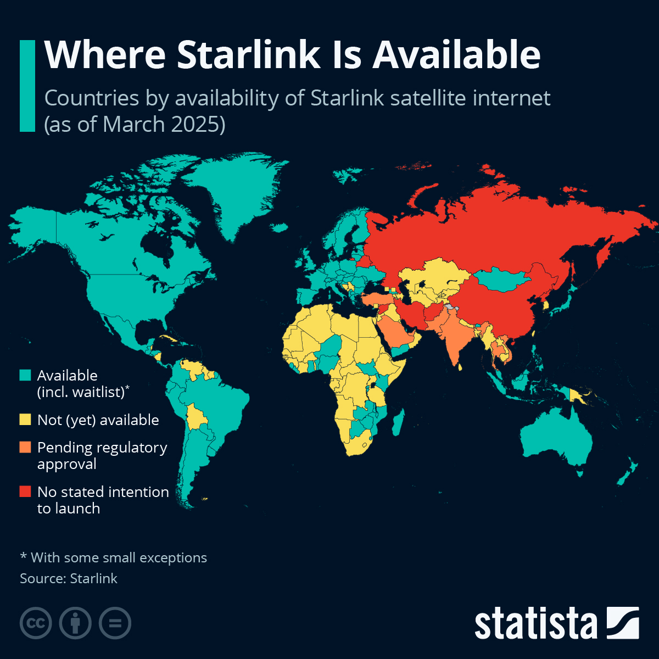
Few doubt that Starlink will continue to grow, and perhaps grow very well as key markets open up to its service. And there are dozens of attractive regions where Starlink is currently unavailable, not least India, Elon Musk’s birth country of South Africa as well as much of the rest of Africa, Turkey, Egypt, the Gulf States and many countries in South-East Asia (and forgetting about China and Russia where service is not anticipated).

The “known unknowns” of elements such as X, and in particular its AI sister-business and ‘Grok’, could grow exponentially over time. But there are many ‘buts’ for SpaceX and in particular its Starship version.

Comments in ‘Modern Diplomacy’ echoed the sentiment of most investors, saying: “The most important thing is this: the company (SpaceX) going public is not primarily a rocket manufacturer or a satellite internet provider. It is the world’s most consequential private geopolitical actor, operating critical infrastructure that governments depend on for national security, that militaries use as a battlefield communications layer, that adversaries have spent significant resources trying to jam, hack, and destroy.”

Another comment, from Mark Boggett, CEO at space investment firm Seraphim Space, who described the IPO as a “landmark moment” for the space economy. “More than simply attracting additional venture capital, it [will] further establish space as a mainstream investment category and provide public market investors with a highly visible benchmark for the sector’s potential.”

He added that Seraphim would expect a listing to increase interest from a broader range of investors, including generalist venture capital firms that may previously have had limited exposure to the sector.

“Historically, category-defining companies have drawn new investors into adjacent parts of their ecosystems as they seek exposure to the next generation of growth opportunities,” he stated.

“However, the bigger opportunity is not simply attracting more venture capital. The SpaceX IPO has the potential to bring additional capital into the asset class, increasing participation from institutional investors, wealth managers, retail investors, and public market participants. We are already seeing evidence of this trend through the emergence of dedicated SpaceTech ETFs and increasing investor engagement with specialist space-focused investment vehicles, including Seraphim Space Investment Trust (SSIT).”

Boggett recognised that SpaceX is an exceptional company [and] also highlights the breadth of the opportunity beyond launch. “The space economy increasingly encompasses critical infrastructure spanning defence and security applications. communications, Earth observation, navigation, energy, and climate intelligence. While launch and connectivity currently capture much of the public attention, a significant proportion of future value creation is likely to occur in the applications, intelligence, and infrastructure layers. In our view, a SpaceX IPO would shine a spotlight on this wider ecosystem and help accelerate capital flows towards the next generation of category-leading SpaceTech companies.”

As the next few days unfold, the market will be able to see precisely what’s happening, at least see the trends in the short term. KGI Securities have entered the opinion market and opened its advice with an ‘Outperform’ rating on SpaceX, and a target price of $227 per share. Private investment firm Oppenheimer also rates the SpaceX stock at ‘Outperform’ and with a target price of $190 per share.

Filed Under: Business & Finance Tagged With: Featured

€131 billion is in. Now Europe has to build the supply chain that can absorb it.

May 27, 2026

By Nick David, Editorial Lead, SatNews

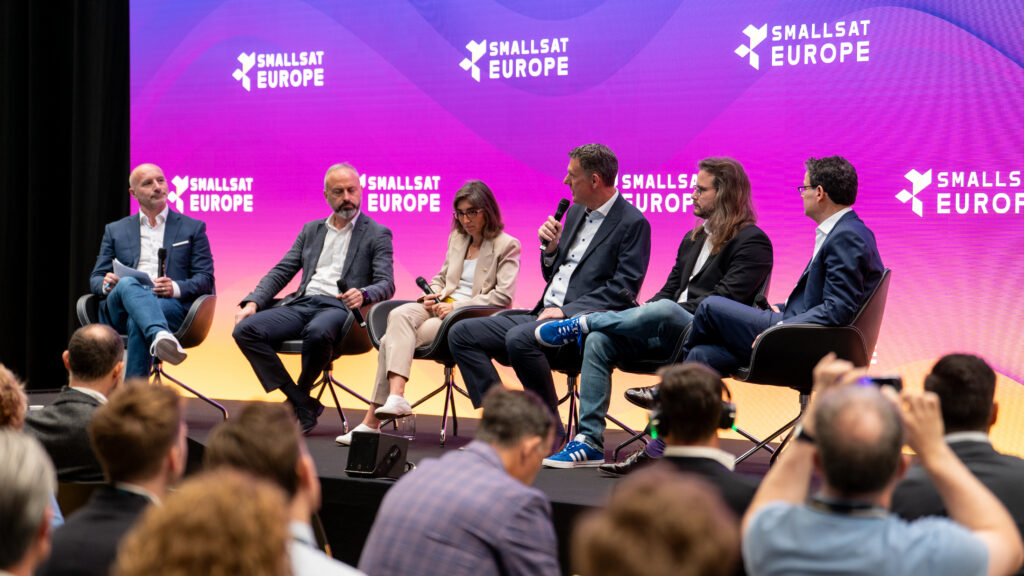
The European Pulse panel on the SmallSat Europe 2026 Business Stage.
The European Pulse: A 2026 Market Outlook for Smallsats panel, SmallSat Europe 2026.

For a decade, European space had one problem: not enough money. By the end of Day 1 of SmallSat Europe 2026, that problem was gone, and a sharper one had replaced it. Europe now has a great deal of money, and very little time to spend it well.

Day 1 Capital Pivot · By the Numbers

€131B

EU MFF “space in defense” over 7 years

€35B

Germany defense space through 2030

€6.5B

Project Bromo (closes 2027)

€730M+

Poland ESA contribution 2026–2028

The numbers on the table are no longer aspirational. The European Commission’s proposed Multiannual Financial Framework puts €131 billion into “space in defense” over seven years. Germany has committed €35 billion through 2030, anchored in its first national Space Safety and Security Strategy. Project Bromo, the €6.5 billion Airbus-Leonardo-Thales space-business combination, closes in 2027. Poland has expanded its ESA contribution to over €730 million across 2026 to 2028. Ukraine’s Ramstein coalitions, in their IT and Drone forms, demonstrate the €1.1 billion and €2.2 billion templates a future space coalition could borrow.

“We had a lot of time and not much budget in the past. Now it’s the other way around. We don’t have much time, but we have a lot of budget that we should efficiently use.” — Lina Pohl, ESPI

That is a capital pivot, not a budget cycle. It is also a deadline. The German operational target for SATCOMBw Stage 4, the country’s sovereign-Starlink-alternative LEO constellation, is 2029. The IRIS² constellation has its own schedule. The Bundeswehr wants on the order of 100 satellites a year for currently planned constellations alone.

The constraint is now physical, not financial

The argument that ran through both stages on Day 1, and the argument worth taking seriously, is that Europe’s industrial base, as currently configured, cannot absorb that capital fast enough.

European launch capacity in 2027 will not match European satellite demand in 2027. “Nobody on this planet can launch it,” Isar Aerospace’s Josef Wiedemann said of the Bundeswehr’s annual demand. The most aggressive new-entrant launcher in Europe is targeting roughly 30 rockets per year, with 2028 slots already selling. Leonardo’s newly inaugurated space factory produces two satellites per week. McKinsey’s most recent benchmark puts U.S. space spending at roughly three times European levels, with the gap widening over five years and an industrial base structurally stronger than Europe’s on every dimension that matters: workforce, tooling, supplier depth.

The European Supply Chain · Where It Breaks

CAPITAL

€131B EU MFF

Settled. Budgeted.

FLOWING

→

PRIMES

Airbus · Leonardo · Thales

Consolidating via Project Bromo

ABSORBING

→

TIER 2 / 3

Small + mid suppliers

Bottleneck machine. Capex gap.

BREAK POINT

→

DEMAND

100 sats / yr

Bundeswehr requirement

2027–2028 cadence target

Whether the budget converts depends on the supplier-tier ramp.

The break point is not the prime contractors. It’s the layer beneath them. Tier 2 and Tier 3 suppliers, the firms that make the single bottleneck machine, the actuator, the specialty connector, the radiation-hardened part, are the ones being asked to industrialize on a timeline that European procurement still has not adjusted to. “Theoretically, they have all the engineering knowledge, the capabilities,” ESA’s Michael Mallon told the European Pulse panel. “Then it often bolts down. Okay, but one machine is the bottleneck. And I cannot procure this machine. It doesn’t come in time. I don’t have capital.” The engineering knowledge exists. The capital to buy the bottleneck machine does not, and the procurement signal to justify the capex arrives late.

That is the supply chain Europe is asking to deliver 100 satellites a year, two satellites a week, thirty rockets a year, by 2027 and 2028.

What the next 18 months decide

The case for optimism is that Project Bromo, executed well, consolidates the European prime base into a competitive integrator and pulls the supply chain up with it. The case for concern is that Tier-1 consolidation alone delivers Tier-1 outcomes. It shrinks the prime count without expanding the supplier count, and the money flows where the bidding apparatus already exists. “Even the primes have not done that in the past,” Dcubed’s Thomas Sinn said of the 100-satellite-a-year demand. “Even they have never built 100 satellites a year.”

Three questions decide which case wins.

First, whether SATCOMBw Stage 4 procurement actually awards work to non-incumbents in a structural enough way to seed the missing middle. If the contract architecture defaults to the firms that bid every major program, the budget builds capacity Europe already has.

Second, whether the EU Space Act, on track for January 2030 implementation, replaces the existing thirteen national space regimes or adds a fourteenth layer on top of them. The first outcome is consolidation. The second is friction.

Third, whether the supplier tier, Tier 2 and Tier 3, the small and mid-sized firms that have never operated at the cadence Europe is now asking them to, can be financed, contracted, and de-risked fast enough to industrialize before 2028. That is not a technology question. It is a procurement and capital-allocation question.

Europe’s Procurement Window · Through 2030

2026

SATCOMBw Stage 4 procurement opens

Germany awards work to primes, or to non-incumbents.

2027

Project Bromo closes

Airbus + Leonardo + Thales space-business combination.

2027–2028

Supply-chain ramp test

100 sats/yr cadence target, or the supplier tier fails to scale.

JAN 2030

EU Space Act effective

Consolidates 13 national regimes, or adds a 14th layer.

The verdict from Day 1

The capital pivot is real. The compression on the calendar is the structural shift. The next two budget cycles will tell us whether Europe converted its budget into an industrial base, or whether the budget converted itself into a more concentrated prime sector with the same supply-chain bottleneck it had before the money arrived.

The money is in. The clock is running. The supply chain is the bottleneck Day 1 made unmistakably visible. The question for the rest of the conference, and the rest of 2026, is whether the European industry is willing to be honest about it.

Key Takeaway

Europe just committed real money. €131 billion at the EU level, €35 billion in Germany, €6.5 billion in Project Bromo, €730 million more from Poland. The fight that remains is whether the European industrial base can absorb it before the budget defaults to the incumbent primes. The break point isn’t the prime contractors. It’s the Tier 2 and Tier 3 suppliers being asked to industrialize on a timeline European procurement has not adjusted to. The next 18 months decide whether the capital pivot built an ecosystem or financed a more concentrated prime sector with the same supply-chain bottleneck Europe had before the money arrived.


About the Author

A storyteller at heart, Nick David covers space policy, satellite markets, defense, and the technologies reshaping how humanity operates beyond Earth. With a background in creative direction, brand strategy, and editorial storytelling, he brings a modern lens to complex subjects and a relentless curiosity about what comes next.

Filed Under: Business & Finance, Events & Conferences, Funding & Venture Capital, Market Forecasts, SmallSat Tagged With: Featured, SmallSat Europe 2026

SmallSat Europe Speaker Focus: Jordi Barrera Ars, Open Cosmos

May 26, 2026


Open Cosmos closed more than €170 million in contracts last year. The company that started as a platform-as-a-service satellite builder in Harwell is now bidding to build Europe’s sovereign telecom constellation.

Jordi Barrera Ars is the CTO of Open Cosmos, the UK-headquartered company that designs, builds, and operates satellite missions as an end-to-end service. He has more than a decade of hands-on experience across mechanical, structural, propulsion, thermal, and systems engineering for smallsats, combined with the programmatic management that scaling production demands. The dual expertise matters: Open Cosmos doesn’t just manufacture satellites for customers. It operates them, delivering data as a service from orbit.

The company’s contract book tells a scaling story. In August 2025, Open Cosmos kicked off the first rideshare mission for the European Commission’s In-Orbit Demonstration and Validation program, a framework designed to validate new space technologies in orbit. SatNews reported in October 2025 on the completion of the MANTIS mission, a two-year Earth observation program that set new benchmarks for sustainable space operations. In 2026, the company won the contract to build the Spanish Atlantic Constellation for the Spanish Space Agency and ESA, the largest Earth observation constellation ever contracted in Spain. Open Cosmos is also subcontractor and platform provider on the £5.15 million Orpheus mission for the UK’s Defence Science and Technology Laboratory, partnering with Astroscale to enhance space situational awareness.

The ambitions extend beyond observation. Open Cosmos is raising approximately $200 million to build a Ka-band telecommunications constellation, positioning itself as a European provider in the sovereign connectivity market. The company also contracted to manufacture Europe’s first open 6G research lab in low Earth orbit for i2CAT, the Catalan research foundation. With teams across the UK, Spain, Portugal, and Greece, the operational footprint matches the geographic spread of its government customers.

At SmallSat Europe, Barrera Ars joins the panel “The Flexible Factory: Mastering High-Mix, Serial Production for Diverse Manifests” alongside AAC Clyde Space CEO Luis Gomes, Aerospacelab’s Pierre Wilhelm, EnduroSat’s Simon van den Dries, and Tyvak International’s Dr. Marco Villa. The lineup spans the European smallsat manufacturing landscape from vertically integrated builders to platform-as-a-service providers.

Open Cosmos started by making satellites accessible. The question now is whether platform-as-a-service can scale to sovereign infrastructure.

Filed Under: Events & Conferences, Spacecraft & Payload Technology Tagged With: SmallSat Europe 2026

SpaceX Is Worth $1.75 Trillion. Only 7% of That Is Real.

May 21, 2026

By Nick David, Editorial Lead, SatNews

The S-1 reveals a company that is three businesses (Connectivity, Space, and AI), only one of which is profitable today. With $80 billion on the table and an implied $1.75 trillion valuation, here is what every satellite operator needs to read before SPCX prices on June 11.

The S-1 At a Glance · By the Numbers

~$1.75T

Implied valuation

$18.7B

FY2025 revenue

+49.8%

Starlink revenue YoY

<7%

Profitable share of valuation

Executive Brief

SpaceX filed Form S-1 on May 20, registering an offering of up to $80 billion in Class A common stock on Nasdaq and Nasdaq Texas under the ticker SPCX. Pricing is expected June 11, with first trading on June 12. Underlying the headline raise is an implied valuation of roughly $1.75 trillion, which would place SpaceX among the most valuable public companies on Earth at debut. The filing also makes public, for the first time, segment-level economics that reframe the competitive math for every satellite operator: Connectivity revenue of $11.387 billion in 2025, +49.8% year over year, with a 63% Segment Adjusted EBITDA margin. The AI segment lost $6.355 billion in 2025. Musk will hold Founder, CEO, CTO, and Chairman titles, with SpaceX listing as a controlled company under Nasdaq rules.


On Wednesday, May 20, SpaceX filed Form S-1 with the SEC, registering the long-anticipated initial public offering of Space Exploration Technologies Corp. The company will list on Nasdaq and Nasdaq Texas under the ticker SPCX. Pricing is expected June 11; trading begins June 12. The offering targets up to $80 billion in proceeds, which would make it the largest IPO in U.S. history by a substantial margin. Analyst reporting around the filing implies a valuation of roughly $1.75 trillion. If that holds at pricing, it places SpaceX in the company of the five largest public companies on Earth.

That headline is the easy story. The S-1 itself is more interesting. For the first time, SpaceX has had to put numbers next to claims it has been making for years, and the document reveals a company that is three businesses, not one. Only one of those three is profitable today.

The Numbers

The S-1 puts segment-level figures on the record for the first time. Consolidated 2025 revenue: $18.674 billion. Adjusted EBITDA: $6.584 billion. Loss from operations: $2.589 billion. The first quarter of 2026: $4.694 billion in revenue, $1.127 billion in Adjusted EBITDA, an operating loss of $1.943 billion. Capital expenditures across the company totaled approximately $20.7 billion in 2025. Q1 2026 capex alone was approximately $10.1 billion. If anything close to that quarterly pace holds, SpaceX will spend more on capex in 2026 than it generated in revenue in 2025.

The 2025 figures are recast to include xAI (acquired February 2, 2026) and X (absorbed by xAI in March 2025) as common-control transactions. That accounting choice means the historical SpaceX-only revenue line is no longer what the prospectus reports. The headline number is xAI-inclusive; the standalone-SpaceX comparable is roughly $15.5 billion.

The segment breakdown is where the document earns its keep.

Three Businesses, One Profit · FY 2025 Segments

CONNECTIVITY

STARLINK · MOBILE · STARSHIELD

$11.4B revenue

+49.8% YoY · 63% Seg. Adj. EBITDA margin · $4.4B operating income · $4.2B capex

The engine. 61% of total revenue.

SPACE

LAUNCH · DRAGON · STARSHIELD HARDWARE

$4.1B revenue

($657M) operating loss · $653M Seg. Adj. EBITDA · $3.8B capex · $3.0B consumed by Starship R&D

The platform investment.

AI

xAI / X CONSOLIDATED

$3.2B revenue

($6.4B) operating loss · ($1.2B) Seg. Adj. EBITDA · $12.7B capex · $45B Anthropic compute contract through May 2029

The new question mark.

The Architecture

Reading the segment math makes the company’s structure plain. Connectivity is the engine. It produced 61% of 2025 revenue and effectively all of the consolidated EBITDA. Its 49.8% growth rate dwarfs every public satellite operator on the market. Starlink reports approximately 10.3 million subscribers across 164 markets and operates approximately 75% of all maneuverable satellites in orbit, performing more than 1,000 automated collision-avoidance maneuvers per day.

Space, the launch business that made the company famous, is essentially a platform investment now. It lost money on $4.1 billion in revenue in 2025 because Starship R&D alone consumed $3 billion of its operating cost base. Falcon 9 is profitable. Starship is not. The filing acknowledges this directly and names Starship as the single most important execution risk in the entire prospectus. It is the first risk factor listed.

AI is the new question mark. SpaceX is now structurally a major AI compute provider. It has signed Anthropic to a $1.25 billion-per-month compute agreement that runs through May 2029. That is approximately $45 billion in contracted revenue over three years, a single customer engagement nearly four times the size of Starlink’s entire 2025 revenue. It holds an option to acquire Cursor (Anysphere) at an implied $60 billion valuation, with $10 billion in termination and deferred-service fees payable if it walks. Its segment EBITDA in 2025 was negative $1.237 billion. Its capex was nearly $13 billion.

That is not a satellite company line item. That is a separate company being financed by the satellite company.

What This Means for Every Satellite Operator

Every satellite operator now has a problem the wire services won’t lead with. When SPCX prices on June 11, Starlink’s economics become public benchmarks against which every comparable business will be graded, daily, by analysts who don’t care about your spectrum position or your decades of GEO heritage.

An $11.4 billion broadband business growing 49.8% with a 63% EBITDA margin reframes what “good” looks like in this industry. Viasat, itself a useful comparator after the Inmarsat integration, guided FY2026 to low single-digit revenue growth and flattish Adjusted EBITDA. SES, Eutelsat, and Iridium all operate at growth rates an order of magnitude below Starlink’s. As we noted in our April 7 analysis, that disclosure asymmetry was the structural change the IPO would force. The S-1 confirms it.

Public-market scrutiny is now permanent.

For launch customers, the read is more direct. The S-1 makes explicit what SpaceX has been telegraphing since the Starship V3 briefing on May 14: Falcon’s centrality will be retired in favor of Starship-based deployment of V3 satellites at one terabit per second per spacecraft, beginning in the second half of 2026. That is a twenty-fold increase in downlink capacity per launch. With Blue Origin grounded by the FAA since April 30 and no near-term Western alternative for heavy lift, dependence on SpaceX is now disclosed as a financial fact rather than an industry intuition. AST SpaceMobile’s mid-June pivot to Falcon 9 for its next three BlueBirds is what that dependence looks like in practice.

EchoStar’s $42 billion strategic shift, its spectrum sale to SpaceX which received FCC approval on May 12, reads less like a restructuring in retrospect and more like a recognition. And the January waiver granted to SpaceX before the FCC formally rewrote its spectrum-sharing rules now appears in the prospectus as a competitive moat the regulator quietly priced into the offering.

The closest counterweight is Amazon. Project Kuiper has roughly 1,500 satellites in orbit, an enterprise beta running since April, and a publicly stated $20 billion annual revenue target by 2030. Amazon’s consumer service launches later this year. By the time SPCX reports its first full quarter as a public company, the LEO broadband market will have its first real duopoly disclosure.

What the Filing Asks the Market to Accept

The S-1’s structural disclosures are where the optimism encounters resistance. SpaceX will list with a dual-class share structure: Class A common at one vote per share, Class B at ten. Elon Musk will hold a majority of Class B, which alone elects a majority of the board. He will simultaneously hold the titles of Founder, Chief Executive Officer, Chief Technical Officer, and Chairman. SpaceX will be a controlled company under Nasdaq rules and intends to use the exemption: no majority-independent board, no independent compensation committee, no independent nominating committee. Only the audit committee must be fully independent.

The filing’s most candid passage acknowledges that many of SpaceX’s strategic initiatives, including orbital AI compute at scale, AI chip manufacturing, a lunar economy, human augmentation systems, and Moon and Mars transport, “involve significant technical complexity, unproven technologies, or technologies that do not exist or may require significant advancement, and such initiatives may not achieve commercial viability.”

Read against a roughly $1.75 trillion implied valuation, the framing one analyst at PitchBook has offered around the filing is difficult to argue with: the businesses generating actual profit today represent under 7% of the number being sold to investors. That is the gap institutional buyers will price.

Devil’s Advocate

The skeptical read can be overdone. Connectivity’s 49.8% growth is not a single-year anomaly. It is the third consecutive year of compounding expansion against an addressable market that the S-1 sizes at $28.5 trillion (excluding China and Russia). Starshield has not yet been broken out as a separate revenue line, which means the $11.4 billion Connectivity figure understates the U.S. government exposure that almost certainly carries even higher margins. The 27-underwriter syndicate, led by Goldman Sachs with Morgan Stanley, BofA, Citi, and JPMorgan as co-bookrunners, is the broadest in IPO history for a reason: institutional demand for the deal is real, and it will not require Starship to succeed to clear the book. If Starship works, the upside case justifies the valuation. The bull case is not a stretch. It is a bet on execution against a market structure that has, so far, rewarded SpaceX’s execution.

Key Takeaway

The S-1 reveals SpaceX as three businesses, not one. Only Connectivity is profitable today. With less than 7% of the $1.75 trillion implied valuation backed by current profit, June 11 pricing becomes a referendum on Starship execution, AI-segment capital intensity, and a controlled-company governance structure at trillion-dollar scale. For every satellite operator, the disclosure asymmetry that existed before the IPO is now permanent: Starlink’s economics become the public benchmark against which every comparable business is graded.

What to Watch

Pricing on June 11 will resolve some of it. The roadshow will narrow the range. The first day of SPCX trading on June 12 will be a referendum on whether the public market is willing to underwrite Starship execution risk, AI-segment capital intensity, and a controlled-company governance structure at trillion-dollar scale. The S-1 has made the case the company is asking the market to accept. Whether the market accepts it at $1.75 trillion, or at a meaningfully different number, is now a question for an order book, not a balance sheet.

What every satellite operator should read before SPCX prices on June 11: pages 130 through 226.


About the Author

A storyteller at heart, Nick David covers space policy, satellite markets, defense, and the technologies reshaping how humanity operates beyond Earth. With a background in creative direction, brand strategy, and editorial storytelling, he brings a modern lens to complex subjects and a relentless curiosity about what comes next.

Filed Under: Business & Finance, Launch Providers, LEO Constellations, Market Forecasts, Mergers & Acquisitions

Northrop Grumman Unveils LR-450 Positioning System for Diverse Space Missions

May 11, 2026

On Monday, May 11, 2026, Northrop Grumman Corporation (NYSE: NOC) announced the official release of the LR-450, a compact and lightweight positioning and navigation system designed to support a wide spectrum of space missions. Utilizing the company’s milli-Hemispherical Resonating Gyroscope (mHRG) technology, the system provides precise tracking and orientation for spacecraft without the need for external satellite signals.

Advancing Resilient Navigation through mHRG Technology

The LR-450 is a direct evolution of Northrop Grumman’s heritage hemispherical resonator gyroscope (HRG) technology, which has accumulated more than 70 million hours in orbit with a 100 percent mission success rate. While the legacy Scalable Space Inertial Reference Unit (SSIRU) is utilized for high-stakes programs like the James Webb Space Telescope and NASA’s Perseverance Mars Rover, the LR-450 provides a modernized, lower-weight solution for the burgeoning small satellite market.

The “milli” variant of the HRG maintains the same critical quartz components as its predecessor—a high-Q resonator and inner electrode assembly—but in a significantly reduced form factor. This enables the LR-450 to deliver high-precision pointing and stabilization for missions that require long-life performance but have stringent Size, Weight, and Power (SWaP) constraints.

LR-450 Configuration and Technical Specifications

The system is designed for autonomous operation, utilizing inertial measurement to maintain orientation during periods of signal loss or in deep space environments where Global Navigation Satellite System (GNSS) coverage is unavailable.

  • Sensor Core: Three mHRGs arranged as an orthonormal set for three-axis tracking.
  • Design Life: Engineered to operate for millions of hours without maintenance.
  • Expandability: Optional configurations include a fourth “guard” gyro and a set of three accelerometers for full Inertial Measurement Unit (IMU) capability.
  • Integration: Single integrated interface for power, digital processing, and communications bus.
  • Reliability: Naturally radiation-hardened quartz construction, impervious to aging effects and extreme temperature shifts.

“By integrating our proven sensor technology with a compact, rugged design featuring the innovative mHRG system, the LR-450 delivers unmatched precision, reliability and zero-maintenance operation,” said Ryan Arrington, Vice President of Navigation and Cockpit Systems at Northrop Grumman. “The system is designed to support missions ranging from low Earth orbit to planetary exploration.“

Operational Deployment and Availability

Northrop Grumman confirmed that the LR-450 is now available for global purchase and integration. The system is ideally suited for platform attitude control and pointing for deep space probes, lunar landers, and proliferated LEO constellations. By providing an alternative to first-generation ring laser gyroscopes (RLG), the LR-450 sets a new benchmark for duration and accuracy in the commercial and military space sectors.

The system’s modular interface allows it to be tailored to specific mission profiles, including those for the upcoming NASA Nancy Grace Roman Space Telescope and future Artemis-related lunar infrastructure.

Filed Under: Mission Deployments & Manifests, Spacecraft & Payload Technology

Blue Origin CEO Attributes BlueBird 7 Satellite Loss to Second-Stage Thrust Anomaly

April 23, 2026

On Monday, April 20, 2026, Blue Origin CEO Dave Limp provided an initial technical assessment of the “off-nominal” orbital delivery during the company’s third New Glenn mission (NG-3).

While the flight achieved a significant milestone by successfully reusing a first-stage booster for the first time (read SatNews), a thrust anomaly in the upper stage resulted in the loss of AST SpaceMobile’s BlueBird 7 satellite.

Technical Failure Analysis: The GS2 Burn

The mission, which launched on Sunday, April 19, from Cape Canaveral, performed nominally through booster separation and recovery. However, data indicates that the issue occurred during the second burn of the second stage (GS2). One of the two BE-3U hydrogen-fueled engines failed to produce sufficient thrust to reach the target insertion orbit.

As a result of the underperformance, the BlueBird 7 satellite was deployed at an altitude significantly lower than planned. AST SpaceMobile confirmed that while the satellite successfully separated and initialized its power systems, its onboard thrusters do not have the propellant capacity to raise the spacecraft to a sustainable operational orbit. Consequently, the satellite will be de-orbited to prevent the creation of long-term space debris.

Strategic Impact on AST SpaceMobile

The loss of BlueBird 7 is a setback for AST SpaceMobile’s timeline for a nationwide direct-to-cell commercial service. BlueBird 7 was the second of the company’s larger Block 2 architecture, following the successful deployment of BlueBird 6 in February.

Despite the mission failure, AST SpaceMobile representatives stated that the cost of the satellite is expected to be recovered under the company’s insurance policy. The firm has reiterated its target of having 45 satellites in orbit by the end of 2026, with BlueBird satellites 8 through 10 currently scheduled for shipment in approximately 30 days.

Executive Perspective: Blue Origin Leadership

“Early data suggest that on our second GS2 burn, one of the BE-3U engines didn’t produce sufficient thrust to reach our target orbit. While we are pleased with the nominal booster recovery, we clearly didn’t deliver the mission our customer wanted, and our team expects.” — Dave Limp, CEO of Blue Origin.

Regulatory Status and Next Steps

The Federal Aviation Administration (FAA) has officially classified the event as a “mishap” and has grounded the New Glenn vehicle pending a formal investigation. Blue Origin will lead the investigation with FAA oversight to identify the root cause of the engine underperformance.

The investigation must receive FAA approval before New Glenn can return to flight. This grounding may impact the launch manifest for the remainder of 2026, though industry analysts point to the rapid 15-day return-to-flight timeline achieved by SpaceX following similar upper-stage anomalies in 2024 as a potential benchmark for recovery.

Filed Under: Missions & Constellations, Rocket Technology & Vehicles

Blackwave Expands COPV Production to the United States

March 27, 2026

On March 24, 2026, Blackwave announced its strategic expansion into the United States during the SATELLITE 2026 conference in Washington, D.C. The Munich-based aerospace manufacturer has established its first U.S. operational hub in Lockhart, Texas, to better serve the rapidly growing North American launch and satellite markets.

By bringing its high-performance Composite Overwrapped Pressure Vessels (COPVs) closer to U.S. customers, Blackwave aims to address supply chain bottlenecks and provide mission-critical hardware with unprecedented speed.

Texas Operations: Scaling for the U.S. Launcher Market

The new facility in Lockhart initially focuses on specialized cleaning and final quality inspections to ensure rapid response times for domestic partners. Blackwave plans to ramp up to full-scale COPV manufacturing in Texas later this year, laying the foundation for long-term industrial growth in the United States.

A key highlight of the U.S. expansion is Blackwave’s entry into the large-volume launcher segment. The company is introducing a new 300-liter COPV, which will be manufactured locally. For the first time, this product will feature a stainless steel liner, offering compatibility with cryogenic and gaseous oxygen—a critical upgrade for launch vehicle manufacturers seeking simplified integration through weldable fittings and improved reliability.

Streamlined Procurement via COPV.com

Central to Blackwave’s U.S. strategy is its digital procurement platform, COPV.com. Launched to remove traditional request-for-quote (RFQ) delays, the web shop allows engineers and program managers to order flight-ready, off-the-shelf tanks instantly.

  • Speed: Selected configurations are available with lead times as short as one week.
  • Transparency: Users can access real-time pricing, technical specifications, CAD models, and compliance documentation.
  • Accessibility: Direct purchase options are available for U.S. commercial customers, bypassing the lengthy procurement cycles that historically slowed development timelines.

Ending COPV Failure

The move to the United States aligns with Blackwave’s broader mission to “end COPV failure in spaceflight.” High-pressure vessels have historically been a common point of failure for both satellites and launch vehicles. By combining automated European manufacturing precision with local U.S. support and proximity, Blackwave is positioning itself as the benchmark supplier for mission-critical pressure systems.

Executive Perspective

“Our off-the-shelf approach has proven highly successful,” said Bastian Behrens, Founder and CEO of Blackwave. “Now we are bringing that same speed and reliability closer to customers in the United States—with Texas operations and instant availability as the new baseline.”

Filed Under: Missions & Constellations

Lynk Global Files for FCC Experimental License to Test Multi-Orbit D2D Relay

March 16, 2026

Direct-to-Device (D2D) pioneer Lynk Global, Inc. has filed a request with the Federal Communications Commission (FCC) for an experimental license to begin technical validation of a first-of-its-kind multi-orbit relay architecture.

The application, accepted for filing on Monday, March 16, 2026, marks a critical step in Lynk’s strategic partnership with SES, aimed at utilizing Medium Earth Orbit (MEO) and Geostationary (GEO) assets to backhaul cellular traffic from Low Earth Orbit (LEO) “cell-towers-in-space.”

Solving the “Ground Station Gap”

Current D2D solutions, including those from SpaceX/T-Mobile and AST SpaceMobile, typically rely on a dense network of terrestrial ground stations to relay signals from satellites back to the public switched telephone network (PSTN). This requirement creates significant geographical limitations, particularly over oceans and in politically sensitive regions.

Lynk’s proposed experimental campaign seeks to bypass this bottleneck by testing inter-satellite links. Under the “multi-orbit, multi-spectrum” model, a user’s text or voice data is received by a Lynk LEO satellite, relayed upward to an SES mPOWER (MEO) or SES-17 (GEO) satellite, and then down-linked to an existing SES gateway. This approach potentially allows for “always-on” global connectivity without the capital-intensive deployment of thousands of new ground stations.

Merger Integration and Spectrum Expansion

The experimental request coincides with the finalization of Lynk’s merger with Omnispace. The combined entity, which will operate as Lynk Global Holdings, Inc., integrates Lynk’s operational LEO platform with Omnispace’s 60 MHz of globally coordinated S-band spectrum.

  • Frequency Bands: The testing will utilize S-band frequencies (2 GHz) compatible with 3GPP Non-Terrestrial Network (NTN) standards.
  • Network Depth: SES, a major shareholder in the merged company, provides access to over 70 satellites across MEO and GEO orbits.
  • Target Device: Unmodified standard 5G and LTE smartphones.

Strategic Validation

The FCC filing follows a series of successful 2025 field trials, including a notable demonstration in Portugal with MEO where Lynk proved its ability to provide two-way messaging and emergency alerts in remote maritime environments.

“The D2D market is entering a phase where reliability and guaranteed SLAs [Service Level Agreements] will separate the winners,” stated SES CEO Adel Al-Saleh during a briefing at MWC 2026. “By utilizing our multi-orbit edge, Lynk can deliver a lower-cost business case with higher resilience than LEO-only systems.”

Technical Objectives: The “Relay Payload”

The experimental license specifically covers the operation of a new “Relay Payload” slated for launch on Lynk’s next generation of “Tower” satellites. Key technical benchmarks include:

  • Latency Management: Measuring the round-trip delay of LEO-to-MEO-to-Ground paths for real-time voice applications.
  • Handover Stability: Testing the seamless transfer of a mobile session as LEO satellites move across the field of view of the MEO relay.
  • Interference Mitigation: Ensuring the high-power relay links do not disrupt adjacent terrestrial or primary satellite services.

Outlook for 2027

Pending FCC approval, testing is expected to begin in the third quarter of 2026. If successful, the multi-orbit relay function will become a standard feature of the “Lynk-Omnispace” constellation, which targets a 5,000-satellite deployment by 2030. This architecture is designed to provide broadband speeds directly to mobile phones, positioning the company to compete for the 5.2 billion existing mobile users globally who frequently traverse “not-spots” in terrestrial coverage.

Filed Under: Business & Finance, SmallSat

Satellite Connectivity in a Post Capacity Era

March 12, 2026

A newly released report from Novaspace, the eighth edition of its Capacity Pricing Trends survey (published March 12, 2026), declares that the global satellite industry has officially entered a “Post-Capacity Era.”

This shift marks a fundamental change in market dynamics where raw bandwidth is no longer a luxury or a differentiator. Instead, the abundance of capacity—driven largely by the rapid expansion of Low Earth Orbit (LEO) constellations—has turned satellite internet into a commoditized service.

Key Pillars of the Post-Capacity Era

The report, authored by industry experts including Grace Khanuja, outlines five major structural changes redefining the sector:

  • Commoditization of Bandwidth: For decades, satellite capacity was defined by scarcity. Today, supply outpaces demand in many regions, shifting the competitive battleground from “having capacity” to “how it is delivered.”
  • The $/GB Benchmark: Starlink has reset global standards by pushing pricing below $0.30 per GB. This aggressive cost compression is forcing traditional geostationary (GEO) operators to abandon wholesale leasing in favor of flexible, consumer-style service tiers.
  • Vertical Integration: Starlink’s ability to control everything from rocket launches to terminal manufacturing is cited as the primary driver of this era. Their vertically integrated model allows them to undercut competitors who must pay high third-party costs for hardware and launch.
  • Terrestrial Cost Parity: In rural and underserved markets, satellite broadband is nearing cost parity with land-based fiber and 5G. This is forcing terrestrial Mobile Network Operators (MNOs) to treat satellite as a direct competitor rather than a niche backup.
  • Value Moving Downstream: Because capacity is no longer special, value is now captured at the “edge.” Success now depends on terminal economics (lower-cost user dishes), bundled software services, and superior user experience (UX).

The “Starlink Effect” and the Market Response

The report highlights that Starlink’s sub-$0.30/GB pricing is not just a promotional tactic but a structural reset. By February 2026, Starlink had reportedly surpassed its own launch revenue for the first time, signaling its transition from a SpaceX subsidiary to a dominant global telecom operator.

In response, other industry players are pivoting:

  • Eutelsat-OneWeb and SES are increasingly focusing on “hybrid” GEO-LEO service models to blend high-capacity broadcast with low-latency data.
  • Amazon’s Project Kuiper is expected to enter the market later in 2026, which Novaspace predicts will trigger a second “pricing plunge” as two mega-constellations compete for the same user base.

“The market has fundamentally moved beyond capacity as a differentiator,” notes Grace Khanuja, Manager at Novaspace. “As supply expands and economics converge, the real battleground is end‑user pricing and integrated service delivery.“

Why This Matters for the Future

For the end user, the Post-Capacity Era means higher speeds and lower bills. For the industry, it means a “survival of the most integrated.” Companies that cannot lower their terminal manufacturing costs or offer value-added cloud and AI services will likely struggle as bandwidth prices continue their structural downward slide.

Filed Under: SmallSat

BlackSky Awarded $99M Air Force Contract for Advanced Optical Testbed; Lockheed Martin Expands Missile Production

March 8, 2026

HERNDON, VIRGINIA – On Friday, March 6, 2026, the U.S. Department of Defense announced a major $99 million award to BlackSky Geospatial Solutions LLC for the development of a next-generation optical imaging system testbed. Simultaneously, Lockheed Martin Missiles and Fire Control received a $53.1 million contract modification to accelerate production of the Long Range Anti-Ship Missile (LRASM).

Both companies were featured in the major Department of Defense contract announcement on March 6, 2026. While the awards were separate, they highlighted the Pentagon’s dual-track strategy of funding traditional heavy-metal production alongside emerging satellite technology. The breakdown is as follows:

  • BlackSky: Awarded a $99 million SBIR Phase III contract to develop an advanced optical imaging system testbed. This project utilizes cutting-edge segmented mirrors and laser metrology to create high-resolution, low-cost space optics.
  • Lockheed Martin: Awarded a $53.1 million modification for the Long Range Anti-Ship Missile (LRASM) program, bringing that specific contract’s value to over $462 million.

BlackSky: Advancing Large-Aperture Space Optics

The BlackSky award, a sole-source Small Business Innovation Research (SBIR) Phase III contract, focuses on high-fidelity research and development for the Air Force Research Laboratory (AFRL) Center for Rapid Innovation.

The program aims to develop a low-cost, precision, large-aperture optical imaging system. Technical specifications for the testbed include:

  • Segmented Primary Mirror: Utilizing multi-segment architecture to achieve larger apertures while maintaining launch-vehicle compatibility.
  • Precision Metrology: Integration of laser metrology and mirror positioning systems for real-time optical alignment.
  • Focal Plane Arrays: Deployment of large-format arrays to enhance image resolution and field-of-view.

Work will be performed in Herndon, Virginia, with an estimated completion date of March 6, 2032. This contract follows BlackSky’s recent validation of its Gen-3 satellite constellation, which achieved 35cm resolution milestones earlier this year.

Lockheed Martin: Scaling LRASM Output

In a separate action, Lockheed Martin was awarded a $53.1 million modification for the facilitation of “Phase IV B” tooling and test equipment. This funding is specifically directed at increasing production capacity for the LRASM to meet rising Navy requirements.

This modification brings the total cumulative face value of the underlying contract to $462.9 million. The effort aligns with a broader industry-wide push to quadruple munitions output following high-level meetings between defense primes and the current administration.

Industry Context: The Shift to Proliferated Architectures

The BlackSky award represents a significant pivot by the Department of War toward leveraging commercial “NewSpace” firms for core optical R&D that was previously reserved for traditional primes.

“Our Gen-3 satellite constellation has set a new industry benchmark… we are poised for continued growth as we expand our satellite capabilities and enhance our AI-driven analytics,” said Brian O’Toole, BlackSky CEO, during a recent earnings call regarding the company’s 2026 outlook.

The “Sensor-to-Shooter” Pipeline

In modern warfare, BlackSky and Lockheed Martin’s technologies are increasingly integrated.

  • BlackSky provides the “eyes” (Tactical ISR), using AI-driven satellite constellations to detect and track moving targets (like ships or mobile launchers) in real-time.
  • Lockheed Martin provides the “arrows” (Missile Defense and Precision Munitions).For example, in recent 2026 exercises like Lightning Surge 2, Lockheed Martin’s Next Generation Command and Control (NGC2) systems have worked to integrate real-time commercial satellite data—such as that provided by BlackSky—to enable faster live-fire execution.

Competition in Proliferated Space Architecture

Both companies are key players in the Proliferated Warfighter Space Architecture (PWSA), though they occupy different niches:

  • Lockheed Martin builds the large-scale infrastructure, such as the transport and tracking layer satellites for the Space Development Agency (SDA).
  • BlackSky focuses on the rapid, high-frequency imagery and AI analytics that provide “dynamic monitoring.”

Comparison Table: 2026 Status

FeatureBlackSkyLockheed Martin
Primary FocusAI-driven Real-time Intelligence (ISR)Missile Defense, Aircraft & Space Systems
Key 2026 TechGen-3 Satellite Constellation (35cm res)F-35, LRASM, Next-Gen Interceptor (NGI)
Strategic Role“NewSpace” disruptor & SaaS providerGlobal Defense Prime & System Integrator
2026 Revenue Est.$120M – $145M (22% growth)

Filed Under: Military & Defense

  • « Go to Previous Page
  • Page 1
  • Interim pages omitted …
  • Page 3
  • Page 4
  • Page 5
  • Page 6
  • Page 7
  • Interim pages omitted …
  • Page 48
  • Go to Next Page »

Primary Sidebar

Coverage

  • Missions & Constellations
  • Business & Finance
  • Military & Defense
  • Launch
  • Software Automation & Ground Systems
  • Government & Regulation
  • Services & Applications

Most Read Stories

  • AST SpaceMobile Finalizes Assembly of Next-Generation BlueBirds for August SpaceX Launch
  • SpaceX Controlled-Deorbit Report Discloses Decommissioning of 260 Starlink Satellites Over Six Months
  • SpaceX Files FCC Application for 100,000 Third-Generation Starlink Satellites
  • EchoStar’s Dish DBS Initiates Prepackaged Chapter 11 Restructuring to Resolve Impending Senior Note Maturities
  • BNP Paribas Outlines Steep Regulatory Obstacles in SpaceX Mobile Integration Strategy

Secondary Sidebar

Footer


Satnews is a leading provider of satellite news, events, publications, research and other satellite industry information in both commercial and military enterprises worldwide.

Stories By Category

  • Business & Finance
  • Government & Regulation
  • Launch
  • Military & Defense
  • Missions & Constellations
  • Services & Applications
  • Software Automation & Ground Systems
  • Spectrum & Licensing
  • Startups & NewSpace Business

About Us

  • Leadership & Editorial Team
  • SatNews History
  • Free Satnews Subscription
  • SatNews Events
  • Magazines

Navigation

  • Latest Stories
  • Magazines
  • Events
  • Contact
  • Cookie & Privacy Policy for Satnews

We use cookies to ensure that we give you the best experience on our website. If you continue to use this site we will assume that you are happy with it.
x
Sign up Now (For Free)
Access daily or weekly satellite news updates covering all aspects of the commercial and military satellite industry.
Invalid email address
Notify Me Regarding ( At least one ):
We value your privacy and will not sell or share your email or other information with any other company. You may also unsubscribe at anytime.

Click Here to see our full privacy policy.
Thanks for subscribing!