

Chris Forrester — The numbers are in. The SpaceX stock listing is up on NASDAQ and rose a spectacular 30% on its first trading day. The value of $2.3 trillion is proof positive that the pre-IPO efforts have worked like a dream, and some $50 billion-worth of shares were traded.
It would be extremely easy to simply say ‘Musk has done it!’. The pre-IPO hype has clearly worked, but now the harder work must begin, and the challenges are not insignificant.
For example, SpaceX must now grow some 600-fold to truly justify its IPO price and its true believers. The fact is that no business has ever come close to achieving that (perhaps excluding the Dutch ‘Tulip Mania’ of the period 1634-1637 when a single bulb could command 10-times the annual earnings of a skilled artisan).
But bringing the SpaceX results into 2026 focus and the upcoming years require a heroic annual growth of around 50 percent to grow from its current revenues of $18.7 billion to the 2035 target of $1.1 trillion.
By 2035 SpaceX is forecast to grow its revenues to a staggering $360 trillion. One analyst suggests that the 2035 target for SpaceX would need to generate 2.4% of the entire US GDP all by itself. The comment was that these targets were pure “science fiction”.
The analyst added: “At $1,750,000,000,000 you’re not buying a rocket company. You’re buying a math problem that has never been solved in market history. Amazon at peak growth, Apple during its best decade, Google in its prime. None of them came anywhere near this growth requirement.”
Since that comment the market now knows that SpaceX also up an additional 83.33 million shares at $135 per share, for the offering’s underwriters to market to the would-be investors. But the end result by close of business on June 12 was a share price of $176.52 per share, and thus guaranteeing Musk’s personal wealth well north of $1 trillion.
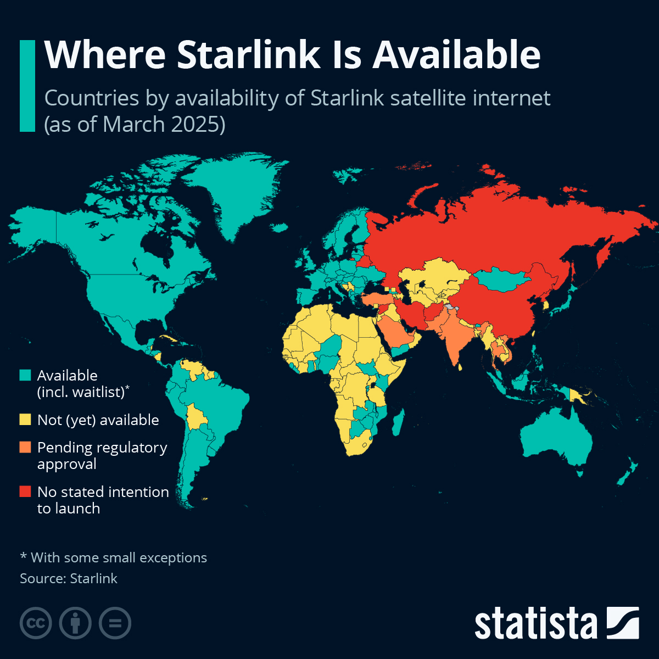
Few doubt that Starlink will continue to grow, and perhaps grow very well as key markets open up to its service. And there are dozens of attractive regions where Starlink is currently unavailable, not least India, Elon Musk’s birth country of South Africa as well as much of the rest of Africa, Turkey, Egypt, the Gulf States and many countries in South-East Asia (and forgetting about China and Russia where service is not anticipated).
The “known unknowns” of elements such as X, and in particular its AI sister-business and ‘Grok’, could grow exponentially over time. But there are many ‘buts’ for SpaceX and in particular its Starship version.
Comments in ‘Modern Diplomacy’ echoed the sentiment of most investors, saying: “The most important thing is this: the company (SpaceX) going public is not primarily a rocket manufacturer or a satellite internet provider. It is the world’s most consequential private geopolitical actor, operating critical infrastructure that governments depend on for national security, that militaries use as a battlefield communications layer, that adversaries have spent significant resources trying to jam, hack, and destroy.”
Another comment, from Mark Boggett, CEO at space investment firm Seraphim Space, who described the IPO as a “landmark moment” for the space economy. “More than simply attracting additional venture capital, it [will] further establish space as a mainstream investment category and provide public market investors with a highly visible benchmark for the sector’s potential.”
He added that Seraphim would expect a listing to increase interest from a broader range of investors, including generalist venture capital firms that may previously have had limited exposure to the sector.
“Historically, category-defining companies have drawn new investors into adjacent parts of their ecosystems as they seek exposure to the next generation of growth opportunities,” he stated.
“However, the bigger opportunity is not simply attracting more venture capital. The SpaceX IPO has the potential to bring additional capital into the asset class, increasing participation from institutional investors, wealth managers, retail investors, and public market participants. We are already seeing evidence of this trend through the emergence of dedicated SpaceTech ETFs and increasing investor engagement with specialist space-focused investment vehicles, including Seraphim Space Investment Trust (SSIT).”
Boggett recognised that SpaceX is an exceptional company [and] also highlights the breadth of the opportunity beyond launch. “The space economy increasingly encompasses critical infrastructure spanning defence and security applications. communications, Earth observation, navigation, energy, and climate intelligence. While launch and connectivity currently capture much of the public attention, a significant proportion of future value creation is likely to occur in the applications, intelligence, and infrastructure layers. In our view, a SpaceX IPO would shine a spotlight on this wider ecosystem and help accelerate capital flows towards the next generation of category-leading SpaceTech companies.”
As the next few days unfold, the market will be able to see precisely what’s happening, at least see the trends in the short term. KGI Securities have entered the opinion market and opened its advice with an ‘Outperform’ rating on SpaceX, and a target price of $227 per share. Private investment firm Oppenheimer also rates the SpaceX stock at ‘Outperform’ and with a target price of $190 per share.
