

By Nick David, Editorial Lead, SatNews
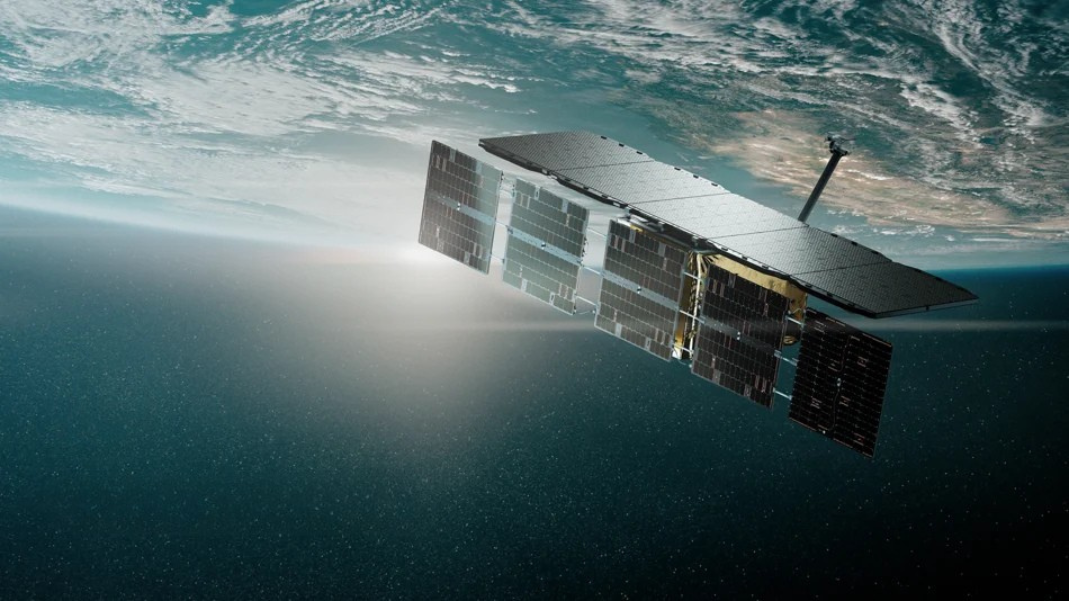
ICEYE’s Gen4 satellite platform shown in orbit, representing the company’s next-generation radar-satellite architecture for sovereign, high-cadence Earth observation missions.
The mood in Europe this month is one of arrival, and it is easy to see why. The Finnish radar-satellite maker raised more than a billion euros at a valuation above ten billion. In the same stretch, the Rheinmetall–ICEYE joint venture, Rheinmetall ICEYE Space Solutions, is standing up a satellite production line on German soil — the industrial spine behind a 1.7 billion euro German reconnaissance contract and a customer roster that now spans seven nations. A German defense prime, a sovereign satellite line in Neuss, governments lining up to fly their own constellations. The coverage reads the moment as a summit reached: Europe, long wary of relying on others for satellite intelligence, now has a champion of its own.
That framing is right about the achievement and wrong about the timing. This isn’t a summit; it’s base camp.
The real significance of ICEYE is strategic: it has proven a model. A European company can build synthetic-aperture radar satellites at cadence, sell the spacecraft rather than only the imagery, and let a government fly its own constellation under its own flag. Five years ago that was theory. ICEYE has made it routine. Whether the continent can own its eyes in space is no longer the question; ICEYE has settled that. What’s still open is how many operators of its caliber Europe can build, and how fast.
The numbers say the demand is there, and that it is larger than any one company can satisfy. ICEYE crossed 250 million euros in revenue in 2025 with more than 100 million euros in profitability, and its backlog, now above 1.5 billion euros, is dominated by national-security work rather than commercial imagery. Sweden, Poland, Portugal, the Netherlands, Greece and Finland have all bought sovereign systems, and Germany makes the seventh through the Rheinmetall venture; Portugal expanded its fleet again this month. Poland’s POLSARIS constellation is already operational under its ARGUS agency. The company is roughly doubling output, from about 50 satellites a year toward 100 by 2028. Those are the metrics of a category creator in its first innings, with plenty of runway still ahead.
ICEYE · By the Numbers
€10B+
Valuation in the June 2026 funding round
€1B+
Capital raised in the round
€250M
2025 revenue, with €100M+ profitability
€1.5B
Contracted backlog, dominated by national security
€1.7B
German reconnaissance contract via the Rheinmetall venture
100
Satellites per year targeted by 2028, doubling from ~50
The celebratory read misses something structural. A sovereign-intelligence market growing this fast is not best served by a single supplier, however good. It needs an industry: peers, shared supply chains, deep talent pools, and a political base broad enough to survive budget cycles. ICEYE created the category. Europe’s job now is to give it company.
The Rheinmetall venture shows the continent already reaching for exactly that. Rheinmetall ICEYE Space Solutions is more than a satellite contract: it pulls Reflex Aerospace, OroraTech, constellr and LiveEO into a German space cluster, with production starting in Neuss next quarter. That is how an industry forms around a leader: a proven anchor, an industrial prime, and a ring of specialist firms growing up beside them. The same pattern should be repeated, in more countries, across more sensing modalities.
Europe does not have too much ICEYE. It has too little of what ICEYE represents.
The strongest counterargument is the efficiency case. One champion is cleaner. Spreading sovereign demand across a dozen subscale startups would waste capital, dilute engineering talent, and slow delivery at the precise moment European governments need working capability in orbit. Better to back the proven winner and let it scale. The argument has real force, and it explains why so many ministries reached for ICEYE first.
But the efficiency case is incomplete, because it treats a thicker industry as competition for ICEYE rather than reinforcement. The opposite holds. A deeper European SAR base means more component suppliers, a larger pool of radar engineers, more launch demand, and a sovereign-space constituency that no single budget vote can unwind. Those are tailwinds for the category leader. The firms most able to thrive in a maturing market are the ones that defined it, and ICEYE has the head start, the backlog, and the operating record. A growing field compounds that lead, the way a strong anchor tenant gains when the rest of the district fills in.
The verdict is straightforward, and it is a growth story for everyone in it. Europe has not finished building sovereign intelligence; it has finally started, and it has a working blueprint. ICEYE is that blueprint. The right response to its success is to replicate the model deliberately, funding the next generation of European space-sensing champions while the demand curve is still climbing. This will take sustained political will, and the real risk is the opposite of complacency: that Europe funds a scatter of fragmented national champions rather than one coherent, interoperable industry.
For procurement officers, that means treating ICEYE as the standard to build around and using sovereign contracts to seed an industrial base with real depth. For investors, the ten billion euro valuation is best read as an early price for the leader of a fast-growing category, with output doubling and a backlog dominated by the most durable customers a space company can have. And for the agencies in Berlin, Warsaw, Lisbon and Stockholm now operating their own constellations, the ambition worth holding is bigger than the one the headlines describe: not a single European champion, but a European industry built on the model ICEYE proved.
Key Takeaway
ICEYE’s €10B valuation and the Rheinmetall venture mark a beginning, not a finish line. The company has proven a model: build SAR satellites at cadence, sell the spacecraft, and let governments fly their own constellations under their own flag. Seven European nations now operate sovereign systems and output is doubling toward 100 satellites a year. The task ahead is to turn one proven champion into a full industry built on that blueprint.
About the Author
A storyteller at heart, Nick David covers space policy, satellite markets, defense, and the technologies reshaping how humanity operates beyond Earth. With a background in creative direction, brand strategy, and editorial storytelling, he brings a modern lens to complex subjects and a relentless curiosity about what comes next.
