

On Thursday, September 3, 2026, satellite operator SES announced that the final three O3b mPOWER satellites arrived at Cape Canaveral, Florida.
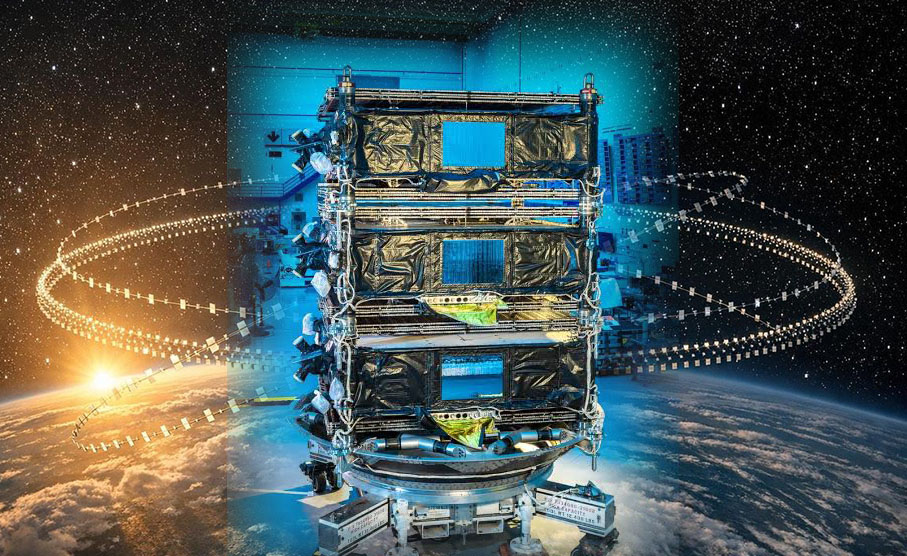
Transported from Boeing Space and Launch facilities in El Segundo, California, the spacecraft will undergo launch processing and integration before launching aboard a SpaceX Falcon 9 rocket later in September 2026. Upon deployment, the three satellites will complete the initial 13-spacecraft Medium Earth Orbit (MEO) constellation.
Program History and Technical Upgrades
The delivery marks the culmination of SES’s second-generation MEO network buildout. SES launched the initial O3b mPOWER satellites in late 2022 and 2023, following the deployment of the fifth and sixth O3b mPOWER satellites aboard a SpaceX Falcon 9.
Following early power module anomalies identified in the initial satellite flight units, SES and Boeing executed a technical mitigation strategy. Boeing re-engineered the power system components for the final satellites and expanded the overall procurement contract to add two additional satellites to the O3b mPOWER constellation. The manufacturing modifications, combined with software routing adjustments, ensured system redundancy and operational longevity across the active constellation, as outlined in SES’s constellation update and power system review.
MEO Payload Specifications and Beamforming Architecture
Built on the Boeing 702X software-defined satellite bus, the final three O3b mPOWER spacecraft operate at an orbital altitude of approximately 8,000 kilometers above Earth. The MEO architecture delivers high-throughput, low-latency broadband connectivity to enterprise, government, maritime, and aeronautical customers across the globe.
Key technical characteristics of the spacecraft include:
- Phased Array Technology: Equipped with electronically steered phased array antennas capable of generating and shaping up to 5,000 dynamic spot beams per satellite.
- Flexible Bandwidth Allocation: Operates across Ka-band spectrum, enabling real-time allocation of gigabit-per-second throughput to specific geographic regions or mobile assets.
- Low-Latency Transit: Delivers round-trip latency under 150 milliseconds, providing fiber-like connectivity for cloud computing, cellular backhaul, and defense networks.
- Autonomous Beam Steering: Dynamically shifts link capacity and tracks moving terminals across maritime vessels, commercial aircraft, and tactical military units.
Market Rationale and Enterprise MEO Advantage
The completion of the 13-satellite constellation secures SES’s market positioning as the primary commercial operator running multi-orbit networks across Geostationary Earth Orbit (GEO) and MEO. While Low Earth Orbit (LEO) constellations provide high-density consumer broadband, MEO platforms offer dedicated, high-availability throughput with predictable orbital coverage and fewer ground handoffs.
The expanded mPOWER constellation supports high-capacity data demands from government and cruise maritime sectors, enabling secure, sovereign communications channels for defense forces alongside cloud interconnectivity for multinational enterprises operating in remote regions.
Executive Leadership Perspective
“The arrival of these final mPOWER satellites at Cape Canaveral represents a milestone for SES and our technology partners,” said Adel Al-Saleh, Chief Executive Officer of SES. “Completing this constellation unlocks the full operational capabilities of our MEO architecture, allowing us to deliver reliable, high-throughput, low-latency connectivity to our commercial and defense customers worldwide.”
Launch Schedule and Orbital Commissioning Timeline
The three spacecraft are undergoing fueled system checks, payload calibrations, and encapsulation within the Falcon 9 payload fairing at Launch Complex 40. Following launch later in September, the satellites will use onboard electric propulsion to raise their orbits to 8,000 kilometers, undergo payload testing, and enter full commercial service alongside the 10 operational O3b mPOWER satellites by early 2027.
