

WASHINGTON — NASA’s 22-year-old Neil Gehrels Swift Observatory is projected to reenter Earth’s atmosphere and burn up on or around Friday, Nov. 6, 2026, following the failure of a commercial mission to raise its orbital altitude.
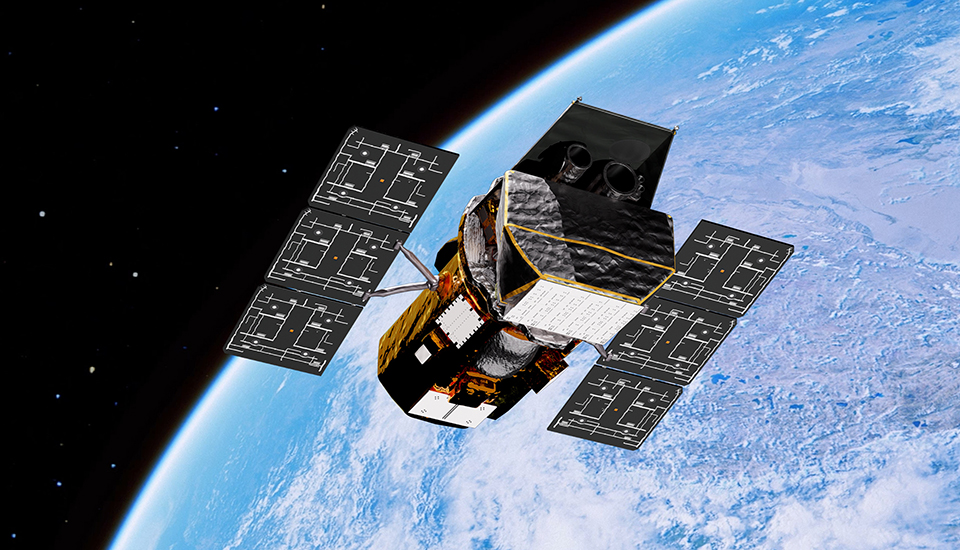
Operating in low Earth orbit (LEO) since November 2004, the astrophysics satellite has ceased scientific observations as severe atmospheric drag rapidly destabilizes its altitude.
Orbital Decay and Unsuccessful Servicing Attempt
Elevated solar activity during the recent solar maximum expanded Earth’s upper atmosphere, creating heightened aerodynamic resistance that dragged the 1,500-kilogram observatory from its nominal 600-kilometer orbit down to critical altitudes below 275 kilometers. In response to the accelerating degradation, NASA commissioned an emergency commercial life-extension initiative, but the telescope was projected for atmospheric reentry after Arizona-based contractor Katalyst Space Technologies aborted a robotic docking attempt.
The rescue spacecraft, named LINK, launched aboard an air-launched Pegasus XL rocket after undergoing cleanroom environmental testing and fairing encapsulation earlier this year. However, persistent attitude control system anomalies forced flight controllers to terminate proximity operations within 15 kilometers of Swift, precluding the mechanical latching and ion-engine reboost necessary to keep the science platform aloft.
Scientific Instrumentation and Spacecraft Architecture
Swift launched without an onboard propulsion system to maintain orbit, relying on momentum wheels and magnetic torquers for three-axis pointing. Over more than two decades, the spacecraft functioned as the astrophysics community’s primary rapid-alert platform for transient phenomena, observing more than 2,000 gamma-ray bursts using three co-aligned instruments:
- Burst Alert Telescope (BAT): A wide-field coded-aperture mask instrument detecting hard X-ray and gamma-ray transients.
- X-Ray Telescope (XRT): A grazing-incidence optic measuring spectra, light curves, and celestial coordinates.
- Ultraviolet/Optical Telescope (UVOT): A 30-centimeter Ritchey-Chrétien telescope capturing counterpart afterglows.
With atmospheric drag exceeding reaction wheel limits in late October, the operations team at Pennsylvania State University placed Swift into safe mode and permanently terminated science operations.
Reentry Trajectory and Tracking Timeline
U.S. Space Command and international orbital tracking networks are monitoring the spacecraft’s descent as altitude loss accelerates ahead of the anticipated Nov. 6 reentry window. While atmospheric friction is expected to incinerate the majority of Swift’s structure, dense components such as internal tungsten shielding may survive. Debris modeling indicates any surviving fragment
