

On August 20, 2026, NASA and commercial partner Katalyst Space Technologies confirmed that the LINK servicing spacecraft was unable to perform planned docking maneuvers to raise the altitude of the Neil Gehrels Swift Observatory.
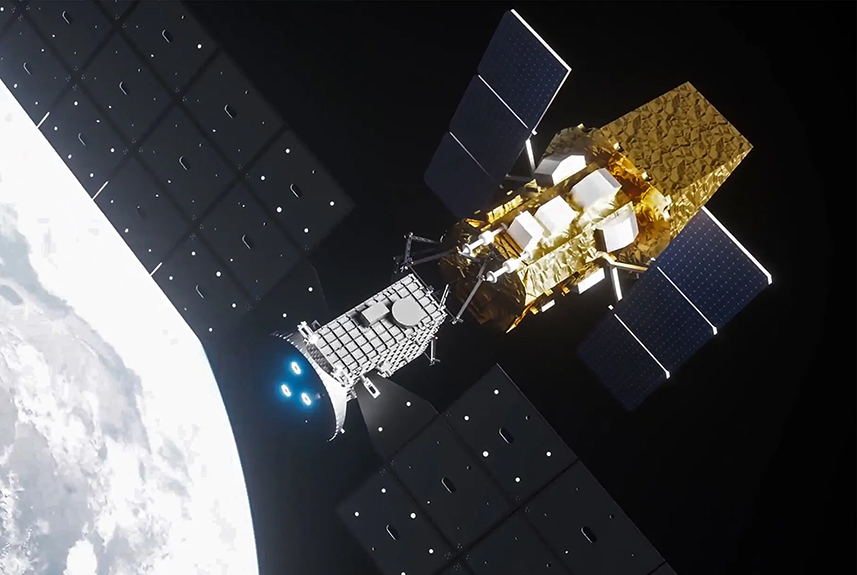
In a previous SatNews Report, NASA and aerospace startup Katalyst Space Technologies scheduled an orbital servicing mission on Tuesday, June 30, 2026, aimed at arresting the atmospheric decay of the Neil Gehrels Swift Observatory. But a result of the unsuccessful orbital boost, NASA expects the 21-year-old gamma-ray burst telescope to re-enter Earth’s atmosphere later in 2026.
Orbital Parameters and Servicing Mission Architecture
The Neil Gehrels Swift Observatory was launched in November 2004 into a 600-kilometer circular low Earth orbit to study high-energy astrophysical phenomena. Over two decades of operation, atmospheric drag gradually decayed Swift’s orbital altitude to below 400 kilometers, placing the uncrewed observatory on a re-entry trajectory.
To address the orbital decay, NASA partnered with Katalyst Space Technologies to deploy the LINK spacecraft, a low-cost servicing platform designed to rendezvous with, capture, and re-boost legacy space assets. The LINK platform integrated optical sensors, relative navigation software, and a mechanical docking mechanism engineered to attach to Swift’s aft ring without requiring specialized pre-existing servicing interfaces.
Mission History and Commercial Servicing Context
The orbital attempt followed Katalyst Space Technologies’ July 2026 launch of the LINK mission, which was funded through a public-private partnership under NASA’s commercial servicing and life-extension initiative.
During rendezvous operations, the LINK servicer successfully approached within close proximity of Swift and validated its autonomous relative navigation algorithms. However, telemetry anomalies and thruster alignment discrepancies during the final approach phase prevented the spacecraft from establishing a secure mechanical latch on the telescope, leading mission controllers to abort further docking attempts to avoid collision risks.
Re-entry Projection and Operational Outlook
Following the decision to stand down from docking operations, Katalyst Space Technologies repurposed LINK to perform non-contact proximity inspection maneuvers around Swift, collecting diagnostic flight data to inform future autonomous servicing systems. NASA science teams are executing final science data downlinks before decommissioning Swift’s primary instruments, while ground radar networks monitor the telescope’s orbital decay rate ahead of an uncontrolled atmospheric re-entry over the ocean.
