

CAPE CANAVERAL, Fla. — Amazon has placed fewer than 400 operational broadband satellites into orbit for its Amazon Leo constellation due to cascading development and grounding delays across its primary heavy-lift launch providers, SpaceNews reported on Tuesday, Nov. 3, 2026.
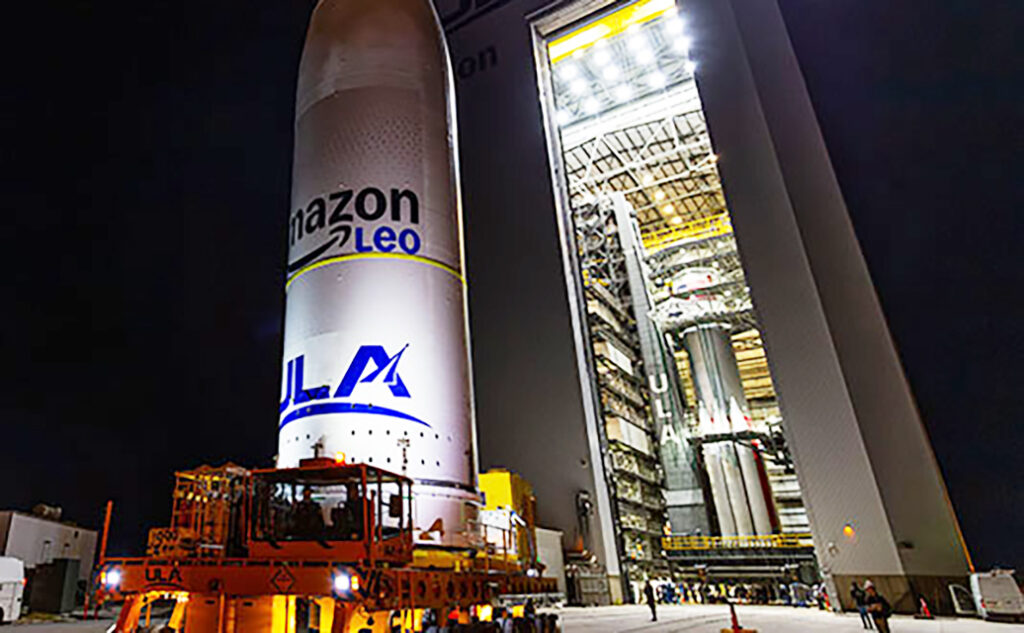
The tech giant is banking on an operational acceleration as United Launch Alliance (ULA) prepares to return its Vulcan Centaur rocket to flight as early as Nov. 13 carrying a dedicated batch of satellites from Space Launch Complex 41.
Heavy-Lift Delivery Bottlenecks
Amazon originally contracted 77 heavy-lift missions across Arianespace, Blue Origin, and ULA to deploy its 3,232-satellite constellation, but technical setbacks have constrained launch cadence. ULA’s Vulcan has remained grounded since February following a solid rocket booster nozzle anomaly during a Space Force mission, which prompted military officials to reassign national security flights to SpaceX.
Simultaneously, Blue Origin’s orbital timeline stalled after a New Glenn vehicle exploded during a static fire test in May, while Arianespace’s Ariane 6 launch manifest has struggled to achieve the high flight frequency necessary to sustain Amazon’s deployment schedule.
Vulcan VC6L Return-to-Flight Configuration
The upcoming Vulcan Leo 1 (LV-01) mission will mark the operational debut of Vulcan in its heavy-lift VC6L configuration. The vehicle incorporates six Northrop Grumman GEM 63XL solid rocket boosters equipped with reinforced thermal nozzle insulation, alongside an optimized Centaur V upper stage. The flight will carry 40 Amazon Leo satellites housed within a 5.4-meter payload fairing, representing the single largest payload volume launched for the network to date.
Inflection Point for Regulatory Milestones
Industry analysts project that 2027 could serve as the decisive operational inflection point for Amazon if commercial flight rates ramp across all three contracted rocket families. Under its Federal Communications Commission (FCC) authorization, Amazon must deploy half of its constellation by mid-decade and complete all 3,232 satellites by July 2029. Establishing a predictable monthly launch cadence with Vulcan and European launchers is critical for Amazon to avoid spectrum priority penalties and deliver continuous commercial broadband.
