
By Nick Warfield, Editorial Lead, SatNews
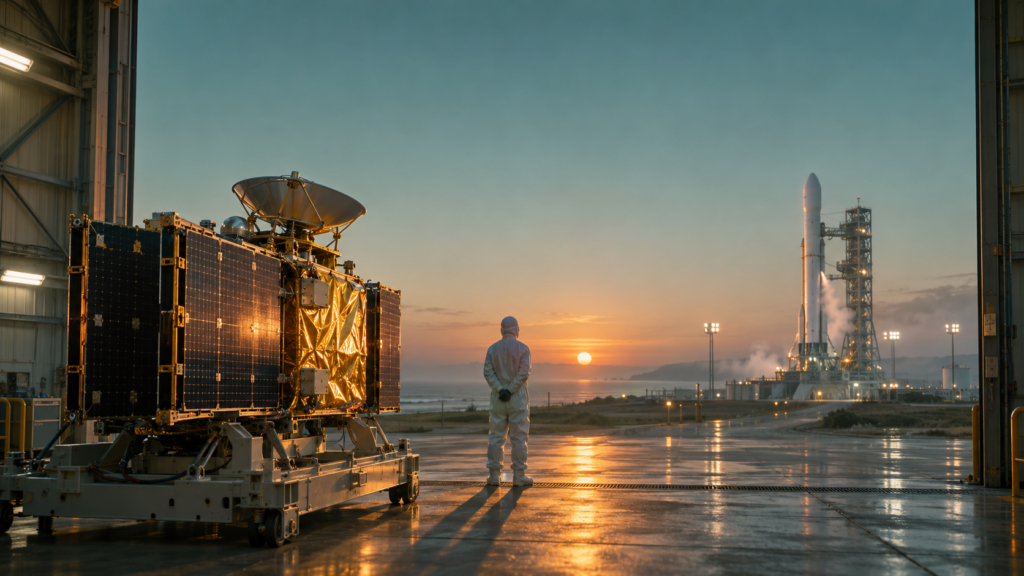
On Nov. 6, AST SpaceMobile said it would build its own rocket. On Nov. 17, radar satellite operator ICEYE offered about €2.05 billion in cash for Avio, the Italian company that builds Europe’s Vega C. The two announcements came during a rough stretch for launch: on Nov. 15, a United Launch Alliance Vulcan carrying 40 Amazon Leo satellites failed 10 minutes after liftoff.
Add Rocket Lab’s pending purchase of Iridium, and three companies are now working to put satellites and rockets under one owner. Each gives its own reasons. Taken together they suggest that well-funded operators are losing confidence in launch as a service they can count on buying. That leaves a question for every operator that cannot afford a rocket.
Who owns the stack
Three routes to putting the service, the satellites and the rocket under one owner. Status as of Nov. 20, 2026.
Build
AST SpaceMobile
Service
Direct-to-device connectivity
Owned today
Satellites
BlueBird
Owned today
Rocket
Blacklift
In development; first flight targeted for late 2028
Engine contract$1.3 billion with Firefly Aerospace
What it buys36 Miranda and Vira engines for the first three rockets
Capacity20 tons to low Earth orbit, reusable
Until thenBuys rides from other providers
Buy
ICEYE and Avio
Service
Radar imagery for its own fleet and defense ministries
Owned today
Satellites
ICEYE radar satellites
Owned today
Rocket
Vega C, built by Avio
Offer made Nov. 17; Avio’s board is evaluating it
PriceAbout €2.05 billion in cash, €41 a share
Condition66.67% of Avio’s shares, a threshold ICEYE can waive
ReviewsItaly, France, United Kingdom, European Commission, United States
Vega C in 2026Two flights; a third is waiting on late-arriving satellites
Merge
Rocket Lab and Iridium
Service
Iridium’s L-band spectrum and about 2.7 million subscribers
Acquisition pending
Satellites
Iridium’s constellation
Acquisition pending
Rocket
Rocket Lab’s launch business
Owned today; larger Neutron rocket still in development
Enterprise valueAbout $8 billion
Terms$54 a share: $27 in cash and Rocket Lab stock
Stockholder vote99.6% of votes cast, Sept. 24
Expected closeBy mid-2027, subject to regulatory approvals
Owned todayIn developmentDeal pending
Sources: company announcements; AeroTime; European Spaceflight; Payload.
Build: AST SpaceMobile
AST’s rocket is called Blacklift. It is a reusable vehicle designed to lift 20 tons to low Earth orbit, with a first flight targeted for late 2028. Firefly Aerospace will supply 36 Miranda and Vira engines for the first three rockets under a contract worth $1.3 billion, along with three years of engineering support. After that, AST plans to build the engines itself under license at a new plant.
“The Blacklift rocket is the springboard to significantly expand our total addressable market,” founder, chairman and CEO Abel Avellan said in the announcement.
The logic is competitive. AST’s main rival in direct-to-device service is SpaceX, which launches its own satellites on its own rockets. AST signed launch agreements with Blue Origin, ISRO and SpaceX in November 2024, and it has since had to work around bottlenecks at more than one provider, as SatNews reported on Nov. 7.
Payload called the 2028 date “an incredibly aggressive timeline” for a new vehicle. Until Blacklift flies, AST still buys rides from others.
Buy: ICEYE and Avio
ICEYE chose to buy. Its offer of €41 a share is a 21.3% premium to Avio’s Nov. 16 price and is conditional on reaching 66.67% of the shares, a threshold ICEYE can waive, AeroTime reported. ICEYE plans to take Avio private, keep its brand and workforce in Italy, and invest a further €1 billion there over five years. Avio said its board would begin evaluating the offer.
“Governments need control of their critical space infrastructure, and Europe needs it most,” CEO and co-founder Rafal Modrzewski said.
ICEYE says a combined company would give governments more certainty over deployment and would support more frequent Vega launches. Its own exposure is plain from its launch record. ICEYE builds radar satellites for its fleet and for defense ministries, and its recent batches have flown on SpaceX rideshare missions, including four satellites on Bandwagon-5 in October. SpaceX has stopped taking rideshare reservations beyond late 2028 or early 2029. Avio brings Vega C, Europe’s light launcher, along with the P120C solid motor it co-produces for Ariane 6 and propulsion for the Aster and CAMM-ER missile families.
The bid has a long way to go. Leonardo is Avio’s largest shareholder with 18.04%, and the Italian state owns about 30% of Leonardo. The deal needs clearance under Italy’s golden power rules, approvals in France and the United Kingdom, a European Commission foreign subsidies review and a U.S. CFIUS review. Italian Defense Minister Guido Crosetto said on Nov. 18 that Leonardo should “think carefully” before exiting Avio, Reuters reported. Vega C has flown twice this year, and Avio chief executive Giulio Ranzo said on Nov. 11 that its third launch is waiting on late-arriving satellites, European Spaceflight reported. Owning the rocket would not on its own give ICEYE the launch rate it needs.
Merge: Rocket Lab and Iridium
The third deal runs the other way. Rocket Lab, a launch and spacecraft company, announced on June 29 that it would acquire Iridium for $54 a share, made up of $27 in cash and Rocket Lab stock, at an enterprise value of about $8 billion. Iridium stockholders approved it on Sept. 24 with 99.6% of votes cast. The companies expect to close by mid-2027, subject to regulatory approvals.
Rocket Lab stated the launch logic directly. Its announcement said the deal is expected to eliminate third-party launch costs for deploying and replenishing the constellation while “guaranteeing orbital access as launch capacity tightens.” Founder and CEO Sir Peter Beck described the aim as combining Iridium’s “trusted global network, spectrum and decades of operating experience” with Rocket Lab’s launch and space systems capabilities.
Iridium brings globally coordinated L-band spectrum, about 2.7 million billable subscribers and a standards-based direct-to-device service it said it activated on Nov. 17. Rocket Lab brings the means to build and launch whatever follows Iridium’s current satellites, though its larger Neutron rocket is still in development. The buyer here is the launch company, and the result is the same structure as the other two: one owner for the spectrum, the satellites and the rocket.
Why now
The market these companies are stepping out of has narrowed quickly. SpaceX stopped taking rideshare reservations beyond late 2028 or early 2029, and executives at World Space Business Week in September said privately that a commercial Falcon 9 had become effectively impossible to buy, The Space Review reported. SpaceX has announced no commercial Starship service to replace it.
The alternatives are flying well below plan. The Nov. 15 failure was Vulcan’s fifth flight and its first in nine months. ULA said on Nov. 18 that preliminary data points to an inadequate supply of fuel to the first-stage engines, not a fault in the engines themselves, and that work remains to find the cause. The FAA is overseeing the investigation. The Space Force had already moved six national security missions from Vulcan to SpaceX by Oct. 1, according to Breaking Defense. Blue Origin’s New Glenn has been grounded since a pad explosion in May. FAA-licensed launches fell in fiscal 2026 for the first time since fiscal 2019.
Amazon shows what buying launch as a service looks like under that pressure. By Spaceflight Now’s count it booked 38 launches on Vulcan, 24 each on New Glenn and Ariane 6, and 13 on Falcon 9, and it had launched 396 satellites before Nov. 15 toward a constellation of more than 3,300.
Who gets stranded
There is a fair objection to reading this as a trend. Three moves by unusually well-capitalized companies do not set a rule for the sector, and new vehicles from Stoke, Isar and others are due before the decade ends. “I don’t think this is a structural problem. I think it’s a temporary gap,” D-Orbit chief commercial officer Renato Panesi told The Space Review, putting the critical period in 2029 and 2030, “and maybe 2031.”
For operators inside that period, temporary is little comfort. ICEYE raised more than €1 billion in June at a valuation above €10 billion, and AST can sign a $1.3 billion engine contract. A startup planning a few dozen satellites can do neither.
Last week showed what those options look like. Launch integrator SEOPS signed for rideshare capacity from 2029 on Stoke Space’s Nova Block 2, a rocket that has not flown. Isar Aerospace’s Spectrum is fully booked for 2027 and 2028, chief commercial officer Stella Guillen told The Space Review. “Now there is suddenly this panic mode for 2028 and 2029,” she said.
The practical effect is a new line in due diligence. Investors and government customers will ask a constellation operator how its satellites reach orbit in 2029 and what happens if that vehicle is late. Operators that own a rocket will have an answer on paper well before they have one on the pad. The next data points are the Avio board’s response to ICEYE and the findings of ULA’s investigation.
About the Author
A storyteller at heart, Nick Warfield covers space policy, satellite markets, defense, and the technologies reshaping how humanity operates beyond Earth. With a background in creative direction, brand strategy, and editorial storytelling, he brings a modern lens to complex subjects and a relentless curiosity about what comes next.