

On Wednesday, Nov. 18, United Launch Alliance (ULA) announced that initial telemetry from its recent Vulcan rocket launch failure indicates that Blue Origin’s BE-4 main engines were not responsible for the vehicle’s performance shortfall.
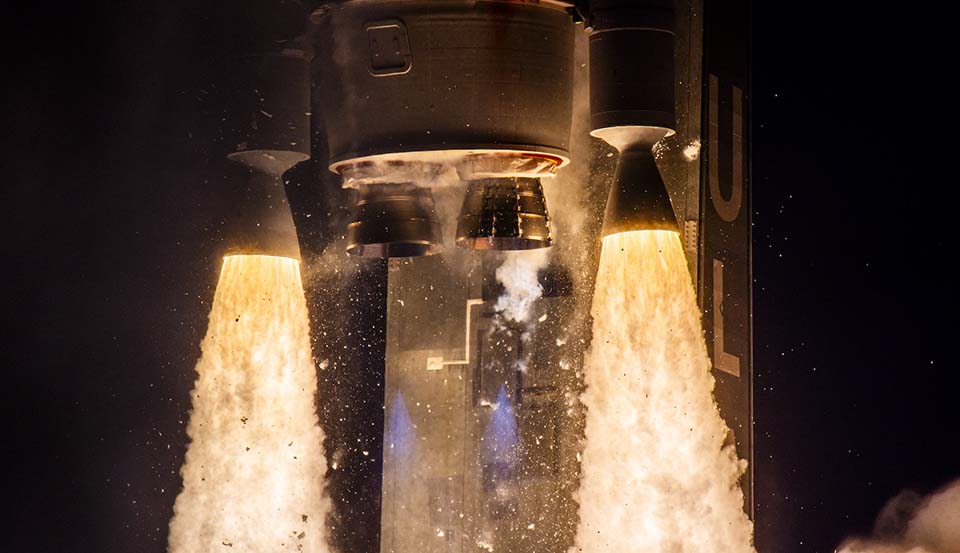
Instead, investigators examining the Nov. 15 launch failure that resulted in the loss of 40 Amazon Leo broadband satellites are concentrating on an inadequate supply of fuel reaching the engines inside the rocket’s liquid core stage.
Eliminating Cross-Vehicle Engine Risk for Blue Origin’s New Glenn
Exonerating the liquefied natural gas-fueled BE-4 engines removes a critical shared-hardware risk across the U.S. heavy-lift launch sector. Because Blue Origin utilizes the same BE-4 engine family to power the first stage of its heavy-lift New Glenn launch vehicle, an internal engine design flaw or manufacturing defect could have forced parallel stand-downs and extensive hardware inspections across both launch providers.
With preliminary flight data clearing the BE-4 propulsion units themselves, Blue Origin can continue advancing toward its targeted early-January return to flight for New Glenn without facing immediate grounding pressure tied to Vulcan’s core stage anomaly. For ULA, isolating the fault to propellant delivery within the booster’s tankage or feedlines narrows the scope of corrective engineering required before Vulcan resumes commercial and national security launch operations.
Stage-by-Stage Telemetry and Propulsion Performance
According to ULA’s Nov. 18 technical update, post-flight data review confirmed nominal operation across the remainder of the launch vehicle’s propulsion systems during the Nov. 15 ascent. All six solid rocket strap-on boosters ignited cleanly and performed normally throughout their burn profiles, and the Centaur upper stage operated as expected following main booster separation.
Engineers have traced the root cause of the orbital insertion shortfall specifically to insufficient fuel delivery to the first-stage engines within the Vulcan liquid core stage. ULA has not yet disclosed what mechanical, pressurization, or propellant feed issue disrupted fuel flow to the engines during flight.
Constellation Deployment Setback for Amazon Leo
The Nov. 15 mission was carrying 40 satellites for Amazon Leo, representing a major deployment batch for the low Earth orbit (LEO) broadband communications constellation. Losing the spacecraft aboard the Vulcan flight delays near-term orbital replenishment while ULA conducts its formal failure investigation and implements corrective hardware or procedural fixes on the Vulcan core stage.
Fault Isolation and Path Toward Return to Flight
Led by President and Chief Executive Officer (CEO) Mark Peller, ULA’s engineering team is continuing detailed telemetry analysis, hardware inspections, and ground testing to pinpoint the exact mechanism that restricted fuel flow to the BE-4 engines. Determining why the liquid core stage experienced a propellant supply disruption—and verifying corrective measures with federal regulators and launch customers—will dictate when ULA can clear Vulcan for its next mission.
