

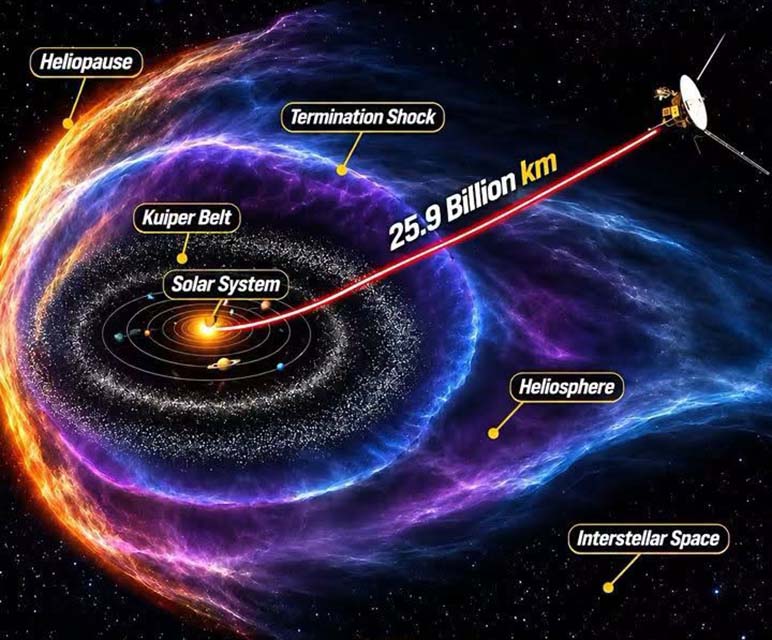
NASA’s Voyager 1 spacecraft became the first human-made object to reach a distance of one light-day from Earth, crossing a deep-space milestone roughly 16.1 billion miles—or nearly 25.9 billion kilometers—away from home.
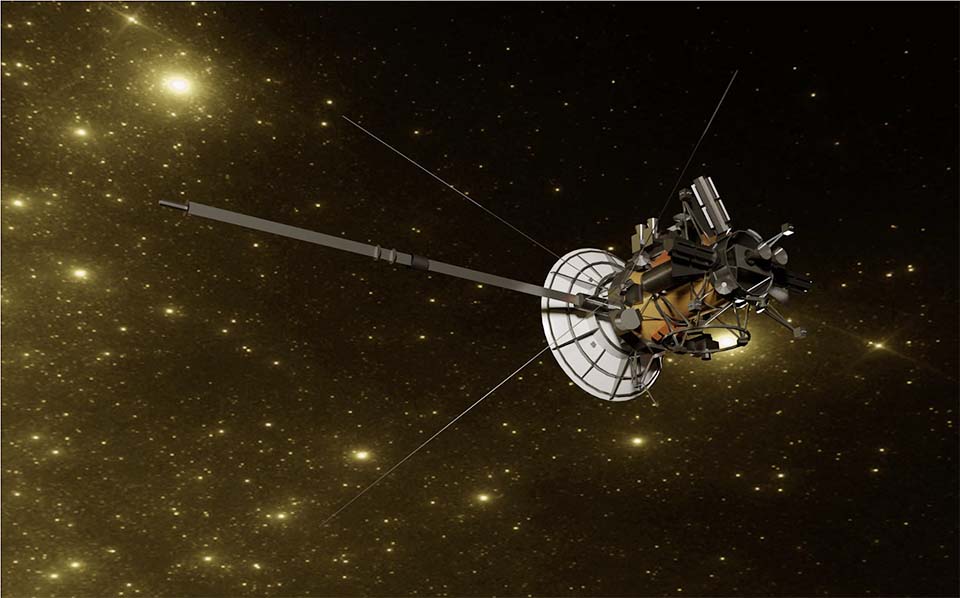
Located at approximately 173 astronomical units (AU) from Earth, the interstellar probe continues transmitting engineering and science data nearly five decades after its 1977 launch.
Decades of Interstellar Flight and Engineering Recovery
Originally launched to conduct flybys of Jupiter and Saturn before entering interstellar space in 2012, Voyager 1 is managed for NASA by the California Institute of Technology’s Jet Propulsion Laboratory (JPL) in Pasadena, California. Operating far beyond the solar system’s heliosphere, the aging spacecraft has required continuous engineering adjustments to sustain deep-space communications and science operations across extreme distances.
In April 2024, JPL flight controllers successfully restored engineering telemetry updates from Voyager 1 following a five-month communications disruption caused by corrupted flight data system memory. Two years later, in April 2026, mission engineers shut off the spacecraft’s Low-Energy Charged Particle instrument to conserve diminishing electrical power from its radioisotope thermoelectric generators, preserving energy for its remaining interstellar plasma and magnetic field sensors.
Distance Scale and Deep-Space Communications Parameters
Crossing the one light-day threshold marks a full 24-hour one-way light-time delay for radio signals traveling between ground antennas and the spacecraft across NASA’s Deep Space Network. Key operational parameters defining the milestone include:
- Heliocentric Distance: Voyager 1 stands roughly 16.1 billion miles (nearly 25.9 billion kilometers, or 173 AU) from Earth, where one AU represents the average distance between Earth and the Sun.
- Command Turnaround Latency: Because radio waves travel at the speed of light, an uplink command transmitted from ground controllers requires 24 hours to reach Voyager 1, and confirmation telemetry takes another 24 hours to return—creating a 48-hour round-trip communications cycle.
- Active Interstellar Payload: Ongoing power management keeps the spacecraft’s Magnetometer and Plasma Wave Subsystem active to sample magnetic fields and plasma density across the interstellar medium.
Sustaining Interstellar Science Operations Into the 2030s
As Voyager 1 travels deeper into interstellar space beyond the one light-day mark, JPL engineers continue balancing dwindling thermal and electrical power output against subsystem heating and attitude control requirements. Ground controllers must sequence commands days in advance while accounting for the two-day round-trip signal delay across deep-space tracking stations. By prioritizing core spacecraft engineering health and selective science instruments, NASA aims to keep Voyager 1 transmitting in-situ measurements from beyond the solar system well into the 2030s.
