
TOOWOOMBA, Australia — Researchers from the University of Southern Queensland (UniSQ) successfully captured the atmospheric breakup of returning spacecraft using a computed tomographic imaging spectrometer (CTIS) during an airborne observation mission over the Pacific Ocean, the university announced on Thursday, Nov. 5, 2026.
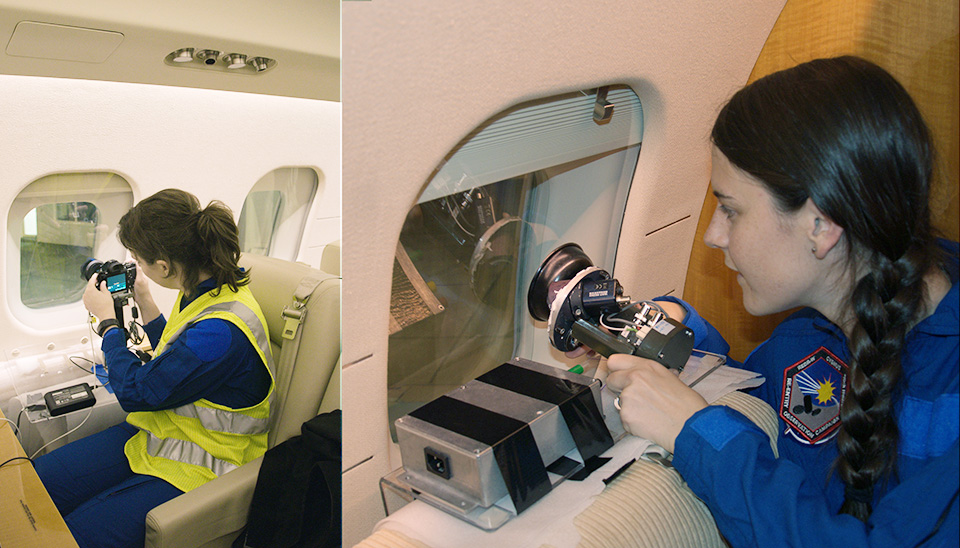
The flight collected real-time spectral data during the Oct. 12 re-entry of 12 experimental capsules deployed under the international Kentucky Re-entry Probe Experiment-3 (KREPE-3) campaign.
Atmospheric Re-Entry Observation Campaign
Operating from Rarotonga in the Cook Islands, the observation team flew aboard a modified business jet to track the targeted re-entry corridor. Supported by the Australian government’s iLAuNCH Trailblazer program, Dr. Byrenn Birch, senior lecturer in thermofluids engineering at UniSQ, integrated four observation payloads alongside international teams from the University of Kentucky, the University of Stuttgart, and Zafiro Systems.
The campaign monitored 11 thermal protection test capsules from the University of Kentucky—following operational testing demonstrated during earlier KREPE missions from the International Space Station—alongside one capsule provided by the University of Stuttgart to evaluate thermal shielding materials under extreme aerodynamic heating.
Tomographic Spectrometer Instrumentation and Optical Filtering
The centerpiece instrument, a custom-built CTIS developed through an Australian Research Council Discovery Early Career Researcher Award (DECRA), resolved multiple breaking fragments simultaneously. While conventional cameras record three primary color channels, the UniSQ spectrometer captures spatial and spectral signatures across more than 500 wavelength channels simultaneously in a single exposure.
The optical suite also included a tracking camera, a conventional slit imaging spectrometer, and a filtered camera calibrated to track carbon emission signatures generated as spacecraft ablative heat shields disintegrate.
Data Exploitation and Aerospace Applications
“Australian researchers are not just participating in major international aerospace missions, we’re bringing technologies to the table that offer capabilities not available elsewhere,” Birch noted. “Seeing our instrument operate alongside international research teams was an exciting demonstration of what Australian research can contribute.”
Analysis of the collected hyperspectral data will refine computational models for spacecraft aerodynamic breakup, assist in the qualification of novel thermal protection systems, and support space situational awareness for orbital debris survivability.