

On Thursday, Nov. 19, Google announced a launch services agreement selecting Blue Origin’s heavy-lift New Glenn rocket to deploy artificial intelligence (AI) satellites in the first quarter of 2029.
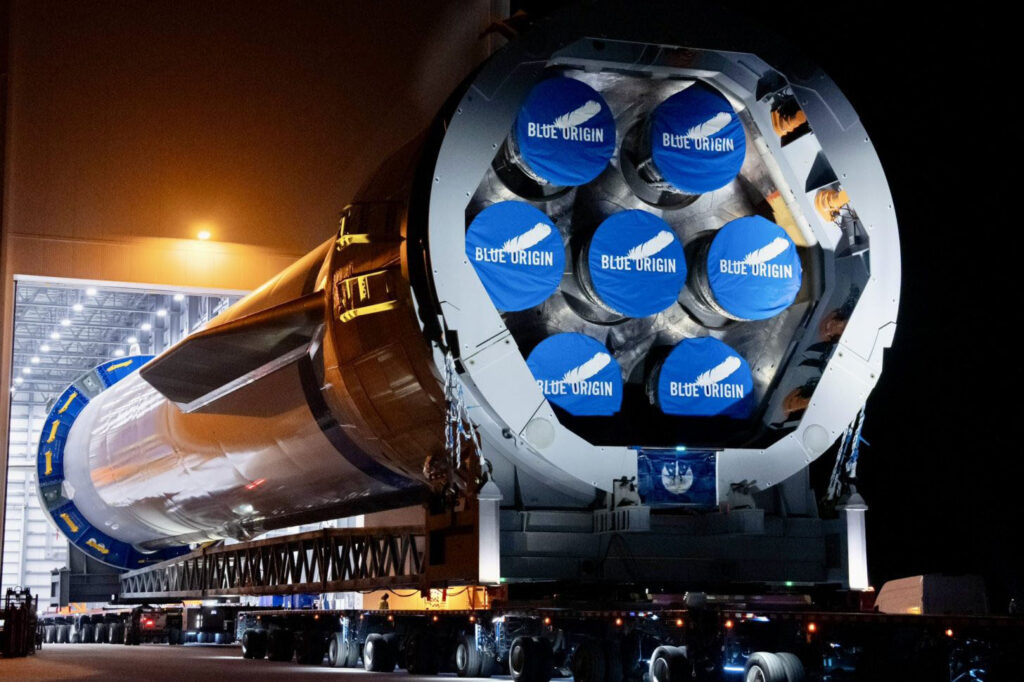
The dedicated mission marks the first heavy-lift orbital launch booked for Google’s Project Suncatcher, an initiative focused on operating solar-powered machine learning compute infrastructure in space.
Advancing Orbital AI Research and Heavy-Lift Flight Readiness
The agreement transitions Project Suncatcher from early technology demonstrations toward dedicated heavy-lift deployment. First unveiled as a research effort to test whether space-based computing clusters can tap continuous solar energy in orbit, Google’s Project Suncatcher architecture centers on equipping spacecraft with custom Tensor Processing Units (TPUs) linked via high-speed optical communications.
For Blue Origin, the contract adds a major commercial technology customer to New Glenn’s long-term manifest. The booking comes as the Kent, Washington-based launch provider advances Launch Complex 36 infrastructure recovery at Cape Canaveral Space Force Station in Florida following a May static-fire anomaly, preparing the heavy-lift vehicle for return-to-flight operations and higher flight cadence over the next two years.
Securing Heavy-Lift Capacity Amid Tightening Launch Availability
Booking a dedicated New Glenn mission for 2029 underscores the growing importance of securing heavy-lift orbital capacity well ahead of planned deployment windows. As commercial constellations expand and payload mass requirements increase for power-intensive orbital computing platforms, satellite developers face tightening launch availability across medium- and heavy-lift vehicles.
Contracting directly with Blue Origin allows Google to diversify its launch provider portfolio beyond earlier prototype rideshare flights while securing dedicated fairing volume and payload integration support tailored to multi-satellite AI hardware. For commercial satellite operators planning deployments late in the decade, locking in multi-year launch agreements helps mitigate manifest congestion as launch providers scale flight rates.
Solar-Powered TPU Spacecraft and Sun-Synchronous Orbit Profile
Under the launch services agreement, Blue Origin will loft a batch of Project Suncatcher satellites into a sun-synchronous orbit (SSO), an orbital plane selected to maximize solar exposure for onboard power generation. Each spacecraft integrates Google’s custom TPU machine learning accelerators alongside thermal management systems and optical inter-satellite links designed to process and route AI workloads directly in low Earth orbit (LEO). Operating in a dawn-dusk orbital path reduces eclipse periods and supports sustained high-power computing operations without reliance on terrestrial electrical grids.
Engineering Milestones Toward the 2029 Launch Window
In the lead-up to the targeted first-quarter 2029 liftoff from Cape Canaveral, Google and Blue Origin engineering teams will coordinate payload interface definitions, environmental qualification testing, and spacecraft integration schedules. Executing the mission remains contingent on Blue Origin’s return to regular New Glenn flight operations and Google’s completion of ongoing orbital prototype validation.
