

Chris Forrester — On Wednesday June 17 an Ariane 6 rocket soared to orbit from Europe’s Spaceport in French Guiana. The latest generation of Europe’s largest and most powerful rocket launched 36 satellites for Amazon’s Leo constellation.
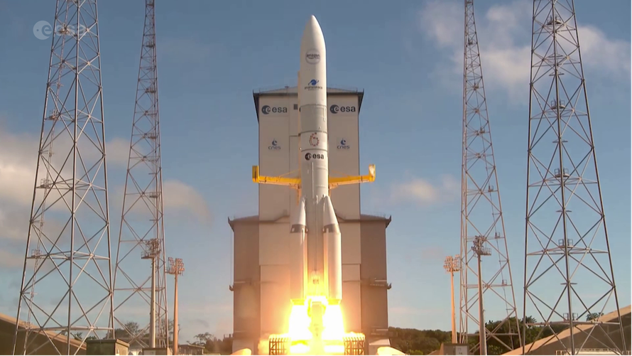
The debut of the four new boosters based on the P160C solid-propellant rocket motor allowed 36 satellites to be launched, four more than the two Leo launches Ariane 6 had delivered before.
This launch – for the Arianespace consortium – is a major achievement. But the current half-dozen or so annual launches for Ariane is no threat to the market domination of SpaceX and its Falcon 9 rockets, let alone the prospects of the massive SpaceX Starship project.
Ariane 6 is Europe’s heavy-lift launcher and a key element of ESA’s efforts to ensure autonomous access to space for Europe’s citizens. Its new P160C boosters increase considerably performance, payload capacity and competitiveness, allowing for more satellites to be launched, further elevating the future of Europe. The heavy-lift rocket debuted in 2024 with two boosters based on the P120C motor. For its sixth launch in February 2026 Ariane 6 flew for the first time with four boosters.
The current ‘launch crunch’ where there’s a serious shortage of launch capacity has been good news for Arianespace and in 2022 it won a massive 18-launch contract to loft Amazon Leo satellites. In the past Ariane had used Russia’s Soyuz rockets to launch missions (including at one stage for Eutelsat’s OneWeb fleet). Sanctions on Russia meant OneWeb had to find another launch partner, in this case SpaceX. There are 15 launches remaining on the Amazon contract which would mean that their 18-flight contract with Amazon Leo would see almost 600 satellites launched.
Arianespace is a subsidiary of ArianeGroup, itself a 50/50 joint-venture between Airbus and Safran.
But while Amazon Leo is happy that Ariane looks after many of its launch demands (and somewhat stymied by Blue Origin’s problems with its New Glenn heavy lifter) one has to question the longer-term strategy for ArianeSpace.
Problem Number 1 is SpaceX and its ambitions to launch and return its huge Starship rocket. Gwynne Shotwell, president and COO of SpaceX has confirmed in a CNBC interview that her engineers are building one of the massive Starship ‘super heavy’ rockets each month. She is working to reduce this to a manufacturing rate of two rockets per week.
During the interview Shotwell said that Test flight #13 is planned to take place during July, and then be followed by #14, already being described as the ‘big one’ in that SpaceX will attempt a full orbital injection and journey from its Texas base. Thereafter, SpaceX – subject to these successful test flights – will ramp up to a monthly launch rate.
She also hinted that by Flight #15 SpaceX was considering launching its rockets from Cape Canaveral.
Shotwell confirmed SpaceX expected Starship to be fully operational in orbit by the end of this year. However, the regulatory approval from the Federal Aviation Authority remains a significant bottleneck which will no doubt be solved, but the manufacturing and engineering pipeline is completely being managed and achieved.
The difference in the plan, compared to the current near-launch cadence of SpaceX’s Falcon 9 rockets, is considerable and part of SpaceX’s move to a fully-fledged space transportation company and as part of the company’s efforts of getting to the Moon – and perhaps beyond.
Problem Number 2 is Europe. The influential European Space Agency (ESA) says that it wants to boost the launch cadence of Ariane 6 (and also its Vega-C medium-lift rocket) from the current 7 or 8 launches per year to 15 or more by 2030.
ArianeSpace already has ambitions to increase launch capacity to 9-10 annually. And there’s considerable pressure on ArianeSpace, not least from global launch demand but also the threat from Germany’s Bundeswehr military for a LEO program, and the ultimatum that the German military is happy to select ArianeSpace if capacity is available but otherwise they’ll choose SpaceX.
A June 17 press briefing at ESA’s Paris HQ saw the Agency’s director general Josef Aschbacher explain his possible solutions to the launch crunch, one of which is to see firm orders emerge from the European Union (EU) to allow rockets to be ordered and built. However, the EU has only very limited cash available and a new budget is not scheduled until 2028. The ESA is planning for 2029-2030. Aschbacher said that ESA was ultimately looking at 12, 15 and 20 launches per year.
“Ariane 6 was designed from the outset to be a modular launcher. We have now seen it launch in three versions in just two years and we are not finished, further evolutions are still to come,” Aschbacher added.
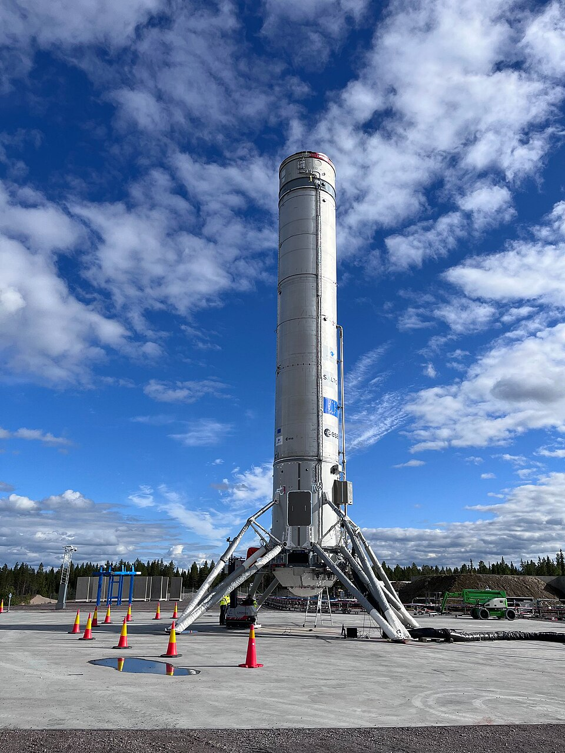
But the biggest ‘unknown’ is ESA’s Themis reusable first stage rocket program, and Europe’s answer to Falcon and Starship. Test flights are planned although the first demo flight- much delayed – is scheduled for this year. But a fully-fledged European rival to SpaceX is some years off.
In other words, SpaceX – in the absence of Blue Origin’s New Glenn – is still dominating the launch sector. ArianeSpace and ESA have their work cut out to catch SpaceX’s industry lead.
