

The European Space Agency (ESA) has awarded German aerospace manufacturer OHB System AG a 102 million euro ($112 million) contract to serve as prime contractor for ClearSpace-1 (CS-1), the agency’s first active space debris removal mission.
Signed on Tuesday, Nov. 17, at Space Tech Expo Europe in Bremen, Germany, and formally announced by ESA on Wednesday, Nov. 18, the agreement establishes prime industrial leadership for the orbital cleanup demonstration while retaining Swiss space sustainability specialist ClearSpace as a core mission partner.
Restructuring Europe’s First Active Debris Removal Demonstration
Originally initiated as an effort to capture and deorbit a Vega Secondary Payload Adapter (VESPA) left in orbit following a 2013 launch, the ClearSpace-1 program underwent a major structural and technical reorganization after that initial target was struck by orbital debris in 2023. Following subsequent architectural reviews under ESA’s Space Safety program, OHB assumed prime industrial leadership to guide the spacecraft through detailed design, assembly, and flight qualification, while ClearSpace continues developing the specialized robotic capture subsystem.
The mission’s capture architecture also informs ClearSpace’s broader commercial servicing portfolio, which recently expanded through a United Kingdom Space Agency award to remove two derelict British satellites. By pairing OHB’s prime spacecraft engineering with ClearSpace’s proximity operations heritage, ESA aims to validate technologies required to remediate non-functional spacecraft across congested low Earth orbit (LEO) corridors.
Autonomous Rendezvous and Controlled Deorbit of PROBA-1
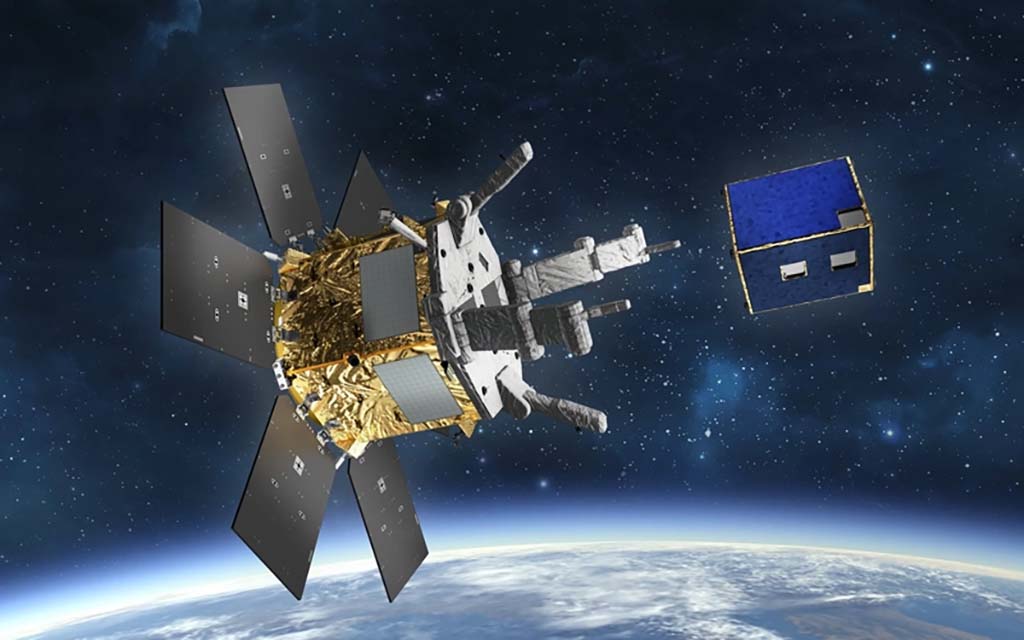
Under the restructured mission profile, the ClearSpace-1 servicer spacecraft will rendezvous with, capture, and safely deorbit ESA’s retired PROBA-1 Earth observation technology satellite, with launch currently scheduled for 2030. Because PROBA-1 was launched in 2001 without standardized docking fixtures or cooperative navigation aids, the ClearSpace-1 servicer must rely on onboard optical and radio-frequency sensors to determine the defunct satellite’s attitude, spin rate, and relative motion during final approach.
Once aligned with the tumbling target, the spacecraft will deploy an autonomous robotic capture mechanism to secure PROBA-1 before executing propulsive maneuvers to lower the combined stack’s orbital altitude. Both the servicer and the captured satellite will then undergo a controlled, destructive atmospheric re-entry, removing the non-operational mass from orbit without generating additional space debris.
Advancing Orbital Sustainability and Servicing Standards
Executing ClearSpace-1 represents a foundational step in ESA’s long-term push to establish circular economy practices in Earth orbit and demonstrate technologies capable of mitigating collision hazards from legacy spacecraft. As OHB leads its international industrial consortium toward Critical Design Review and flight readiness ahead of the 2030 launch window, the program will provide critical operational flight data on uncooperative rendezvous, mechanical grappling, and controlled deorbiting for future European in-orbit servicing missions.
