

WALLOPS ISLAND, VA — NASA’s next landmark leap in commercial space logistics has cleared its final major ground milestone. Engineers at NASA’s Wallops Flight Facility completed the encapsulation of Katalyst Space Technologies’ LINK robotic servicing satellite inside a Northrop Grumman Pegasus XL rocket.
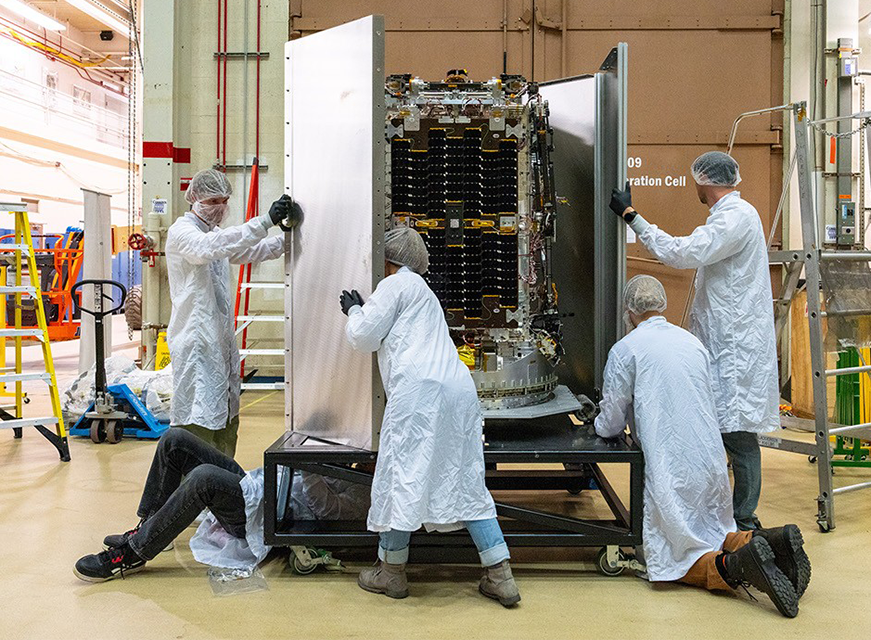
The hardware stack is now being prepared for transport to Kwajalein Atoll in the Marshall Islands, where it will undergo a late-June launch. The high-risk mission marks a watershed moment for the “in-space servicing, assembly, and manufacturing” (ISAM) sector: the first time a commercial operator will attempt to autonomously track, capture, and physically push an unprepared government science asset back into a safe orbit.
The Skyfall: A Half-Billion-Dollar Asset in Peril
The target of this rescue is the Neil Gehrels Swift Observatory, a $500 million space telescope launched in 2004 that serves as the global astrophysics community’s primary “dispatcher” for tracking gamma-ray bursts—the most energetic electromagnetic explosions in the universe. Swift has spent over two decades identifying roughly 100 bursts a year, triggering follow-up observations from ground and space telescopes worldwide.
However, Swift lacks an onboard propulsion system to maintain its altitude. Between late 2024 and early 2026, intense and unpredictable solar activity blasted out high-energy ultraviolet particles that warmed and expanded Earth’s upper atmosphere. The resulting atmospheric swell exerted severe extra drag on Swift, causing its orbit to plummet from a stable 600 kilometers (373 miles) down to approximately 370 km (229 miles).
NASA models projected a 50 percent chance of an uncontrolled, fiery reentry by mid-2026, skyrocketing to 90 percent by the end of the year. To buy time for a rescue plan, the Swift team took the drastic measure in February of disabling two of the observatory’s three telescopes to reduce aerodynamic drag, keeping it above the 300 km threshold required for an orbital boost to remain technically feasible.
Gripping the “Unprepared”
Faced with the permanent loss of a critical scientific asset, NASA took an aggressively risk-tolerant approach. Last September, the agency bypassed traditional multi-year development cycles to award Arizona-based startup Katalyst Space Technologies a rapid $30 million contract to execute an emergency orbital intervention.
The resulting spacecraft, named LINK, is roughly the size of a large mini-fridge, weighing 400 kilograms. The engineering challenge defining the mission is that Swift was never built to be caught or serviced; it lacks docking rings, navigation markers, or grappling fixtures.
To overcome this, LINK is equipped with three highly specialized robotic arms and precision LiDAR ranging sensors. Upon completing autonomous rendezvous proximity operations (RPO), LINK will attempt a non-cooperative docking by mechanically clamping onto the small metal transportation flanges located on Swift’s main structure—rims used strictly for ground handling before the observatory’s launch 22 years ago. Adding to the difficulty, Katalyst CEO Ghonhee Lee noted that no pre-launch photos exist of Swift’s backside, meaning LINK’s autonomous systems must map and adjust to the interface in real time during a close-range flyby.
Once firmly attached, LINK will ignite its three xenon-fueled Hall-effect ion thrusters, counteracting atmospheric drag to push Swift back up to its legacy 600 km altitude, effectively adding a decade or more to the telescope’s operational life.
Why Pegasus Was the Only Choice
The unique parameters of the mission dictated an unusual launch profile. Swift operates at a specific orbital inclination of 20.6 degrees relative to the equator. Reaching this inclination from standard coastal U.S. launch sites requires complex, fuel-heavy dog-leg maneuvers that typical vertical-lift rockets cannot easily execute on short notice.
To circumvent this, Katalyst selected Northrop Grumman’s air-launched Pegasus XL rocket. The rocket will be carried to the South Pacific aboard the Stargazer L-1011 mothership aircraft. By taking off from the Marshall Islands and dropping the Pegasus directly over equatorial waters, the team can inject LINK into Swift’s precise orbital plane with maximum efficiency.
A Blueprint for Hubble and National Security
While the scientific community is watching closely to preserve Swift’s gamma-ray detection capabilities, the broader aerospace industry views the mission as a pilot test for a highly lucrative sovereign ISAM infrastructure.
“This is a forward-leaning, risk-tolerant approach for NASA,” said Shawn Domagal-Goldman, director of NASA’s Astrophysics Division. “Attempting an orbit boost is both more affordable than replacing Swift’s capabilities with a new mission, and beneficial to the nation—expanding the use of satellite servicing to a new and broader class of spacecraft.”
If LINK successfully alters Swift’s trajectory, NASA intends to use the mission parameters as an operational blueprint to salvage the legendary Hubble Space Telescope, whose orbit is also undergoing solar drag-induced decay.
Furthermore, the capability to rapidly intercept, capture, and manipulate an uncooperative satellite holds profound implications for national security. Proving that a commercial startup can go from a contract signing to a physical deep-space robotic intervention in under ten months demonstrates an agile tactical space-responsiveness that the U.S. military is actively trying to mature to defend orbital assets from adversarial threats.
