

On Sunday, August 30, 2026, NASA launched the Nancy Grace Roman Space Telescope aboard a SpaceX Falcon Heavy rocket from Launch Complex 39A at Kennedy Space Center.
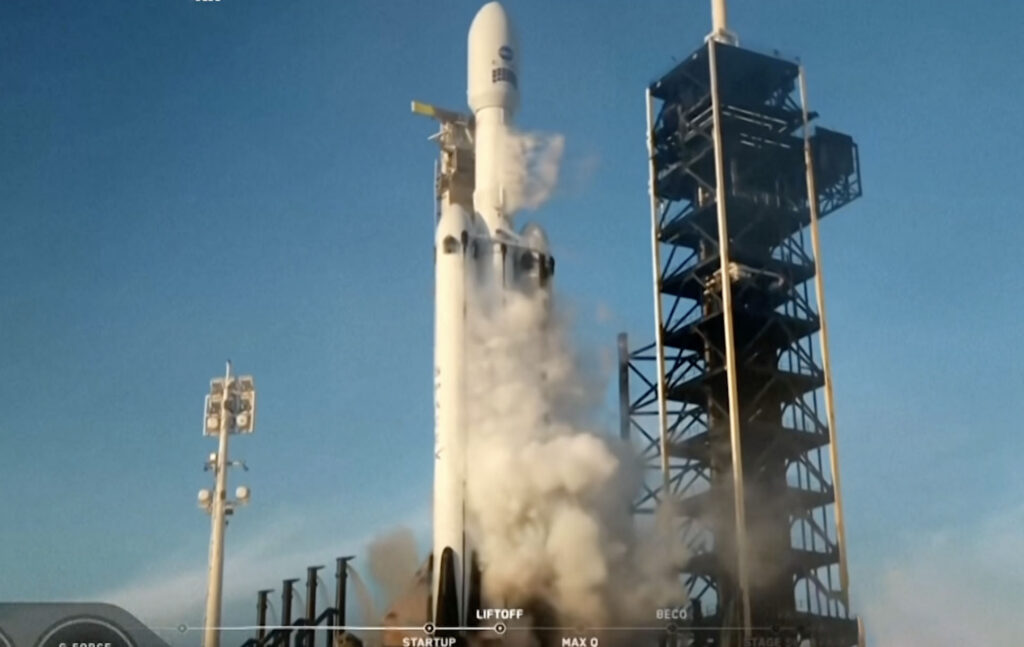
Following orbital insertion, the 4.2-metric-ton astrophysics observatory separated from the launch vehicle’s upper stage to begin a three-month transit toward Sun-Earth Lagrange Point 2 (L2).
Program History and Industrial Integration
Formerly designated as the Wide Field Infrared Survey Telescope (WFIRST), the observatory was named in honor of Dr. Nancy Grace Roman, NASA’s first chief astronomer. The mission represents NASA’s next flagship astrophysics observatory following the Hubble Space Telescope and the James Webb Space Telescope (JWST).
The observatory’s optical components and primary instrument structures were engineered and integrated by BAE Systems Space & Mission Systems in Boulder, Colorado. BAE Systems assumed prime contractor responsibility for the Wide Field Instrument (WFI) optomechanical assembly following BAE Systems’ $5.5 billion acquisition of Ball Aerospace in early 2024.
The launch follows formal Flight Readiness Review approval granted by NASA and SpaceX, which cleared the launch vehicle and spacecraft bus for orbital insertion.
Optical Payload Architecture and Specifications
Built around a repurposed 2.4-meter primary mirror that matches the physical aperture size of the Hubble Space Telescope, the Roman Space Telescope delivers an optical field of view 100 times larger than Hubble’s Wide Field Camera 3.
The spacecraft carries two scientific instrument payloads:
- Wide Field Instrument (WFI): A 300-megapixel focal plane array utilizing 18 mercury-cadmium-telluride (HgCdTe) detectors. The instrument captures optical and near-infrared images across wavelengths from 0.48 to 2.3 microns, covering 0.281 square degrees per exposure.
- Coronagraph Instrument (CGI): A technology demonstration payload featuring active wavefront control and deformable mirrors. CGI suppresses host-star glare by a factor of one billion, enabling direct imaging and spectroscopy of gas giant exoplanets and circumstellar debris disks.
- Spacecraft Bus Subsystems: Incorporates solar array sunshields, hydrazine monopropellant thrusters for trajectory corrections, and active thermal isolation loops designed to maintain the detector arrays at cryogenic operating temperatures near 100 Kelvin.
Cosmological Objectives and Exoplanet Mapping
The primary five-year survey mission focuses on cosmological mapping and stellar microlensing. By observing hundreds of millions of distant galaxies across thousands of square degrees, Roman will measure weak gravitational lensing and galactic clustering to constrain dark energy models and trace the distribution of dark matter across cosmic time.
Concurrently, the observatory’s galactic bulge survey will monitor 200 million stars in the inner Milky Way, utilizing gravitational microlensing to discover thousands of exoplanets orbiting far from their host stars, including Earth-mass terrestrial worlds and rogue planets drifting through interstellar space.
L2 Transit and Calibration Timeline
Following insertion into a halo orbit around Sun-Earth L2, located approximately 1.5 million kilometers from Earth, the observatory will undergo a 90-day commissioning and calibration phase. During this period, flight controllers will deploy the high-gain antenna, cool the WFI focal plane to cryogenic operating temperatures, align the secondary optical assemblies, and calibrate the CGI wavefront control algorithms prior to commencing science operations in early 2027.
