

GERMANTOWN, Md. — Hughes Network Systems, an EchoStar company, secured a $42.5 million task order on Thursday, Oct. 29, 2026, from the U.S. Space Force Space Systems Command (SSC) to develop and deploy automated Enterprise Management and Control (EM&C) architecture across defense communications networks.
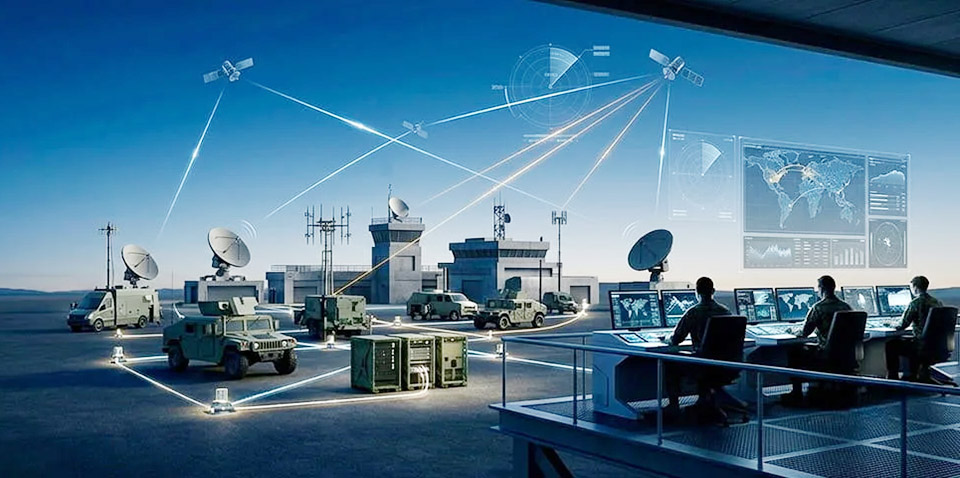
The award tasks Hughes with delivering unified multi-orbit operational control software that bridges military and commercial satellite communication systems into a synchronized tactical network.
Tactical Multi-Orbit Integration and Dynamic Failover
Under the task order, Hughes will integrate its Terminal Management Agent (TMA) software and automated resource-sharing algorithms into deployed military user terminals and enterprise ground nodes. The system provides real-time situational awareness across heterogeneous orbital regimes, allowing tactical transceivers to switch traffic among geostationary orbit (GEO), medium Earth orbit (MEO), and low Earth orbit (LEO) constellations. By monitoring radio frequency interference and throughput degradation, the EM&C software reroutes mission-critical data streams across alternative orbital pathways within milliseconds if a primary link encounters electronic jamming or physical disruption.
The technical architecture interfaces directly with the Department of Defense’s Combined Joint All-Domain Command and Control (CJADC2) infrastructure. Tactical field units operating Hughes HM-series modems and standard software-defined tactical radios will gain automated failover capability without requiring manual realignment of directional satellite dishes or manual entry of alternate satellite access requests. Ground segment software nodes will continuously poll link health, latency metrics, and packet error rates, automatically selecting optimal paths based on pre-programmed operational mission priorities.
Operational Heritage and Defense SATCOM Modernization
The EM&C development expands on prior defense initiatives undertaken by Hughes to modernize tactical communications for joint expeditionary operations. In 2021, the U.S. Air Force selected Hughes as a prime contractor under the Advanced Battle Management System (ABMS) indefinite-delivery/indefinite-quantity framework, where the company first integrated its Terminal Management Agent to establish resilient multi-transport networking for distributed command operations. That effort verified that policy-based automated routing algorithms could manage fluctuating RF environments across dispersed operating bases.
The contractor further matured its military network integration capabilities through subsequent defense programs, including a Department of Defense contract to deploy standalone 5G networks across naval air stations and an Army award to deploy 5G Open RAN infrastructure at military installations. The new SSC task order transitions those standalone enterprise routing protocols into a unified command-and-control framework capable of orchestrating military satellite constellations, such as the Wideband Global SATCOM (WGS) fleet, alongside commercial LEO and GEO networks. The platform aligns with the Commercial Satellite Communications Office (CSCO) strategy to integrate commercial capacity into military architectures.
Executive Perspective on Communications Resilience
“Securing resilient, uninterrupted connectivity across contested operational environments requires moving beyond stovepiped satellite architectures,” said Rick Lober, vice president and general manager of the Hughes Defense & Intelligence Systems Division. “This Space Systems Command award validates our automated management and control capabilities, enabling tactical operators to access commercial and military capacity seamlessly. By applying policy-based automated routing across GEO, MEO, and LEO networks, we ensure warfighters maintain mission-critical data links despite severe electronic interference or localized orbital node degradation.”
Lober noted that modern tactical theaters demand software-defined versatility to outpace adversary electronic warfare capabilities, ensuring joint forces remain synchronized during multi-domain maneuvers.
Demonstration Schedule and Pacific Field Trials
Hughes and Space Systems Command plan to initiate laboratory hardware-in-the-loop validation at SSC integration facilities in El Segundo, California, during the first quarter of 2027. The laboratory phase will evaluate cross-network handover latency, cyber hardening under Zero Trust standards, and protocol compatibility with legacy defense modems.
Following bench testing, operational field demonstrations are scheduled to commence in mid-2027 across U.S. Indo-Pacific Command (USINDOPACOM) regional staging hubs. The Pacific exercises will evaluate dynamic failover performance under simulated contested conditions before widespread terminal software deployment across operational units, establishing a validated operational standard for multi-orbit military communications.
