

By Nick David, Editorial Lead, SatNews
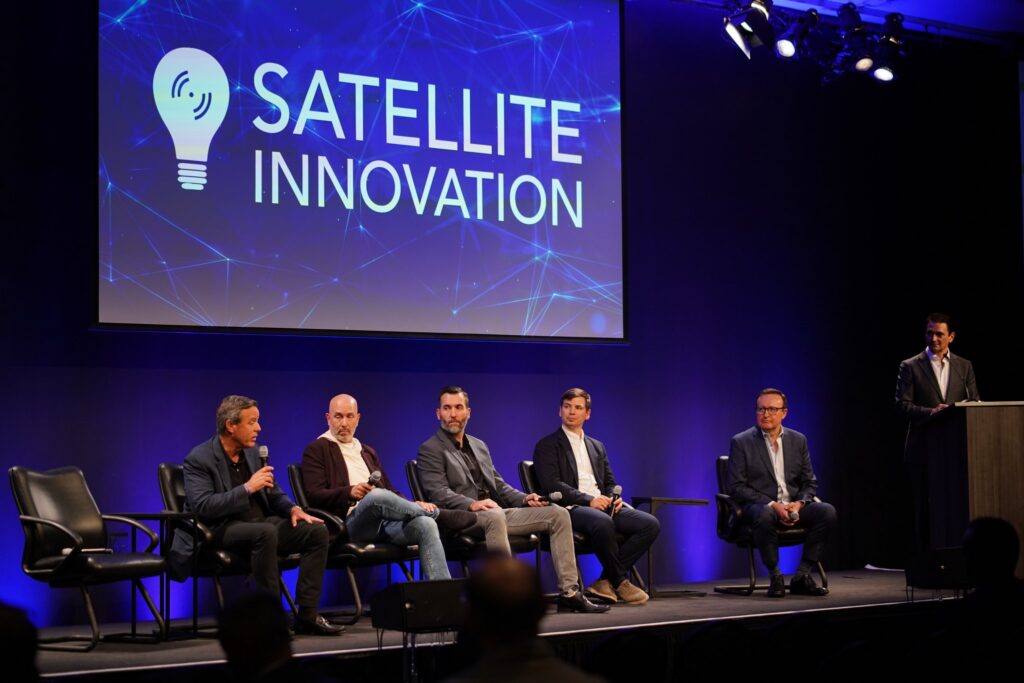
Cowboy Space unveiled its Big Iron rocket on Monday night. On Tuesday, its chief operating officer explained at Silicon Valley Space Week why an orbital data center company decided it had to build one.
Joseph Yaffe, Cowboy’s chief operating officer and chief legal officer, was picking up a point from fellow panelist Slava Turyshev of NASA’s Jet Propulsion Laboratory. “Slava said something really, really critical,” Yaffe said, agreeing that launch is “probably the single biggest bottleneck in this industry.” If you’re looking to ride along with others, he said, “that availability is dwindling, if not gone, in the very short term.”
Yaffe spoke on the Satellite Innovation panel “Orbital Data Centers: Investable Infrastructure or Thermodynamic Bet?,” moderated by Dara Panahy, a partner at Milbank. The panel also included Jason Aspiotis, CEO and co-founder of OwlO Cloud; Rob DeMillo, CEO and co-founder of Sophia Space; and Filip Rezabek, co-founder and CTO of SpaceComputer, an exhibitor at the event.
The rocket is the data center
Big Iron’s upper stage doesn’t come back. It stays in orbit and becomes a megawatt-class data center. Payload reported that the 86-meter, stainless-steel vehicle is designed to put more than 15,000 kilograms into sun-synchronous orbit on nine methane-fueled Clydesdale engines, with a first flight targeted for 2028.
On stage, Yaffe described the deployed upper stage with radiators about 60 meters across and solar arrays about 100 meters wide. “It’s a big object, a very large object, and it requires medium lift launch capacity,” he said.
The economics, he said, come down to two things: bringing launch in-house, and putting as much revenue-producing hardware into orbit per launch as possible. “A megawatt of power per launch allows you to put effectively five NVL72 racks on board,” Yaffe said, referring to Nvidia’s rack-scale GPU systems.
Cowboy also plans to open Big Iron to outside customers whose payloads need up to a megawatt, a service Payload reported it calls Big Iron Express.
Other views on the panel
Not everyone on the panel was working to Cowboy’s clock. The moderator summed up Turyshev’s view as tangible results in about five years and a reliable commercial network in seven to 10.
Financing is part of the challenge, too. Asked about the debt SpaceX has lined up to buy GPUs, Yaffe said “it’s a lot easier to finance things that don’t burn up on re-entry,” though he said Cowboy is exploring alternatives.
Regulators are still asking questions. In an Aug. 28 deficiency letter on Cowboy’s Stampede filing for up to 20,000 satellites, the FCC’s Space Bureau asked the company for details including its satellites’ dimensions, as SatNews reported in September.
Yaffe framed the industry’s question as no longer whether orbital data centers will happen, but what the best design is. Cowboy has now shown its answer. Its first satellite, Reason-1, launched Oct. 1 on SpaceX’s Transporter-18, and Payload reported the company tested part of a Clydesdale engine at NASA’s Stennis Space Center last week.
About the Author
A storyteller at heart, Nick David covers space policy, satellite markets, defense, and the technologies reshaping how humanity operates beyond Earth. With a background in creative direction, brand strategy, and editorial storytelling, he brings a modern lens to complex subjects and a relentless curiosity about what comes next.
