

SpaceX initiated the atmospheric reentry of its Starship Flight 15 upper stage, designated Ship 42, on Saturday, Nov. 14, directing the spacecraft back toward its Starbase launch complex in South Texas for the company’s first attempt to catch an orbital-class upper stage with its launch tower arms.
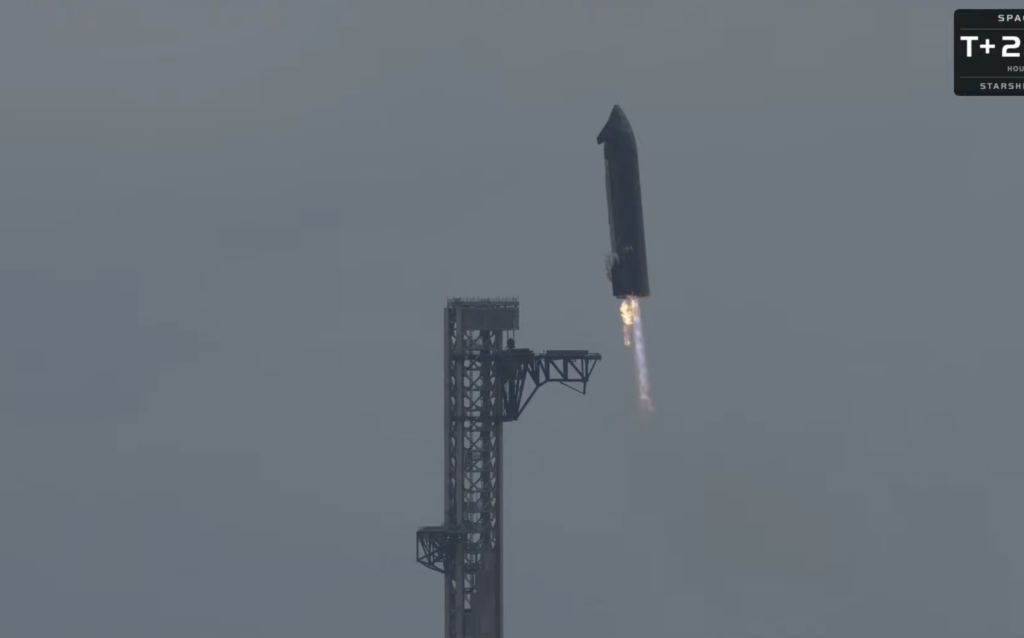
The return maneuver follows the vehicle’s liftoff from Starbase’s Orbital Launch Pad 2 on Friday, Nov. 13, at 5:47 p.m. Eastern Standard Time (EST).
Flight 15 Mission Progression and Booster Divert
Starship Flight 15 builds on the program’s inaugural orbital test flight in September 2026, advancing SpaceX’s campaign toward full two-stage launch vehicle reusability. Following stage separation on Nov. 13, Super Heavy Booster 22 initiated its return burn toward Starbase before its guidance, navigation, and control (GNC) system detected an off-nominal position and executed an automated abort, diverting the first stage to an offshore splashdown in the Gulf of Mexico.
Meanwhile, Ship 42 achieved nominal orbital insertion and entered a coast phase spanning roughly 14 orbits over 22.5 hours.
Orbital Payload Deployment and Thermal Reentry Profile
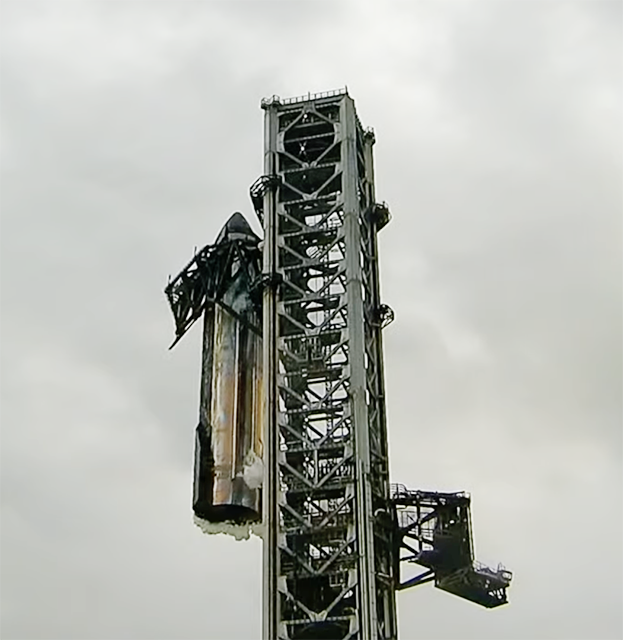
Operating in low Earth orbit (LEO) at an altitude of approximately 275 kilometers, Ship 42 deployed 26 next-generation Starlink V3 satellites—including three units equipped with external cameras to inspect the spacecraft’s thermal protection tiles in orbit. After evaluating telemetry and heat shield posture mid-mission, flight controllers waived off an alternate ocean splashdown off the coast of Chile and authorized the return to Texas.
Ship 42 executed its deorbit burn at approximately 3:23 p.m. EST on Nov. 14, entering peak atmospheric entry heating ahead of its terminal descent toward the launch tower’s mechanical capture arms.
Reusability Cadence at Starbase
Demonstrating precision upper-stage capture at the launch pad is central to reducing refurbishment timelines and scaling flight operations at Starbase, where SpaceX has requested Federal Aviation Administration (FAA) authorization to expand launch cadence. Post-flight inspections of Ship 42 and Booster 22 telemetry will inform hardware refinements for upcoming orbital deployments.
