

By Nick David, Editorial Lead, SatNews
The military’s narrowband satellite system was supposed to start fading around 2030. Now it’s getting two more satellites and a life that could stretch to 2040.
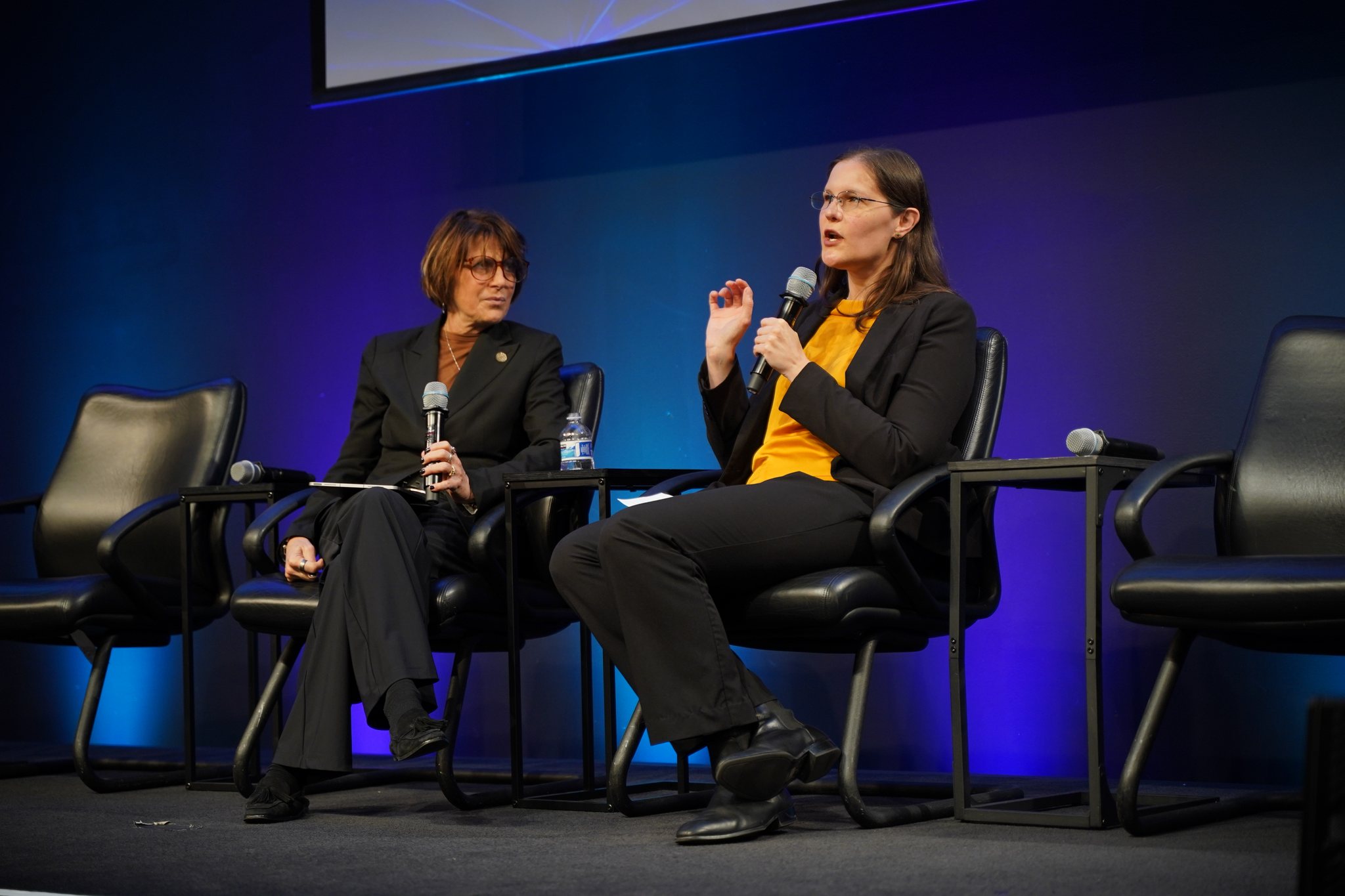
Katherine Coens, senior materiel leader for the Mobile User Objective System at Space Systems Command, laid out the plan Thursday in an interview with retired Maj. Gen. Kimberly Crider of ElaraNova to open the second day of the MilSat Symposium at Silicon Valley Space Week.
MUOS today is a five-satellite constellation in GEO that provides narrowband “double hop” communications and connects back into the Department of War’s IT ecosystem. Under the service life extension program, users essentially told the Space Force they want more of the same, Coens said. “Our contract is two more satellites and upgrades to the ground system so that the system that is currently slated to start diminishing in capability in about 2030 can go out to 2035, even 2040.”
Not a direct-to-device problem
Coens pushed back on the idea that commercial direct-to-device service can stand in for MUOS. Troops in the field don’t want a signal that “basically chirps to the enemy, ‘Hey, I’m right here, come find me,’” she said. MUOS is designed for a lower probability of detection.
Where industry fits
The big constraint is terminals. Any new approach has to work without doing too much damage to the terminals already fielded, Coens said, because the joint services own them and nobody wants to pay to replace them all.
AFRL is running a rapid program to study whether MUOS-style narrowband can be delivered from MEO, and an RFI is already out. Coens said she fully expects more to follow: “RFIs and industry days and reverse industry days over the next year to 18 months.”
She also asked industry for “lightweight, adaptable terminal packages that allow unmanned systems to monitor and process as many diverse signal sets as possible.” What troops want, she said, is as many options and paths in as small a form factor as possible.
Crider, the Space Force’s first chief technology and innovation officer, pressed the same point during the interview: without solving the terminal problem, for the U.S. and its allies alike, narrowband modernization won’t get as far as it needs to.
About the Author
A storyteller at heart, Nick David covers space policy, satellite markets, defense, and the technologies reshaping how humanity operates beyond Earth. With a background in creative direction, brand strategy, and editorial storytelling, he brings a modern lens to complex subjects and a relentless curiosity about what comes next.
