
By Nick David, Editorial Lead, SatNews
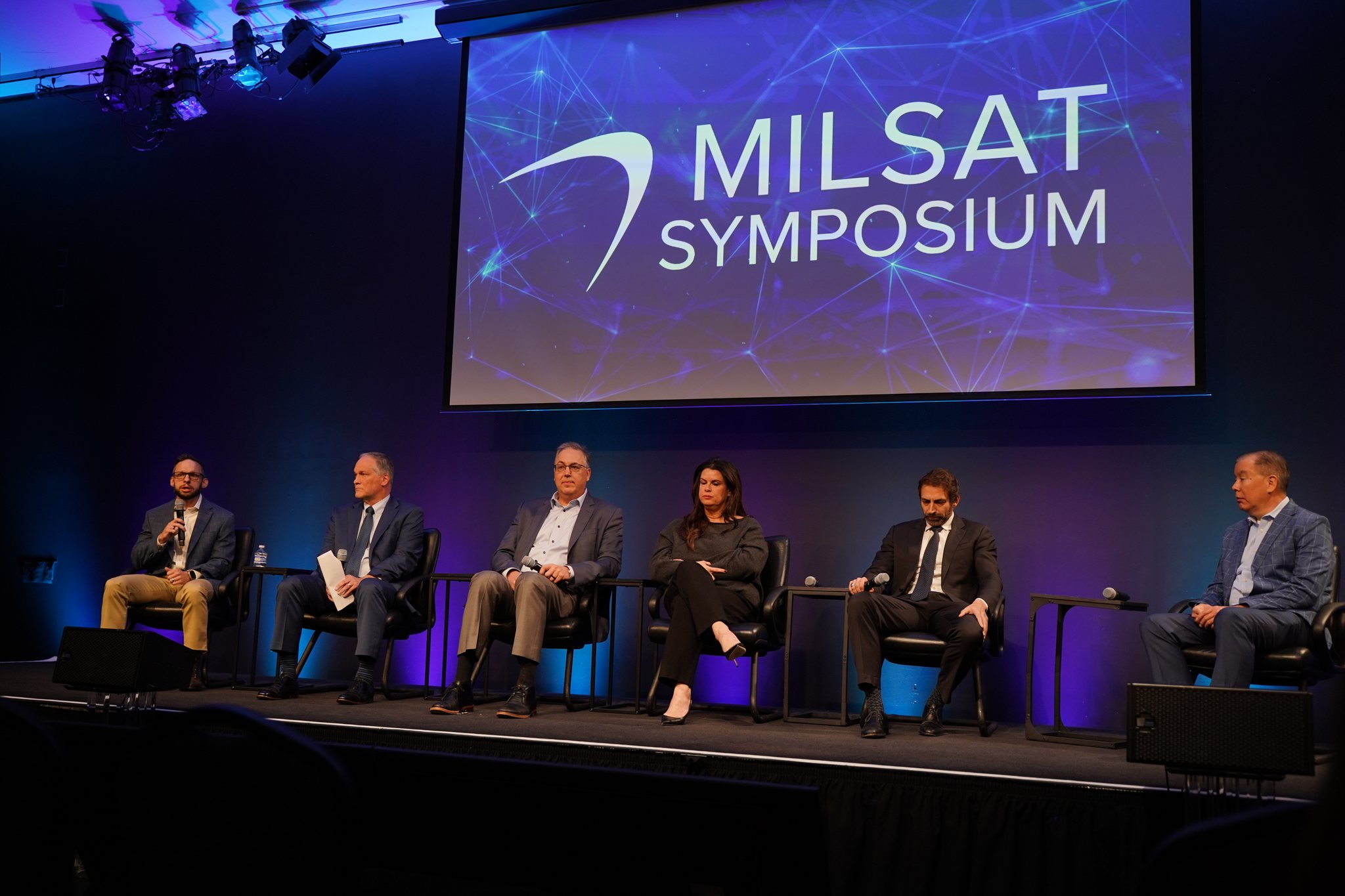
Golden Dome has its money and its program manager. What it doesn’t have yet, according to a former Pentagon policy chief, is bipartisan support.
“Bipartisan support has not really been built for Golden Dome for America,” Momentus Chairman and CEO John Rood, a former under secretary of defense for policy, said Thursday on the MilSat Symposium panel “Golden Dome: Accelerating Industrial Capability on a 2028 Clock” at Silicon Valley Space Week.
The Pentagon puts the architecture’s cost at $185 billion, with a first capability due in 2028. Rood said the program is “very early still,” perhaps “chapter two or three” of the journey. He gave it credit for the structure: a single program manager with unusual authorities, modeled on Gen. Bernard Schriever’s ICBM effort, and funding that came through reconciliation rather than the regular budget.
That funding path is also the exposure. Congress is late passing this year’s budgets, Rood said, and “we’re going to have probably a big omnibus after the election,” with the outcome anybody’s guess. He called it “a very fraught journey, like the history of missile defense has been since the world’s first missiles in the ’40s.”
“On track for the 2028 demo”
Jen Ross, who runs the consultancy Breakwater Strategies and helped stand up the Space Force’s Commercial Space Office, saw it differently. She said she believes Golden Dome is on track for the 2028 demo, and that much of the technology needed for that milestone already exists.
She credited the program office with moving money quickly into the right hands, and doubted the politics would stop it. “I don’t know if the word golden will always be in the front of dome,” Ross said, “but I wouldn’t think that any politician would go, ‘Let’s not protect the homeland today.’”
The integration problem
Joe Rickers of Lockheed Martin’s space business pointed to data and interconnectivity as the gap to close, across systems built separately for years. Other panelists agreed that the hard part isn’t engineering so much as connecting components bought under older contracts that never required open interfaces or shared telemetry.
Phil Carrai, president of the space, training and cyber division at Kratos, moderated. The panel also included David Baughman of thruster maker Frontier Aerospace, Ian Eishen of Aalyria Technologies and John Trionfo of Aeonyx.
About the Author
A storyteller at heart, Nick David covers space policy, satellite markets, defense, and the technologies reshaping how humanity operates beyond Earth. With a background in creative direction, brand strategy, and editorial storytelling, he brings a modern lens to complex subjects and a relentless curiosity about what comes next.