

Financial market disclosures released in early October 2026 highlighted shifting competitive dynamics across the commercial space sector as Rocket Lab USA pursues dual operational tracks: challenging civil space contract awards while expanding its satellite network footprint.
Following a September 11, 2026 formal bid protest challenging NASA’s $700 million Mars Telecommunications Network (MTN) award to Blue Origin, Rocket Lab secured shareholder approval on September 24, 2026, to advance its $8 billion acquisition of Iridium Communications. The dual developments underscore Rocket Lab’s strategy to compete across launch, spacecraft manufacturing, and active satellite constellation operations.
Mars Infrastructure Procurement and GAO Bid Protest
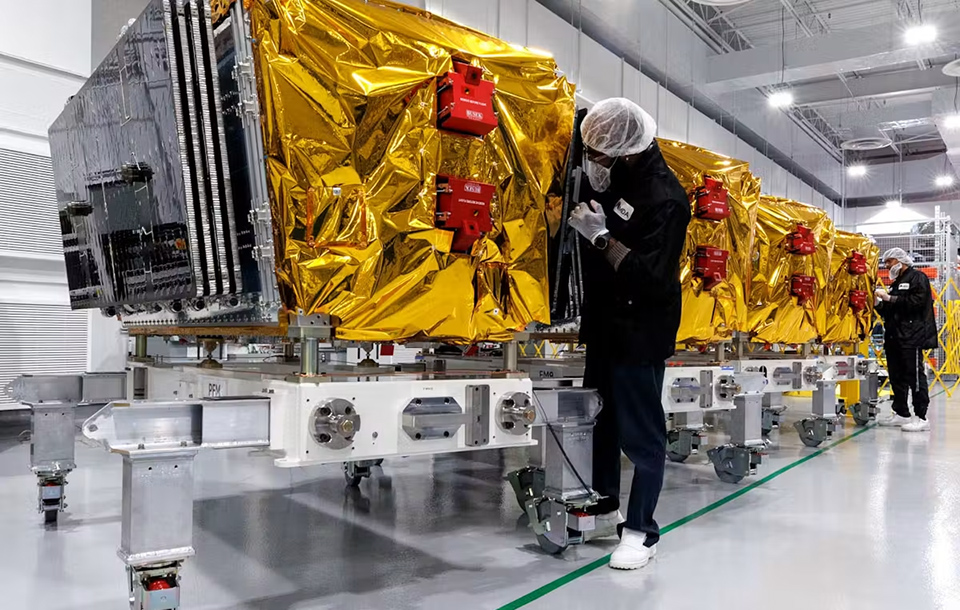
In May 2026, NASA issued a Request for Proposals (RFP) for the Mars Telecommunications Network, seeking commercial satellite architectures to establish high-bandwidth orbital data relay capabilities between Earth and Martian surface assets. NASA selected Blue Origin for an estimated $700 million contract to build, launch, and operate a single Mars Telecommunications Orbiter (MTO) no later than December 31, 2028, with full network operations targeted for 2030. Blue Origin’s MTO design relies on its internally developed Blue Ring spacecraft bus, supported by plans to scale manufacturing capacity up to four Blue Ring units annually.
On September 11, 2026, Rocket Lab filed a formal bid protest with the U.S. Government Accountability Office (GAO) challenging the award. In its filing, Rocket Lab alleged that NASA’s evaluation process violated statutory eligibility criteria and competitive procurement standards mandated by Congress for commercial deep-space infrastructure. The filing triggered an automatic statutory stay on contract performance while the GAO conducts a review, with a decision expected by mid-December 2026. The review timeline introduces potential schedule constraints ahead of the 2028 Earth-Mars launch window, which occurs once every 26 months.
Vertical Integration and Constellation Scale
While pursuing legal remedies for the Mars orbiter program, Rocket Lab advanced its satellite network integration strategy. On September 24, 2026, Iridium Communications shareholders approved Rocket Lab’s $8 billion acquisition of Iridium with 99.6% of votes cast in favor. The transaction, funded in part through a $1.944 billion share issuance, transforms Rocket Lab into an end-to-end space systems provider operating an active constellation of approximately 80 cross-linked low Earth orbit (LEO) satellites.
By bringing satellite manufacturing, payload integration, and launch operations under a single corporate umbrella, Rocket Lab aims to lower long-term constellation replenishment costs. CEO Peter Beck estimated that Rocket Lab could manufacture a replacement LEO constellation comparable to Iridium’s legacy $3 billion network for approximately $350 million using internal assembly lines and modular bus platforms.
Competitive Dynamics and Launch Market Shift
The company’s expansion occurs amid shifting launch market dynamics. SpaceX continues to maintain high launch volumes, reporting 12 million Starlink subscribers at the end of the second quarter of 2026 and $4.29 billion in connectivity revenue—a 66% year-over-year increase. However, as SpaceX focuses internal launch capacity on deploying its proprietary constellation and curtails new commercial rideshare missions on Falcon 9, third-party constellation operators face tighter launch availability.
Rocket Lab addresses this market gap by offering bundled satellite manufacturing and launch packages for commercial and government clients. While its medium-lift Neutron rocket remains under development, Rocket Lab’s Electron launch vehicle recently surpassed ten years of operations from its Launch Complex 1 in New Zealand, approaching 100 total orbital launches.
Executive Leadership Perspective
Company leadership emphasized that vertical integration provides a distinct competitive advantage over market peers reliant on external launch providers or third-party component suppliers.
“Iridium has built the gold standard in secure, safety-critical global satellite connectivity,” said Sir Peter Beck, Founder and Chief Executive Officer of Rocket Lab. “By marrying Iridium’s deep heritage, trusted infrastructure, and highly sought-after spectrum with Rocket Lab’s extensive and proven launch and manufacturing capabilities, we have the capability to unlock entirely new markets. We will go far beyond maintaining a legacy; we are going to build upon it to pioneer next-generation space applications.”
Adjudication Timeline and Operational Outlook
The GAO’s upcoming mid-December ruling on the Rocket Lab bid protest challenging the $700M Mars orbiter award will determine whether NASA must re-evaluate proposals for the Mars Telecommunications Network or proceed with Blue Origin’s Blue Ring platform. Concurrently, Rocket Lab plans to complete the financial closing of the Iridium acquisition to integrate constellation operations and scale satellite bus production across its manufacturing facilities.
