
By Nick David, Editorial Lead, SatNews
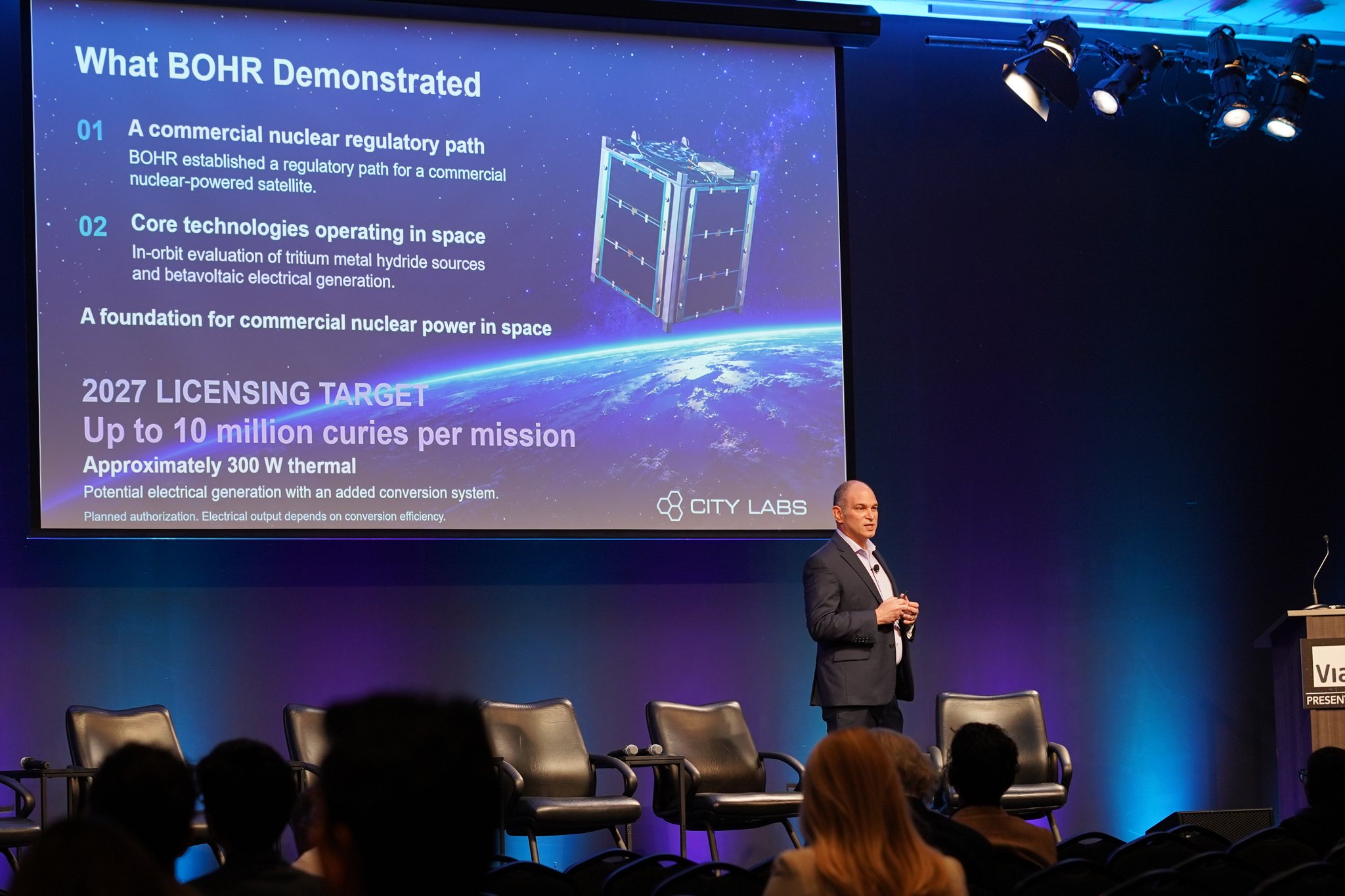
City Labs flew 20 curies of tritium on its first nuclear-powered satellite. It now wants approval for 10 million.
“We’re submitting right now to the FAA an application for 10 million curies. That’s 300 watts thermal,” Peter Cabauy, co-founder and CEO of City Labs, said Thursday in a technical brief at Silicon Valley Space Week’s MilSat Symposium. The company is working with Sandia National Laboratories, which runs the nuclear safety analysis, “so that we can compete and supplement what’s being done with plutonium heat sources today.”
Speaking with SatNews after the talk, Cabauy said City Labs talks with the FAA every two weeks and expects to make the formal submission in December, aiming for approval “sometime next year, summer.” His slide put it as a 2027 licensing target of up to 10 million curies per mission.
A heater flight first
Before that, City Labs plans to fly a tritium heater next year under the approval it already holds. City Labs’ BOHR mission, which the company calls the first commercial nuclear satellite, launched in July under an FAA payload authorization for up to 10,000 curies. “We launched only 20 curies because it was our demonstration,” Cabauy said.
That authorization covers a whole class of devices rather than a single launch. “It’s not like the old days where you just get approval to launch one,” he said. “We approved a class.” City Labs has filed an amendment to add its heat sources to that class, which he hopes to have by January so the heater can fly next year. Each heater unit holds 1,000 curies, he said, and customers can combine them: one gives about 30 milliwatts of heat, and 30 together give a watt.
BOHR is also now public. “A few days ago we put the live telemetry data on BOHR on our website,” Cabauy said, showing its voltage, current and sensor readings.
Surviving the lunar night
Cabauy’s case rests on where solar runs out. “Nuclear should be used whenever you have a situation where solar can’t be used,” he said on stage.
Commercial lunar landers last about 14 days. “Then the night comes in, and $400 million is lost,” he said. “We need nuclear on the Moon.” Keeping a lander warm through the night with batteries is costly, he told SatNews. “For every watt of heat, it’s five kilograms. It’s a misuse of mass and volume.” A tritium heater, he said, can do the same job with a tiny fraction of that mass.
Modular where plutonium isn’t
Plutonium can’t fill the gap at scale, Cabauy argued. It’s difficult to produce, and nuclear-powered launches have averaged about one every five years. Plutonium sources are also clad heavily so they can survive an accident. With tritium, he said, the FAA is letting City Labs build in small modules placed only where heat is needed, such as a single chip or battery.
“This will be able to dial in in small increments and do something the plutonium can never do,” he said.
The regulatory path opened in 2019, when National Security Presidential Memorandum 20 allowed commercial companies to launch nuclear radioisotopes without a presidential signature for each mission. City Labs was the first to use it, which Cabauy credited to 20 years of work making its betavoltaic batteries safe enough for an NRC general license.
About the Author
A storyteller at heart, Nick David covers space policy, satellite markets, defense, and the technologies reshaping how humanity operates beyond Earth. With a background in creative direction, brand strategy, and editorial storytelling, he brings a modern lens to complex subjects and a relentless curiosity about what comes next.