

By Nick David, Editorial Lead, SatNews
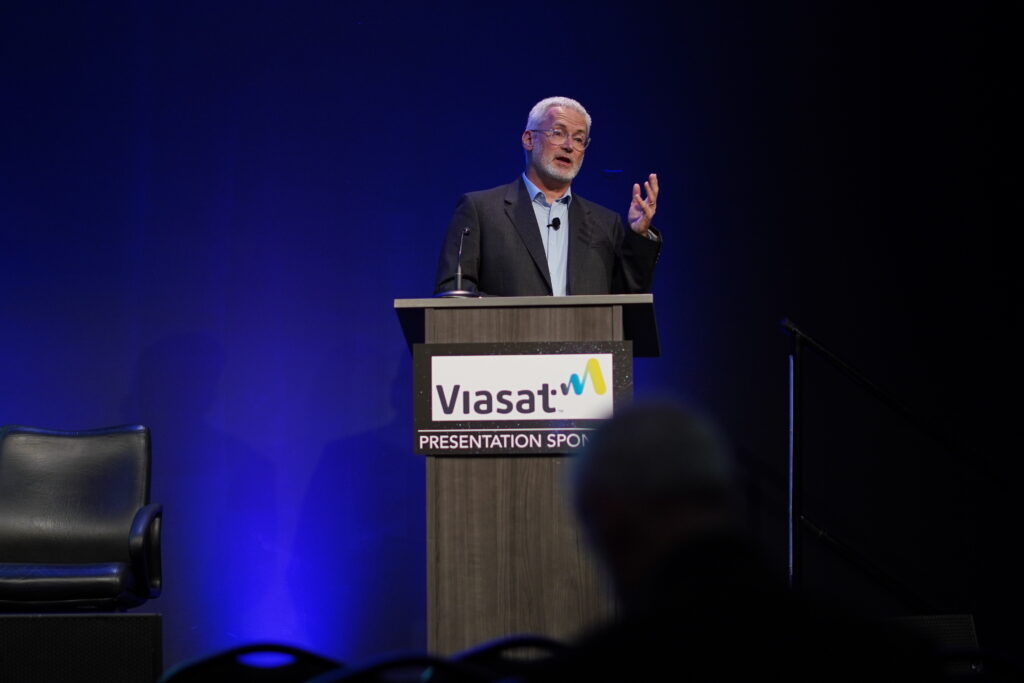
Direct-to-device has users. What it doesn’t have yet, according to Tim Farrar, is a clear way to get them to pay.
“The telcos have really started to conclude that relatively few people are going to pay for direct-to-device service. It’s not a service differentiator,” Farrar, president of TMF Associates, said in a market brief Tuesday on the Satellite Innovation track at Silicon Valley Space Week in Mountain View, Calif.
His talk landed on the same day the FCC approved Amazon’s purchase of Globalstar, the $11.57 billion deal announced in April and built largely around satellite-to-phone service. Farrar said it wouldn’t be a surprise to see Amazon make more moves into direct-to-device “because the telcos so desperately need partners there.”
The usage numbers
Farrar ran through the evidence. On SpaceX’s third-quarter call, President Gwynne Shotwell cited “22 million monthly users on Starlink Mobile.” Farrar said that figure counts anyone who uses the service at least once a month, “which is not very good for a service that now has a couple of hundred million people with access to the service.” Fewer than 10% of people with access use it in a given month, he said, and T-Mobile has given statistics suggesting about two megabytes a day of use.
Revenue is harder to judge. “We don’t know because Starlink stopped giving us the numbers, which doesn’t inspire a lot of confidence in the size of this opportunity,” Farrar said.
T-Mobile has told investors that after a year, pretty much no one is buying satellite service as a standalone product, he said, though he cautioned that the carrier is in a fight with Starlink and its claims should be taken “with a slight pinch of salt.” Apple, which launched Emergency SOS via satellite with Globalstar in 2022, has sold “pretty much no extra phones” because of it, Farrar said.
Why “anywhere” doesn’t sell
Some of the problem is physics. In place of a high-gain antenna on a roof, Farrar said, direct-to-device relies on “your everyday phone in your pocket that’s trying to communicate with a satellite hundreds of miles up in space, as opposed to a tower a mile down the road.”
The rest is expectations, a lesson the industry has been taught for 30 years, he said. In a 2009 survey by TerreStar Networks, the U.S. operator that filed for bankruptcy in 2010, 20% to 40% of people said they would pay for a phone that works anywhere, depending on the price. TerreStar ended up with about 2,000 users after launching its service, Farrar said.
“People don’t get what anywhere means. They think it means in the subway,” he said. In practice, people use direct-to-device in national parks. “If I fall over and break my leg, I really want to be able to get someone to rescue me. But I don’t want to pay for it every month to do that,” Farrar said.
Who pays, and how much
Carriers are thinking about bundling satellite access into monthly plans, which raises the question of what they will pay providers. Farrar described a spread. Apple’s service is free to iPhone users and, spread across hundreds of millions of phones a year, cheap to provide. Cheaper systems still being built could work if carriers only want to pay a few tens of cents. Providers including Starlink and AST SpaceMobile want a dollar or more a month, and if consumers won’t pay more, he said, carriers can’t absorb that much extra cost.
The dispute has reached the terrestrial network, too. Farrar pointed to SpaceX’s push to build its own cell sites and the opposition from Verizon, AT&T and T-Mobile. Musk doesn’t like to back down, Farrar said. “He’s always spoiling for a fight, and this fight is going to run and run.”
For smaller players, Farrar’s advice was to stay out of that fight. He named satellite connectivity built into cellular IoT chipsets, along with PNT, safety services, search and rescue, and RF monitoring, as markets that don’t require taking on Starlink head-on or depend on massive numbers of cheap terminals.
The industry side of the D2D debate came on Wednesday, when Aashu Virmani, senior vice president at Cambridge Consultants, moderated “Orchestrating the D2D Network of Networks” with Iridium CTO Greg Pelton, Skylo co-founder and Chief Business Officer Tarun Gupta, Joby Aviation Vice President Greg Ewert, and Jason Trembley of Terrestar Solutions and the Mobile Satellite Services Association.
Cambridge Consultants is a sponsor of Silicon Valley Space Week, which SatNews produces.
About the Author
A storyteller at heart, Nick David covers space policy, satellite markets, defense, and the technologies reshaping how humanity operates beyond Earth. With a background in creative direction, brand strategy, and editorial storytelling, he brings a modern lens to complex subjects and a relentless curiosity about what comes next.
