

On Thursday, August 27, 2026, NASA announced that astronaut Lt. Cmdr. Jonny Kim has departed the civilian space agency to return to full-time active military duty with the U.S. Navy.
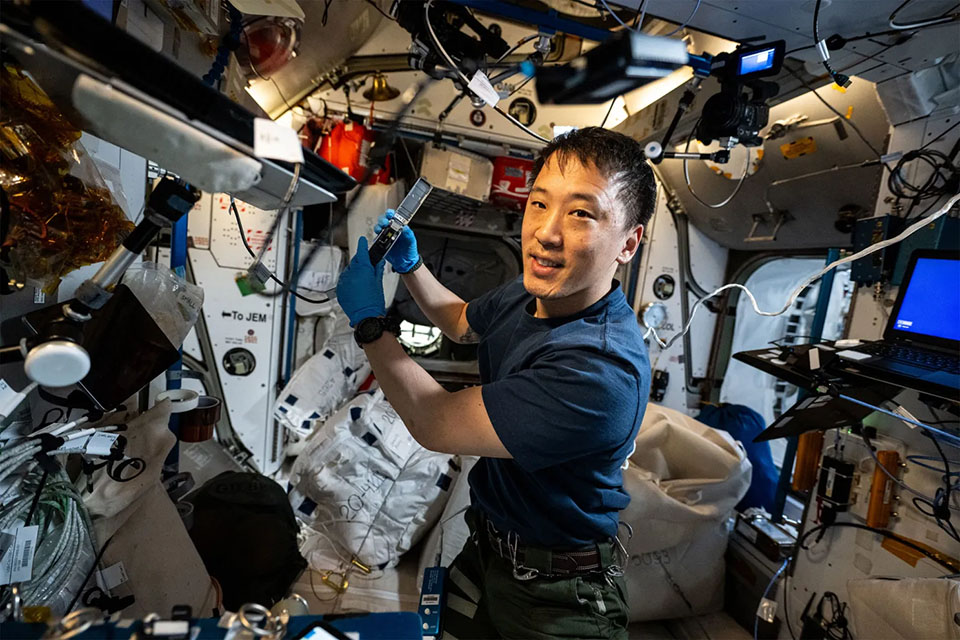
His departure highlights the ongoing movement of highly specialized operational personnel between civil exploration programs, active defense commands, and the broader aerospace ecosystem.
Career Milestones and Civil Space Contributions
Selected by NASA in the 2017 Astronaut Candidate Class, Kim completed two years of initial astronaut training before qualifying for spaceflight assignments. During his nine-year tenure at NASA, Kim supported ground control operations as a Lead Capsule Communicator (CapCom) in Mission Control Houston and served as the Lead Operations Officer for Expedition 65.
A U.S. Navy lieutenant commander, former Navy SEAL, flight surgeon, and naval aviator, Kim represented the dual-use operational talent that civil space agencies draw from military ranks. His transition back to the Navy follows his assignment as a flight engineer aboard the International Space Station (ISS) as part of Expedition 72/73, where he conducted scientific research, microgravity technology demonstrations, and station maintenance operations.
Civil-Military Interoperability and Industry Talent Pressures
Kim’s return to military service comes at a time when the civil and commercial space sectors are competing for cross-disciplinary technical talent. As civil space agencies execute complex Artemis lunar timelines and commercial operators scale orbital constellations, the aerospace sector continues to navigate a high-demand labor environment.
Industry workforce data indicates that 95 percent of space organizations face recruitment or retention challenges, with operational aerospace and software skill sets facing the highest competition. The demand for personnel capable of operating across both military and civilian domains has intensified as national security space architectures expand in tandem with commercial LEO infrastructure.
This human capital competition is not unique to Western space agencies. Civil institutions globally are taking policy measures to preserve operational continuity; for instance, India’s Department of Space enacted directives after ISRO experienced high-level personnel exits to commercial space startups. For NASA, detail agreements with the Department of Defense provide a structured pipeline for military officers to serve as active astronauts before returning to operational military commands.
Operational Rationale for Active Duty Transition
The transition of active-duty military astronauts back to their parent armed services remains an established component of military career paths. Officers detailed to NASA fulfill specialized service obligations while building experience in human spaceflight operations, complex systems engineering, and crisis management.
Upon returning to the U.S. Navy, Kim brings multi-domain operational experience back to active fleet duties. His background—combining combat leadership, aerospace medicine, naval aviation, and long-duration spaceflight—aligns with active defense initiatives focused on integrated multi-domain operations and high-altitude flight safety.
Future Astronaut Corps Pipeline Outlook
NASA continues to manage active astronaut rotations through active recruitment cycles and inter-agency detailing agreements with the U.S. Armed Forces. As the agency prepares for Artemis lunar landing missions and transitions low Earth orbit research toward commercial space stations, NASA will rely on continued military detailing agreements to maintain operational pilot and mission specialist capacity across its active astronaut cadre.
