

As orbital computing initiatives—such as Google’s Project Suncatcher demonstration and mega-constellation deployments—accelerate data generation in orbit, traditional radio-frequency (RF) communication infrastructure faces severe spectrum congestion and physical throughput limits.
/
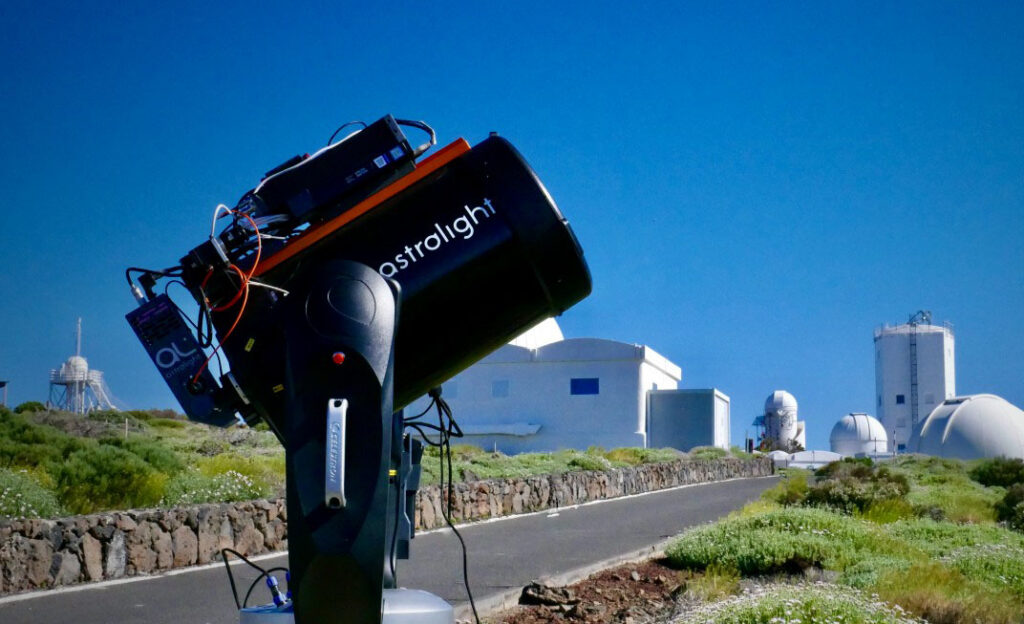
To bypass finite RF bandwidth, European space and defense technology firm Astrolight is scaling its integrated optical communications portfolio, deploying flight-ready laser terminals and automated optical ground stations (OGSs) to create an end-to-end optical network for high-capacity space-to-Earth data transfer.
Technical Parameters and Ground Network Infrastructure
Laser communications utilize tightly focused beams of infrared light—typically operating in the 1550-nanometer wavelength band—to transmit data at rates up to 100 times higher than traditional RF links within equivalent power and mass constraints. Because laser transmissions operate outside the regulatory scope of the International Telecommunication Union (ITU), optical systems eliminate multi-year spectrum coordination delays while offering physical resilience against electronic jamming and interception.
Astrolight’s end-to-end architecture pairs spaceborne user terminals with a growing network of global ground segment assets:
- Spaceborne Terminals: Astrolight’s low-SWaP (size, weight, and power) ATLAS terminals feature integrated Coarse Pointing Assemblies (CPA) designed to operate on small-satellite buses without requiring complex attitude control systems.
- Mediterranean Ground Node: The company established an operational optical ground station in Greece equipped with an 808-nanometer laser beacon and C-band optical receiver delivering data reception speeds up to 2.5 Gbps under variable atmospheric conditions.
- Arctic Ground Expansion: Under an agreement supported by the European Space Agency (ESA), Astrolight is developing an additional optical ground station in Greenland to provide high-latitude ground coverage for polar-orbiting constellations.
Institutional Integration and Tactical Demonstrations
Astrolight is integrating its space segment hardware into flagship European space programs, including a partnership with Kepler Communications to deliver the ATLAS-X terminal for ESA’s HydRON Element 3 mission. The project aims to establish an operational, high-capacity optical transport network across multi-orbit satellite constellations and ground networks.
“Working with Kepler on HydRON Element 3 gives us a valuable opportunity to validate ATLAS-X in orbit and bring customers closer to a terminal that supports high-capacity and secure data transmission,” noted Laurynas Mačiulis, Chief Executive Officer of Astrolight.
In addition to commercial and civil initiatives, Astrolight’s optical technology has undergone tactical maritime and defense evaluations, including operational flight demonstrations during NATO’s REPMUS naval exercises and operational trials with the Lithuanian Navy.
Deployment Roadmap
Astrolight is expanding its global optical ground network footprint with plans to deploy additional ground stations worldwide. The company continues system integration and hardware qualification for upcoming orbital flight demonstrations under the ESA HydRON framework, targeting operational multi-orbit laser communications capacity over the coming years.
