

On Wednesday, April 15, 2026, the European Space Agency (ESA) awarded a multimillion-euro contract to a consortium led by Kepler Communications to develop the user-terminal segment of the High-throughput Optical Network (HydRON). Known as Element 3, this phase of the HydRON project focuses on creating a real-world testing environment for optical communication technologies in orbit.
Lithuanian-based Astrolight joins the team as a key technology partner, providing its next-generation ATLAS-X laser communication terminal. The project is part of ESA’s Optical and Quantum Communications – ScyLight program, which operates within the Agency’s Advanced Research in Telecommunications Systems (ARTES) framework.
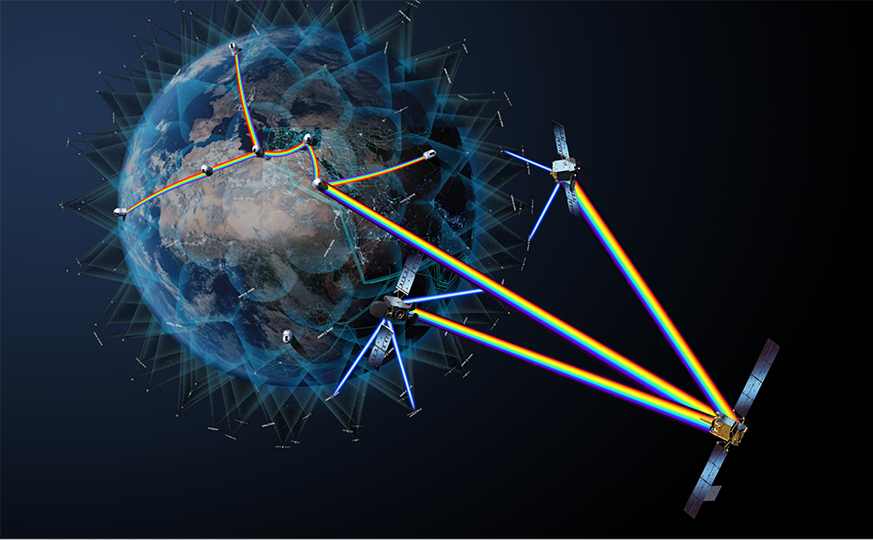
Developing the World’s First Multi-Orbit Optical Transport Network
The HydRON initiative aims to seamlessly integrate space assets into terrestrial fiber networks, creating a high-capacity “internet in the sky.” By establishing secure, interoperable optical data relays, ESA intends to bolster the resilience of European communications infrastructure. Element 3 specifically targets the user segment, demonstrating how commercial operators can connect to and route data through the HydRON network.
Kepler Communications, acting as the mission operator and spacecraft provider, will host the Astrolight hardware aboard its satellites. This mission will validate several critical link types, including inter-satellite and space-to-ground connections in low Earth orbit (LEO), as well as challenging multi-orbit links between LEO and geostationary (GEO) altitudes.
ATLAS-X Technical Specifications and Interoperability
Astrolight’s ATLAS-X terminal is designed to meet the growing demand for low size, weight, and power (low-SWaP) solutions without sacrificing performance. Key features of the terminal include:
- Coarse Pointing Assembly to facilitate easier deployment across various spacecraft buses.
- Compatibility with a subset of the ESA Specification for Terabit/sec Optical Links (ESTOL).
- Full compliance with Space Development Agency (SDA) standards for optical interoperability.
- Versatility for both space-to-space and space-to-ground operational domains.
“Working with Kepler on HydRON Element 3 gives us a valuable opportunity to validate ATLAS-X in orbit and bring customers closer to a terminal that supports high-capacity and secure data transmission,” said Laurynas Mačiulis, CEO of Astrolight.
Executive Perspectives on Optical Infrastructure
The signature of this contract represents a deepening of the collaboration between ESA and commercial industry to deliver terabit-per-second capacity in space. Laurent Jaffart, ESA Director of Resilience, Navigation and Connectivity, noted that Element 3 is a fundamental component for building new industrial capabilities and promoting international cooperation.
Mina Mitry, CEO and co-founder of Kepler, emphasized that interoperable terminals like ATLAS-X are essential for opening space networks to a broader range of users. Kepler, which already operates a commercial optical data relay constellation, will use the mission to further demonstrate real-time, continuous space communications.
Future Vision for In-Orbit Data Centers
Following the initial demonstration phase, the ATLAS-X terminal will serve as a functional data relay node within the HydRON network. This capability is expected to support future applications such as in-orbit data centers and high-security national security communications. By maturing these technologies today, ESA and its industrial partners are preparing for a future space economy where high-speed optical connectivity is as ubiquitous as terrestrial fiber.
