

Chris Forrester — There’s a wonderful scene in the 1963 20th Century Fox movie ‘Cleopatra’. Cleopatra is dead, and the victorious Romans under Gaius Octavian (played by Roddy McDowell) having won the vital sea battle at Aktion (near today’s Lefkada in Greece) have reached Cleopatra’s palace in Egypt. She is dead, and a Roman general reports to Octavian that Mark Antony is with her. “He’s dead”. Octavian say to the soldier: “Is that how one says it? As simply as that. The soup is hot, the soup is cold. Antony is living, Antony is dead.” Octavian shouts at the general: “Shake with terror when such words pass your lips. And if true, for your lifetime boast that you were honoured to speak his name, even in death. The dying of such a man must be shouted, screamed.”
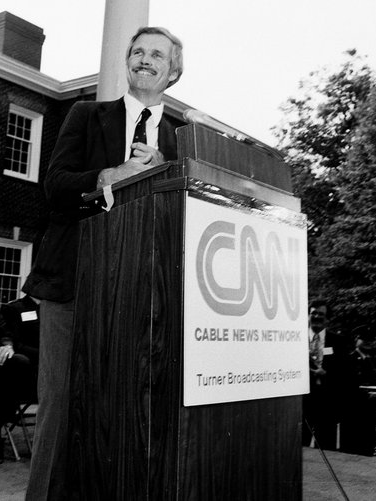
The words came to mind when I heard the news of Ted Turner’s passing. Even though the past few years had been a challenge for Ted his impact on broadcasting and the satellite and cable industries should never be forgotten.
The obituaries were fine enough and many spoke of his own personal tragedies, not least his suicide of his father which forced him to take the reins of the family business. He grew billboard business to bravely buy a struggling UHF station Channel 17 WJRJ-TV which he initially renamed as WTCG (“Watch this channel grow”) and which formed the basis of his future plans. It showed old films, and cartoons. Ted personally introduced some of the films, such was his passion for movies.
His following years have been well documented. Challenging the FCC in 1976 to permit the new named WTCG Super Station to beam via satellite to thousands of cable head-ends and the cash started rolling in. That same year he bought the Atlanta Braves, and the Atlanta Hawks in 1977, and broadcast their games to North America as WTBS in 1978.
When CNN came along, Ted stated: “We won’t be signing off until the world ends. We’ll be on, and we will cover the end of the world, live, and that will be our last event … we’ll play the National Anthem only one time, on the 1st of June 1980, and when the end of the world comes, we’ll play ‘Nearer, My God, to Thee’ before we sign off.”
CNN has been though its own challenges, but he took the brand internationally and into a dozen linguistic versions. He created CNN’s World Report which brought global journalists to Atlanta for a week of top-level interviews, panel sessions and a chance to chat to Ted and the stars of the network. A 1994 World Report session with (then) President Bill Clinton saw Christiane Amanpour accuse him of “constant flip-flops” in his Bosnian strategy. I was in the room for the session at CNN’s OMNI Hotel headquarters. Such was Ted’s influence he could get political world leaders, sports figures and movie stars to Atlanta for these compelling telecasts.
CNN’s global presence was established during the ‘Desert Storm’ Gulf War when Peter Arnett was the last international journalist to report from Baghdad and reported back to Bernard Shaw. This was 24/7 coverage and put CNN on the map, certainly as far as the Gulf and Arab states were concerned. Tiny Bahrain’s 2nd channel was used to carry CNN signals terrestrially reaching as far as Kuwait and the Eastern Province of Saudi Arabia as well as Qatar, the UAE and Oman. The Middle East has remained a powerful friend of CNN ever since.
However, his 1986 purchase of the MGM/United Artists studios for $1.5 billion almost collapsed the core business. But he wriggled out by selling the studio and keeping the 2200 film library. And so TNT and eventually TCM were born and the Cartoon Network created.
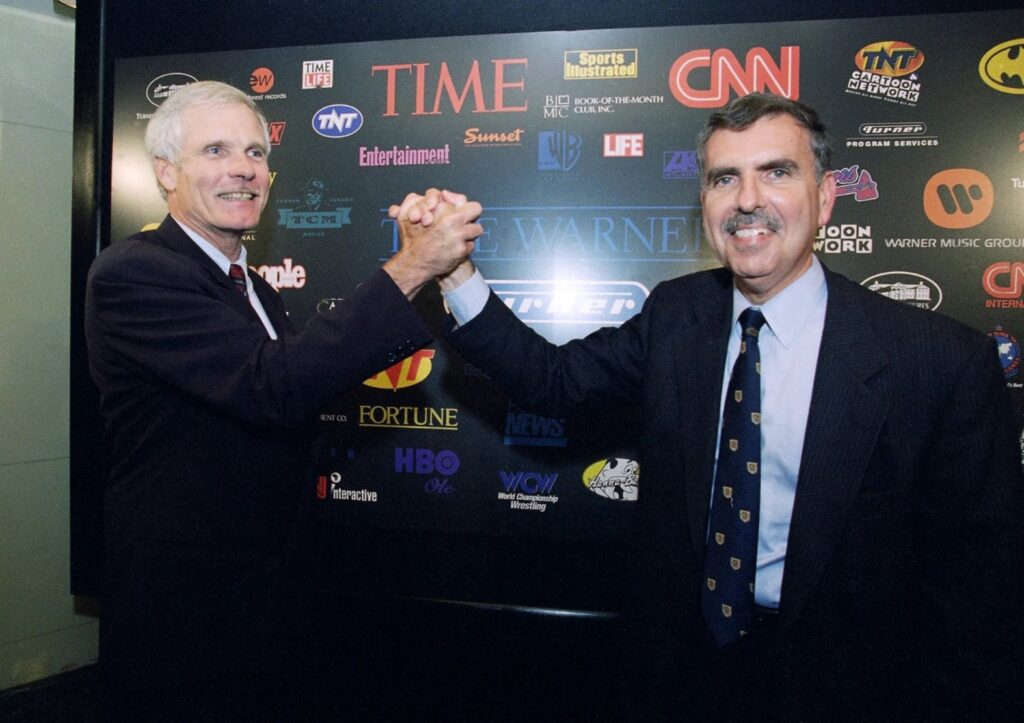
Analysts have suggested that the end of Ted’s empire started in 1996 when Turner Broadcasting System merged with Time Warner. Gerald Levin came to World Report to explain the strategy and there was some scepticism in the room amongst delegates. There were anxieties that the money men were now in control. By 2001 those worries were confirmed when AOL bought Time Warner. Ted’s shares in the business were decimated, and it is widely reported that he lost $7 billion as a result of the collapse in share value.
And CNN was no longer alone. Rupert Murdoch launched Fox News in 1996 and this opened up years of rivalry between the two channels which continues to today.
But as CNN media anchor Brian Stelter reminded viewers a few days ago: “CNN, in its DNA, was always slightly unhinged. It was built by a man who thought the rules didn’t apply to him, in a city that wasn’t New York or Washington, staffed by journalists who didn’t get jobs at the networks…”
Turner might not have been the savviest businessman. That accolade certainly goes to John Malone, but the plaudits from Malone (“Ted, totally transparent with the passion of an evangelical preacher”), Barry Diller, dozens of other industry leaders and even Rupert Murdoch praise him.
“Ted was an intensely involved and committed leader, intrepid, fearless and always willing to back a hunch and trust his own judgment,” CNN chairman and CEO Mark Thompson said in a statement. “He was and always will be the presiding spirit of CNN.”
“Ted’s entrepreneurial spirit, creative ambition and willingness to take risks changed the media industry forever,” Warner Bros. Discovery head David Zaslav said in a message to staff members on May 6. “He believed deeply in the power of ideas, in doing things differently and in building platforms that could inform, inspire and connect people around the world.”
Ted Turner must never be forgotten. Philanthropist, humanitarian, visionary, film-fan, sailor, rancher, fly-fisherman…. He has many wholly justifiable attributes. As Octavian, who would later become Augustus Caeser, might say: “The dying of such a man must be shouted, screamed.”
