

SES has advanced the operational framework for its “meoSphere” program, a next-generation Medium Earth Orbit (MEO) network designed to anchor the company’s multi-orbit In-Flight Connectivity (IFC) strategy. Following the announcement of its partnership with K2 Space to deploy an initial 28 high-power satellites, SES is now focusing on the ground segment, specifically the development of multi-band Electronically Steered Antennas (ESA).
These terminals are engineered to provide seamless handovers between MEO, Geostationary (GEO), and Low Earth Orbit (LEO) constellations, addressing the “always-on” requirements of commercial aviation and government mobility.
The meoSphere Architecture and K2 Space Partnership
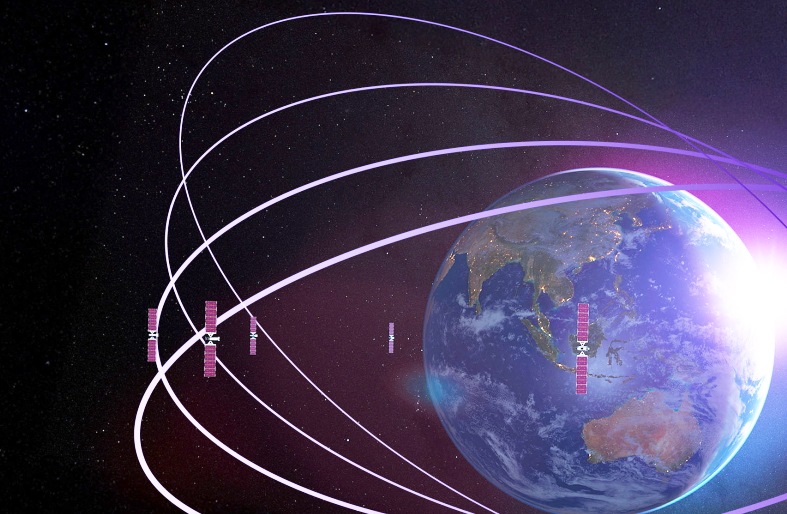
The meoSphere network represents a strategic evolution beyond the current O3b mPOWER system. Orbiting at approximately 8,000 km, the first phase of the constellation will consist of 28 satellites across four inclined orbital planes.
Each satellite, built on the high-power K2 Space bus, will deliver 20 kW of power—nearly double that of previous MEO generations. This increased power envelope allows for digital regenerative payloads that support software-defined beamforming, enabling SES to dynamically shift capacity to high-demand flight corridors or maritime routes in real-time.
Standardizing Multi-Band Electronically Steered Antennas
To unlock the capacity of meoSphere, SES is overseeing the development of two standardized ESA form factors: 25 x 25 cm and 50 x 50 cm flat-panel arrays. These terminals are designed to deliver throughput speeds of up to 1 Gbps per aircraft. Unlike legacy mechanically steered dishes, these ESAs can simultaneously track multiple satellites across different orbits—such as an SES MEO satellite for high-volume data and a Eutelsat OneWeb LEO satellite for low-latency applications.
This “multi-link” capability is a critical component of the SES Open Orbits network, which recently granted type approval to ThinKom’s ThinAir Ka2517 antenna for multi-orbit operations.
Strategic Transition to Multi-Orbit In-Flight Connectivity
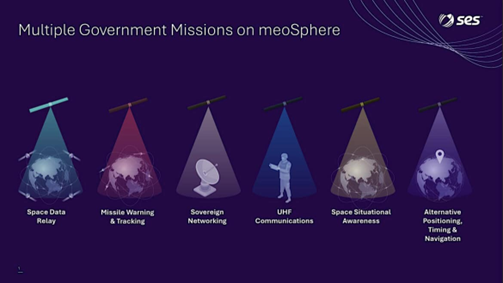
“meoSphere is taking MEO throughput capability to flat panel architectures, which is what a lot of our customers are asking for,” stated Adel Al-Saleh, CEO of SES, during a briefing at SATShow 2026. The shift targets the B2B and B2G markets, where sovereign nations and global airlines require resilient, high-bandwidth connections that do not depend on a single orbital regime. By integrating MEO’s geographic efficiency with the low latency of LEO, SES aims to differentiate its service from vertically integrated competitors like Starlink.
Capital Expenditure and Deployment Timeline
The meoSphere initiative is integrated into SES’s capital expenditure guidance for 2026, which follows a disciplined deployment model based on market demand. The company plans to launch a series of “pathfinder” missions over the next 24 months to validate the K2 Space bus and the new digital ASICs (Application-Specific Integrated Circuits) required for the onboard processors. Full-scale commercial operation of the meoSphere network is targeted for 2030, though pathfinder capacity is expected to support early-adopter government and mobility customers as early as 2028.
