

The Canadian government has introduced sweeping new regulatory measures to oversee satellite re-entry and orbital debris, directly coinciding with a massive reconfiguration of SpaceX’s Starlink fleet. On April 27, Transport Canada announced the Canadian Space Launch Act, while Innovation, Science and Economic Development Canada (ISED) finalized strict de-orbiting mandates.
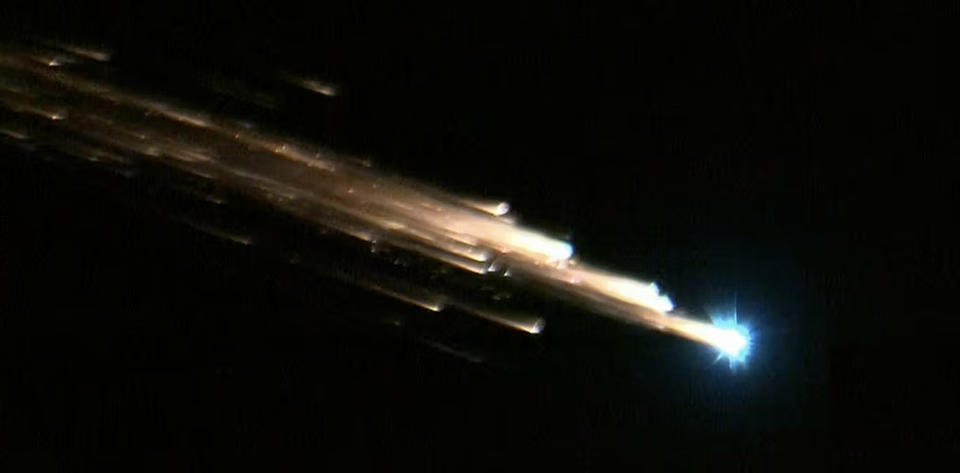
These actions address growing public and scientific concern over the environmental impact of satellite “burn-up” events, which are increasingly visible across the 50th parallel and other high-latitude regions.
New 5-Year De-orbit Mandate
Under ISED’s new regulatory framework (SMSE-005-26), non-geostationary satellite orbit (NGSO) systems must now undergo controlled atmospheric re-entry no later than five years after the end of their operational life. This replaces previous voluntary guidelines with enforceable licensing conditions. Furthermore, any satellite operating with an apogee above 600 km is now required to carry active propulsion for collision avoidance and end-of-life disposal. These rules are designed to prevent the long-term accumulation of “zombie” satellites that contribute to the risk of Kessler syndrome.
SpaceX Starlink Altitude Reconfiguration
To align with increasing safety and regulatory pressure, SpaceX began a massive technical shift on January 1, 2026. Michael Nicolls, Vice President of Starlink Engineering, confirmed the company is lowering the orbital altitude of approximately 4,400 satellites from 550 km down to 298 miles (480 km).
This move is intended to increase atmospheric drag, reducing the natural de-orbit time from four years to just a few months. While this improves orbital safety, it significantly increases the frequency of re-entry fireballs visible from the ground as defunct units are purged from the constellation.
Atmospheric and Environmental Implications
Recent scientific breakthroughs have intensified the debate over these re-entries. A study published in Communications Earth & Environment in February 2026 recorded, for the first time, a ten-fold increase in lithium and aluminum oxide density in the stratosphere following a Falcon 9 re-entry.
Researchers from the Nature-family journal warn that the deposition of these metals—which are not naturally present in high concentrations—could accelerate ozone depletion and alter the atmosphere’s thermal reflectiveness. With SpaceX’s recent FCC filing for an “Orbital Data Center” involving up to one million additional satellites, scientists estimate re-entry events could eventually occur every three minutes.
The Canadian Space Launch Act
The legislative response in Ottawa, spearheaded by Transport Minister Steven MacKinnon, aims to establish a sovereign framework for space activities. The Canadian Space Launch Act provides the government with the authority to oversee re-entry activities conducted from or impacting Canadian territory. This includes establishing liability protocols for debris that fails to fully demise in the atmosphere. The act is part of a broader $200 million investment in core space infrastructure intended to ensure that private company operations do not compromise national security or environmental integrity.
Outlook for Mega-Constellation Governance
As the commercial space sector moves toward higher launch cadences, the focus of global regulators is shifting from launch authorization to end-of-life accountability. The transition period for Canada’s new rules allows for a 126-day administrative window, after which all new NGSO systems must prove a 90% or higher probability of successful disposal. For industry leaders like SpaceX and Amazon Leo, the challenge will be balancing the rapid replenishment of constellations with the emerging scientific consensus on upper-atmospheric pollution and the loss of the natural night sky.
