

Targeting the efficiency gap in traditional liquid rocket engines, Astrobotic announced on Friday, April 24, the successful completion of a hot-fire test campaign for its Chakram rotating detonation rocket engine (RDRE).
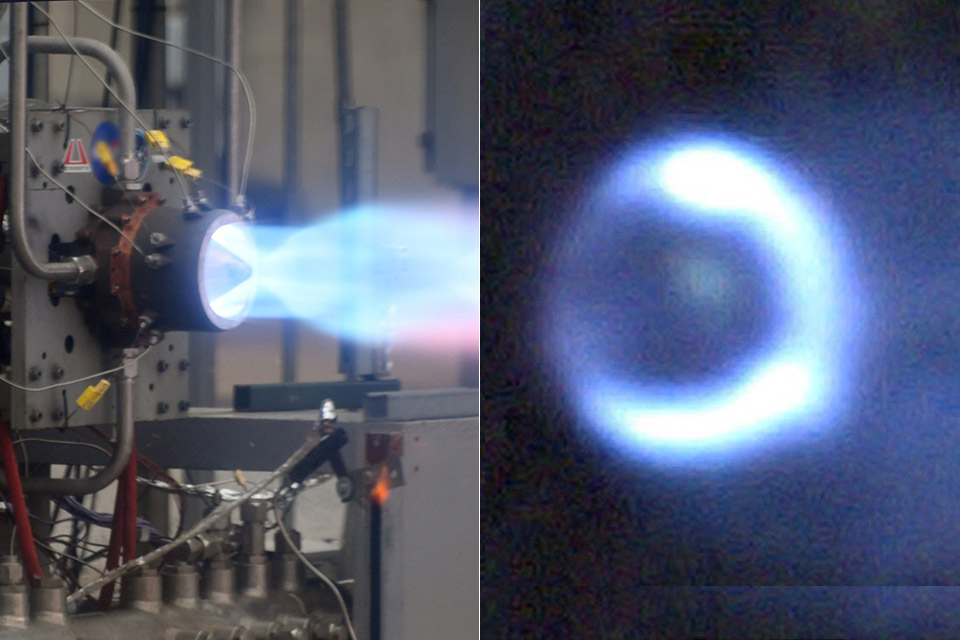
Conducted at NASA’s Marshall Space Flight Center (MSFC) in Huntsville, Alabama, the test campaign featured a continuous 300-second burn, marking the longest recorded duration for an RDRE to date. The propulsion system is being developed to support high-efficiency lunar landers and orbital transfer vehicles (OTVs) in cislunar space.
Advancing Pressure Gain Combustion Technology
The Chakram engine represents a shift from isobaric combustion used in conventional rockets to pressure gain combustion. Unlike standard engines that rely on a steady flame, RDREs utilize supersonic detonation waves that rotate around a ring-shaped chamber.
This process extracts significantly more work from the same volume of propellant, potentially increasing specific impulse by up to 15%. During the recent campaign, two prototype engines completed eight successful hot fires, accumulating over 470 seconds of total run time while consistently reaching a thermal steady state.
Technical Performance and Manufacturing Specifications
The hardware utilized in the MSFC tests demonstrated 4,000 pounds of thrust, positioning Chakram as one of the most powerful RDREs ever tested. To manage the extreme thermal loads generated by supersonic detonation, Astrobotic integrated its patented PermiAM technology—a specialized form of metal additive manufacturing with tunable porosity.
This technique, co-developed with Elementum3D, allows for advanced thermal management and stable propellant injection, which prevented any discernible damage to the engine hardware throughout the record-breaking firing.
Strategic Integration for Cislunar Logistics
The development program has been funded through two NASA Small Business Innovation Research (SBIR) awards and a Space Act Agreement with MSFC. According to Bryant Avalos, Astrobotic’s Principal Investigator for the Chakram program, the engine exceeded performance expectations during the steady-state tests.
The company intends to mature this technology for its Griffin-class lunar landers and its upcoming Xodiac and Xogdor reusable rockets. By reducing engine mass and fuel consumption, the RDRE is expected to increase payload capacity for commercial deliveries to the lunar surface.
Next Phases of Engine Maturation
Following the successful baseline performance demonstration, Astrobotic will shift focus toward mission-critical flight requirements. The next phase of development will concentrate on regenerative cooling systems, mass reduction, and deep-throttling capabilities necessary for soft lunar landings. While a specific flight date has not been set, the data gathered from the 300-second burn provides the foundation for transitioning the experimental hardware into a flight-qualified propulsion system for the emerging cislunar economy.
