

Questions for Blue Origin
Chris Forrester — Losing a satellite is hardly ever good news, and last week’s April 19 failure for the AST Space Mobile (AST) BlueBird #7 craft is quite definitely bad news. For AST it again questions their build cadence which seems to have slowed from a promised 45-60 satellites in orbit this year to a revised commitment of “about” 45 craft into orbit.
But April 23 saw good news emerge from the FCC which was – mostly – positive for AST, of which more in a moment.
However, there are also questions for the Jeff Bezos-backed Blue Origin which despite an undoubted success with the 1st stage booster and a flawless landing, although the second stage failed to accurately deploy BlueBird #7.
The lost satellite was insured for $30 million, but that modest compensation will not help the damaged reputation of AST (and the Bezos rocket company). AST’s shares fell more than 15 percent in after-hours trading on Sunday April 19 (a fall of $12.54 to $72.99 at one stage). Over the past few days AST’’s share price has recovered to about $78 but still below the April 17 (pre-launch) position of some $88.
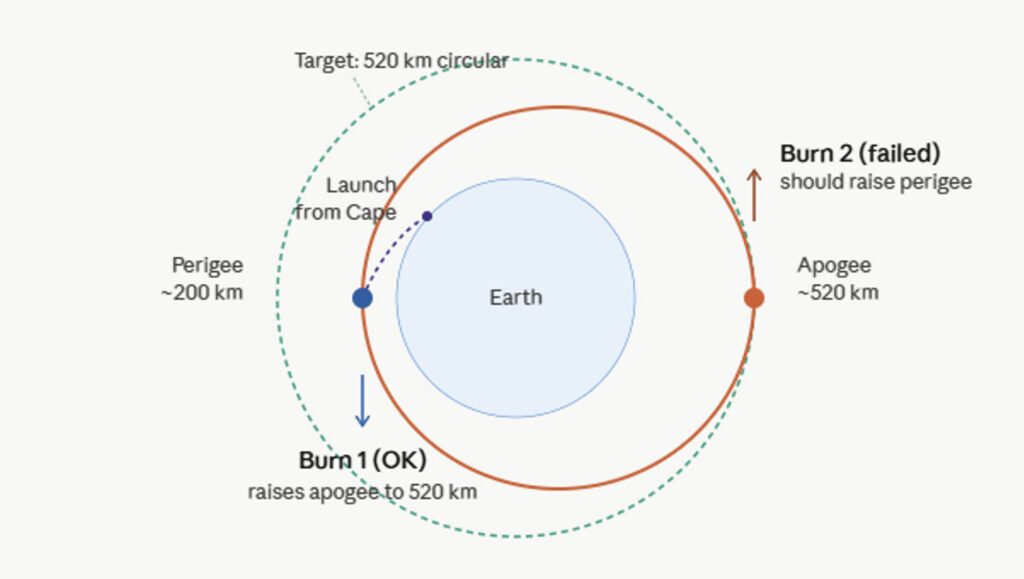
The New Glenn problem was with the upper stage which evidently failed to fire its engine correctly and which resulted in the satellite being stranded in a low orbit (“non-nominal”) that was too far from its intended location. The satellite was not carrying sufficient fuel to enable a repositioning under its own power.
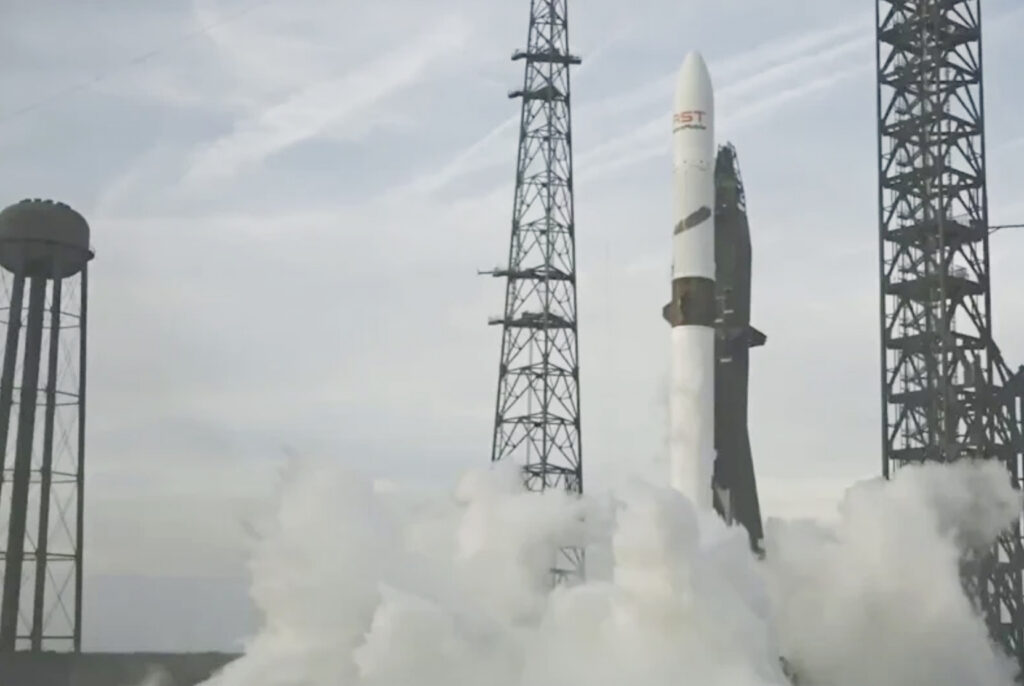
The Blue Origin New Glenn variant is now grounded pending a post-launch review. The Federal Aviation Administration (FAA) ordered an investigation into a “mishap” involving the failed launch of a satellite. Blue Origin’s chief executive Dave Limp said the failure was caused by a lack of “sufficient thrust” in an engine.
BlueBird 7 was the 2nd of AST’s “Block 2” satellite in the internet constellation of Texas-based company AST SpaceMobile. Its predecessor, BlueBird 6, launched on an Indian LVM3 rocket last December. BlueBird 6 is one of the largest satellites in space, with an antenna that spans 2,400 square feet (223 square meters). BlueBird 7 had the same dimensions.
It should have been placed into a circular orbit of 460 kms but instead was left in a highly elliptical orbit of 154 x 494 kms and is thus unusable.
However, the failure has brought AST itself under close inspection. It frequently makes promises on delivery dates and expectations – and frequently misses them. This is not considered by many to be acceptable for a publicly quoted business. The failure will also force Blue Origin to look again at its rocket’s performance, and this post-launch investigation could last months, not weeks. A post-launch review will then need to be submitted to the FAA for comments/approval. Dave Limp said the investigation will allow Blue Origin to “learn from the data and implement the improvements needed to quickly return to flight operations.”
Before the end of last year AST talked about the – then – upcoming launch of BB#6 on an Indian rocket, which was successful and that there would be “5 launches by the end of March 2026”. This has fallen short.
AST said in its post-launch statement that it “continues to target approximately 45 satellites” in orbit this year. “The company is currently in production through BlueBird 32, with BlueBird 8-10 expected to ship in approximately 30 days,” AST said in its statement, saying it expects “an orbital launch every one or two months on average during 2026.”
Loren (Larry) Reed, Spacecraft & Launch Vehicle Engineering, AST SpaceMobile, stated: “Unfortunately, the on-board propulsion capability of BB-7 is not sufficient to boost it into a suitable orbit, so rather than allow the current orbit to decay unpredictably the satellite will be deorbited deliberately in a controlled manner. Although the fault was not with AST, and the cost of the loss will be covered by insurance, this is still a real “gut punch” for the AST’s production, launch, and payload operations teams, as well as the rest of the company.”
AST’s next planned launches will be on SpaceX Falcon 9 rockets.
There are reports – unconfirmed – that AST will need to modify future satellites, adding more fuel for in-orbit positioning which will also take time, and engineering skills. There is also talk of AST adding an extra electrical thruster to the satellite’s configuration.
Comments from Blue Origin were light on any sort of public apology. “While we are pleased with the nominal booster recovery, we clearly didn’t deliver the mission our customer wanted, and our team expects. Early data suggest that on our second GS2 burn, one of the BE-3U engines didn’t produce sufficient thrust to reach our target orbit. Blue Origin is leading the anomaly investigation with FAA oversight to learn from the data and implement the improvements needed to quickly return to flight operations. We have been in steady communication with the team at AST SpaceMobile, we appreciate their partnership, and we’re looking forward to many flights together,” said Blue Origin.
Equity analysts at Deutsche Bank, in a note to clients following the failure, reiterated its price target for AST’s stock – at $117 per share. “Launch failures in one form or another do happen with some regularity in this industry. In this case, our main concern is how it will impact the forward launch plan since ASTS’ plan is to launch approximately 45 satellites by the end of 2026 (down from the original guidance of 45-60) and we estimate most of the ~45 are planned to be on New Glenn,” says the bank.
“While Blue Origin needs to investigate the problem and identify the cause before we can estimate the impact on timing, we’re optimistic that this won’t cause a delay of more than a couple months. If it does last longer than that, then we believe ASTS could fall well short of the ~45 target. On the more positive side, Blue Origin landed the first stage booster safely onto its drone ship, a first for New Glenn, allowing for reuse and an increasing launch cadence with lower costs,” the bank’s report adds.
“AST also announced that it will ship Bluebirds 8-10 within the next 30 days, a bit later than we expected based on management’s prior commentary indicating these would ship during April. Consequently, we now expect these three satellites to launch in early to mid-June, instead of our prior expectation for late May. We estimate that AST will need to execute one launch per month from June through December (including three New Glenn stacked multi-satellite launches) in order to reach 42 satellites in orbit by YE2026.”
Quilty Space’s CEO Chris Quilty told Mobile World Live (MWL) AST’s satellites are manufactured on a production line, “implying minimal impact on the deployment cadence” going forward. “The biggest impact is on launch cadence,” he said. “New Glenn is unlikely to fly for three to six months while they perform a root cause analysis and remediation.”
The good news is that – undoubtedly – Blue Origin will closely inspect every element of New Glenn’s second stage and eliminate the problem. But AST is also in receipt of positive news: The FCC on April 22 granted AST commercial approval for all previous granted Special Temporary Authorities (STAs), all requested frequencies through AT&T & Verizon, all requested global MMS (outside the US) and the previous STA granted for FirstNet. Total granted: 664 MHz. The ‘bottom line’ covers up to 248 satellites to deliver Supplemental Coverage from Space using the 700 MHz and 800 MHz bands, “which offers superior penetration and coverage characteristics, in coordination with its mobile network operators strategic partners Verizon, AT&T, and FirstNet”.
AST has also added 200 new staff over the past few months taking its workforce to more than 2000. This can only improve the build cadence. These approvals eliminate many anxieties and effectively gives the green light for what has been described as a new era of global connectivity.
Then on April 23 the FCC specified frequencies for AST.
- Low-band cellular spectrum for direct-to-device service links in the US and globally
- V-band spectrum for gateway and feeder link operations (37.5–42.0 GHz, 45.5-47 GHz, 47.2–50.2 GHz, 50.4–51.4 GHz)
- S-band and UHF spectrum for TT&C operations (but not the European S-band which places uncertainty over the AST/Vodafone European joint-venture).
“Today marks an important step as we continue scaling our network and moving closer to commercial service,” said Abel Avellan, Chairman/CEO of AST: “We are accelerating deployment of our constellation, advancing integration with leading mobile network operators, and preparing to deliver seamless, space-based cellular broadband directly to everyday smartphones, bringing us closer to connecting people everywhere.”
AST now has to start launching! Any further delays will damage investor confidence. The immediate news is that AST will use SpaceX to launch BlueBirds 8-10, 11-13 and 14-16. Thereafter, it is hoped that New Glenn will be back on line.
