

In mid-May 2026, French space mobility operator Exotrail announced the successful deployment of the NASA-funded Atmosphere Effects of Precipitation through Energetic X-rays (AEPEX) mission.
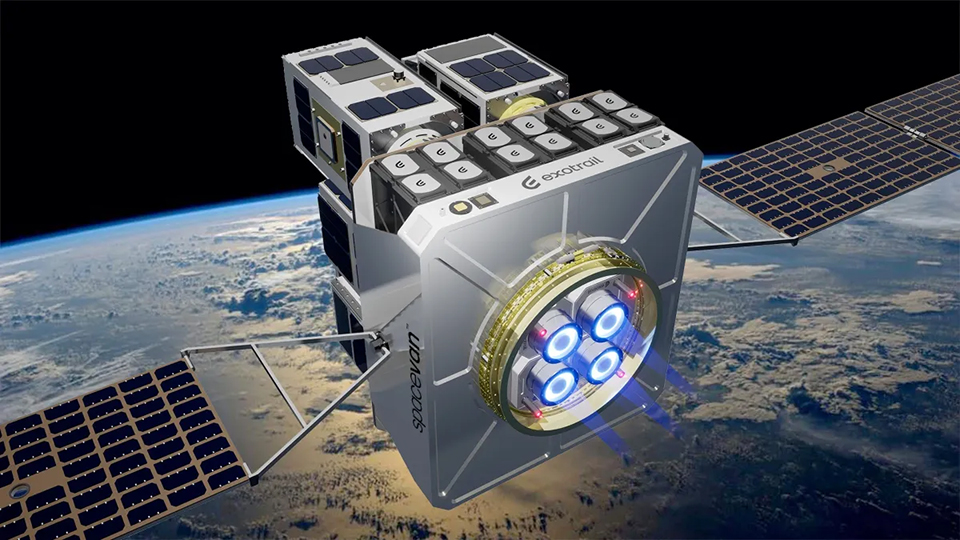
The 6U CubeSat was delivered to its precise target orbit using Exotrail’s spacevan 002 orbital transfer vehicle (OTV), which launched earlier this year as part of the SpaceX Transporter-16 rideshare mission.
Precision Mobility for Heliophysics Research
The AEPEX mission, led by the University of Colorado Boulder, is designed to study how high-energy electrons from Earth’s radiation belts precipitate into the upper atmosphere. This process plays a critical role in Earth’s atmospheric chemistry and climate modeling. By utilizing the spacevan 002, the AEPEX team was able to achieve a specific orbital inclination and altitude (approximately 500 km at an inclination above 70 degrees) that standard rideshare launches typically cannot reach without secondary propulsion.
The spacevan 002, dubbed “Wings of Light,” is Exotrail’s first fully vertically integrated OTV, featuring an in-house designed satellite bus and electric propulsion system. Unlike the company’s 2023 debut mission, spacevan 002 was optimized for “pick-up and drop-off” services, allowing it to transport multiple customer payloads to distinct orbital trajectories within a single mission.
Diverse Manifest and Hosted Payloads
Beyond the AEPEX deployment, the spacevan 002 mission serves as a multi-user platform for testing advanced space technologies in situ. Several other international partners successfully utilized the vehicle’s hosted payload services during this flight:
- Cailabs (France): Tested the Astrolight ATLAS-1 terminal to validate high-speed optical communication links between the OTV and ground stations.
- QuantX Labs (Australia): Demonstrated a critical component of its TEMPO atomic clock, aimed at improving the precision of GNSS-based systems.
- DcubeD (Germany): Successfully tested a new deployable solar panel array using the spacevan’s integrated power and control systems.
- Lunar Outpost (USA): Validated advanced robotic components designed for future autonomous lunar and cislunar missions.
Industrial Rationale and Proliferated Architectures
Exotrail’s success with the AEPEX mission highlights the growing trend of integrating commercial orbital transfer vehicles into civil and defense space architectures. By offering a “last-mile” delivery service, OTVs enable agencies like NASA and the DoD to deploy smallsat constellations with high precision while sharing the cost-benefits of large-scale commercial launches.
The mission also serves as a proof-of-concept for Exotrail’s goal of industrializing in-space mobility. The company is currently scaling its production to support a cadence of two LEO missions per year, with a larger GEO spacevan variant expected to debut in late 2026 or early 2027 to support geostationary satellite life extension and servicing.
“The success of spacevan 002 and the precise deployment of the AEPEX mission demonstrate our ability to produce and operate space mobility solutions at scale,” said Jean-Luc Maria, CEO of Exotrail. “By mastering these complex proximity maneuvers, we are enabling a new era of orbital flexibility for our commercial and government partners.”
Timeline for Upcoming Missions
Following the completion of the AEPEX deployment, Exotrail has confirmed that its third LEO mission (spacevan 003) is on track for a launch in late 2026. This upcoming mission will focus on 550 km Sun-Synchronous Orbit (SSO) delivery services. Additionally, the company is finalizing the manifest for its inaugural geostationary mission, which is being developed in collaboration with the French Space Agency (CNES).
