

By Nick David, Editorial Lead, SatNews
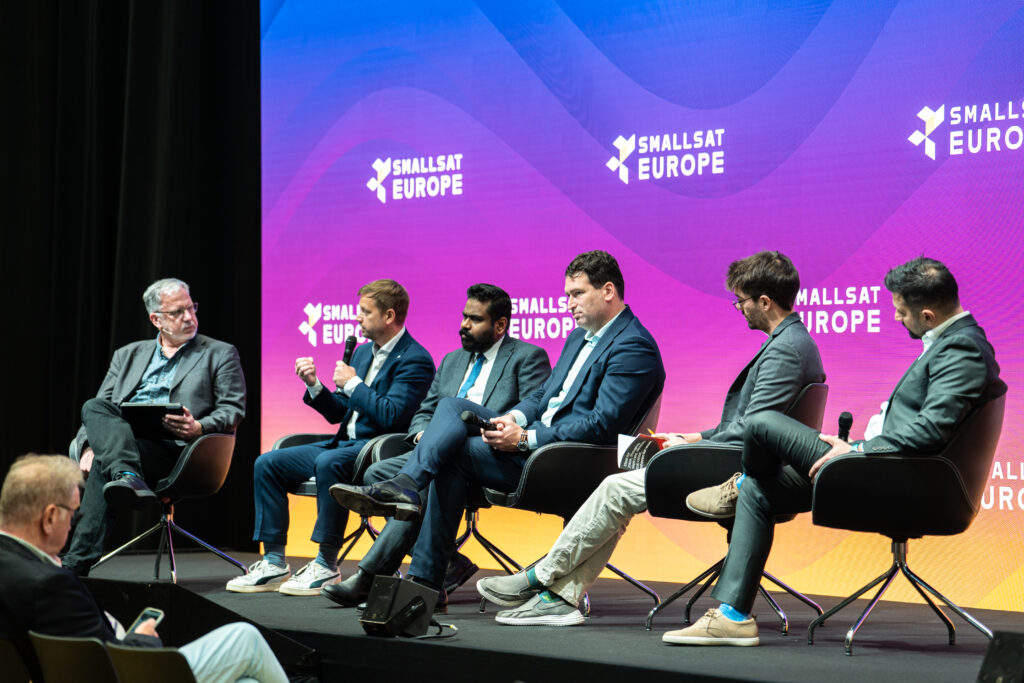
The line that organised the third day of SmallSat Europe 2026 came from a tech brief, not a panel. Stefano Antonetti, VP of Strategy & Growth at D-Orbit, walked the Business Stage tech brief through a category change his industry has been circling for two years and never quite said out loud. Europe has built ships for half a century, but it has not built ports. Everything Day 3 argued about, IRIS², protected satcom, ground-segment resilience, EUSPA’s operational pivot, sits downstream of that admission.
“In every domain on Earth, infrastructure is what enables everything else. Ports enable maritime trade. Power grids enable industrial economies. Infrastructure is not the end product, it is the platform on which all other businesses are built on.” Stefano Antonetti, VP of Strategy & Growth, D-Orbit
Antonetti said it more directly thirty seconds later. “In other words, we have ships, but we don’t have ports.” Inside the next eight hours, four other speakers in four other rooms used some version of the same frame. By the closing keynote, the unit of strategic argument had moved off the satellite and onto the infrastructure layer beneath it. That is a category shift at the level of how the industry talks about itself, and it is one of the most consequential things the conference did.
What “infrastructure” actually means in this argument
Antonetti’s case is operational. In-orbit servicing transforms a satellite from a disposable object into a manageable asset, and the moment you can interact with an asset in space, you move from missions to operations. Operations are what define every mature domain. The satellite is the ship; the servicer, the refueling depot, the optical link, and the resilient ground segment are the port. Without them, a constellation is a fleet of isolated assets drifting across an ocean.
The argument lands harder because of where it puts Europe. Antonetti is explicit about why infrastructure is the lever Europe should pull. “It is clear now that we cannot achieve the same launch cadence than Americans and Chinese are showing. And we will not be able, not in the next 20 years. So maintaining those few assets we can send into orbit in as smart a way is the way to position ourselves.”
Translate that: Europe will not out-launch SpaceX or the Chinese state, but it can out-operate them. Infrastructure is where the gap narrows.
The financial framing followed. “These investments shall be made by governments as well as on grounds where governments built roads, airports, and the highways. And these infrastructure shall be run by private entities.” The model Antonetti is reaching for is the post-war European infrastructure compact: public capital, private operation, sovereign reach.
The Layered Argument · Satellite to Infrastructure Compact
SHIP
Satellite
Old unit of argument. Disposable asset, mission-scoped.
ANTONETTI · D-ORBIT
SERVICER
On-Orbit Servicing
Refuel, relocate, repair, life-extend. Turns the asset into operations.
D-ORBIT
OPTICAL LAYER
Real-Time Network
Inter-satellite links, on-orbit compute, distributed sensors. Modern internet in LEO.
JARVIS · KEPLER
BACKBONE
IRIS² Multi-Orbit
Backbone and data relay connecting other constellations. Diversity at the terminal.
MIGNOLO · ESA
SERVICES
EUSPA Operational Layer
Galileo, Govsatcom, IRIS², EOGS. Services riding on hardened infrastructure.
ANGELLOTTI · EUSPA
PORT
Public capital, private operation, sovereign reach. The infrastructure compact Day 3 surfaced.
The same frame, five more times
By mid-morning, the metaphor was loose in the building.
On the protected satcom tech brief that followed Antonetti’s, Beau Jarvis, Chief Revenue Officer of Kepler Communications, reframed his own company’s roadmap in identical terms. “We used to talk about the fact that we are building the internet in space, which is true, but it’s not the legacy internet, which was very limited in terms of connectivity and capability. It’s more of the modern internet in low earth orbit.” The pitch had moved from a satcom product to an infrastructure layer, including optical inter-satellite links, on-orbit compute, and distributed sensors, that other operators plug into. Jarvis closed by calling Kepler’s network “a real-time optical network that is open.” The unit of value had become the network.
In the IRIS² Ground Game session on the Business Stage, Domenico Mignolo, Head of the Technology and Products Division at the European Space Agency, made the same move on the IRIS² programme itself. He has the institutional standing to say so. “It can become very interesting when you think about this square like a backbone or a data relay to connect with other constellations. And the multi-band allows you to address the different needs.” A backbone that connects rather than competes. Koen Willems, VP of EU/NATO Programs & Government Relations at ST Engineering iDirect Europe, sitting next to Mignolo on the same panel, extended the frame to ground. “I also look at how can IRIS² in the portfolio of an end user make sure that there is an increased diversity. So, and that they can switch between different constellations.” The terminal becomes a node on a multi-orbit infrastructure, and the constellation is one input.
“Space is no longer a simple infrastructure in orbit. It is an operational tool supporting decision making, crisis management and public security.” Fabio Angellotti, Space Segment Leader, EUSPA
Fabio Angellotti, Space Segment Leader at EUSPA, speaking on behalf of Executive Director Rodrigo da Costa, closed the morning with the EUSPA keynote and the most institutional version of the argument. EUSPA, he said, “operates at the interface between infrastructure, industry, and the users.” Galileo, Govsatcom, IRIS², the future Earth Observation Governmental Service — Angellotti described each as a service layer riding on top of a hardened infrastructure base. The pivot in the EUSPA mandate the European Commission has proposed is, in his framing, the move “towards an even more operational approach, where the development of space infrastructures goes hand in hand with the delivery of secure and resilient services.” Infrastructure first, services riding on it: the same architecture Antonetti was sketching, in EUSPA legalese.
On the resilience panel later in the afternoon, Sabrina Alam, Space Lead at the SnT Technology Transfer Office at the University of Luxembourg, put the wartime version of the same argument on the table. “Space is actually what we call this first line of defense. It really underpins our critical infrastructure.” Space is the thing every other defended asset runs on. Power grids, telecom, navigation, emergency response. Alam’s argument is that those depend on space infrastructure the way an industrial economy depends on a port, and Europe has not built that base.
Five rooms, five speakers, one frame. The conference converged on a category change without explicitly debating it.
Old Unit vs. New Unit of Argument
OLD UNIT OF ARGUMENT: SATELLITE
- Capability per spacecraft is the metric.
- Procurement is a satellite RFP, sometimes a constellation RFP.
- “How many satellites” is the budget question.
- Spacecraft form factor and bus drive the supplier conversation.
- The conversation Europe has had for 50 years.
NEW UNIT OF ARGUMENT: INFRASTRUCTURE LAYER
- Operational continuity is the metric.
- Procurement is a ports-roads-airports compact: public capital, private operation.
- “What infrastructure does this constellation ride on” is the budget question.
- Network, ground segment, servicing depots, optical backbone drive the supplier conversation.
- The conversation the conference moved to on Day 3.
The shift matters because €131 billion of post-Niinistö-era European defense spending is in the pipeline. If sovereignty is a constellation RFP, the money buys hardware; if sovereignty is an infrastructure layer, the same money buys a sustained programme.
The platform and propulsion camps pushed back
The frame did not go unopposed. The Smallsats as a Service panel on the Business Stage, moderated by Spacewatch Global publisher and CEO Torsten Kriening, surfaced the strongest counterpoint. Dennis Moore, CCO of Reflex Aerospace, made the case for the satellite as the unit of innovation rather than the network around it.
“There is a market for software-defined applications in space, but it only makes sense and it’s only valuable if the underlying hardware fits the mission and fits the needs of the customer. So there’s no generic approach. There’s no generic solution for it. It needs to be mission specific.”
Dennis Moore, CCO, Reflex Aerospace
Moore’s argument is that infrastructure abstractions hide the part that actually decides whether a mission works, which is the spacecraft. The reflexive position reads as this: the bus, the payload integration, the platform tailoring are where European competitiveness gets built, and generic ports are the wrong unit for a sovereign defense supplier.
The active debris removal panel moderated by Chris Quilty of Quilty Space held the same level. The discussion stayed at the component level, including refueling, life extension, inspection, and partnerships, and never reached for the infrastructure abstraction Antonetti’s tech brief had opened. The on-orbit servicing tool-or-threat panel earlier in the afternoon, moderated by Jeff Foust of SpaceNews, stayed in the same component-level register. Two units of argument inside the same conference: the propulsion and platform vendors stayed with the spacecraft, while the servicing, satcom, ground-segment, and policy speakers moved up a layer.
That split tells you who is driving the category change. The operators who already think in networks and the agencies that have to procure them are pulling the conversation up a layer, while the spacecraft-platform vendors stay with the bus.
Why this is the consequential argument of the conference
Three years of European space policy have argued about which satellite to buy and from which member state. The Day 3 move is to argue about what those satellites ride on and whether Europe is buying any of it. The implication for procurement is sharp. A satellite RFP funds a prime, while an infrastructure programme funds a tier of operators, ground-segment builders, servicing companies, and optical-network providers, the missing-middle ecosystem European defense space says it wants. The architecture shapes the supplier base.
The implication for sovereignty is sharper. If sovereignty is operational continuity rather than spacecraft ownership, the question shifts from “do we build the satellite in Europe” to “can we keep operating European services when the partners step back.” That is the question Angellotti’s EUSPA framing answers, Mignolo’s IRIS²-as-backbone framing answers, and Alam’s first-line-of-defense framing answers. None of those answers fits inside a constellation RFP.
Sitting in the room is the institutional inheritance: Italy’s IRIDE programme, Spain’s Atlantic Constellation, the IRIS² ground game, the protected satcom layer Kepler is building. These read as infrastructure programmes that European agencies are now beginning to procure as infrastructure rather than as satellite procurements. The EUSPA mandate refresh and the IRIS² ground-game tender are the two clearest signals.
The verdict from Day 3
The conference performed a category change rather than announcing one. Antonetti supplied the metaphor in the Business Stage tech brief, and Jarvis, Mignolo, Willems, Angellotti, and Alam supplied the same frame in different costumes across the same morning. The propulsion and platform camps held the older line. By Friday afternoon, the unit of strategic argument on the European space stage had become the infrastructure layer.
The through-line Day 3 surfaced is that the work of the next two years is building the ports the spacecraft Europe already has can actually operate from.
If Europe builds them, it owns the rules. If somebody else builds them, somebody else does.
Key Takeaway
Day 3 of SmallSat Europe 2026 moved the European space industry’s unit of strategic argument from the satellite to the infrastructure layer. Antonetti’s ports-vs-ships frame surfaced in five other Day 3 venues, including Jarvis at Kepler, Mignolo at ESA, Willems at ST Engineering iDirect, Angellotti at EUSPA, and Alam on the resilience panel. The platform and propulsion camps held the older satellite-as-unit line. The decisions of the next two years will tell us whether Europe procures the infrastructure layer it just decided it needs.
About the Author
A storyteller at heart, Nick David covers space policy, satellite markets, defense, and the technologies reshaping how humanity operates beyond Earth. With a background in creative direction, brand strategy, and editorial storytelling, he brings a modern lens to complex subjects and a relentless curiosity about what comes next.
