

SANTA ROSA, Calif. – August 2, 2026 – To address the growing risk of uncontrolled space debris re-entering Earth’s atmosphere, international space agencies and regulatory bodies are reassessing orbital disposal rules following an August 1, 2026 investigation detailing the frequency of falling rocket bodies and hardware fragments.
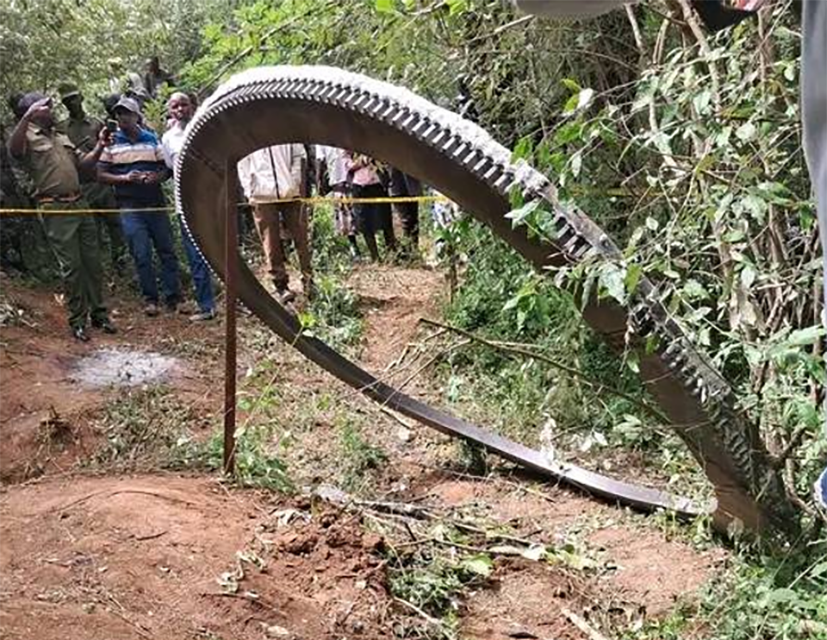
ember to a dull gray. The ring had once connected parts of a rocket. It was supposed to have burned up
on its return to Earth.
The analysis highlights a sharp increase in hardware survival rates during atmospheric descent, driven by the unprecedented volume of commercial mega-constellation deployments and heavy-lift launch vehicles. Current estimates indicate that more than one metric tonne of manufactured space debris returns to Earth unguided every week, creating operational hazards for international airspace and populated terrestrial regions.
Recent ground impacts demonstrate the persistence of large structural hardware surviving descent. In a notable incident in Mukuku, Kenya, a large metal rocket ring weighing several hundred kilograms impacted farmland after surviving atmospheric re-entry. The event prompted formal field investigations by the Kenya Space Agency and underscored the risks posed by unmanaged upper-stage disposals.
Mass Re-Entry Dynamics and Ground Impact Events
As is well known in the space community, there are currently more than 36,000 tracked objects larger than 10 centimeters orbiting Earth, alongside millions of smaller fragments, contributing to a total orbital debris mass exceeding 13,000 tonnes. While atmospheric friction incinerates lightweight satellite components, high-density elements—such as titanium propellant tanks, engine thrust chambers, and structural payload adapters—frequently survive thermal entry.
Atmospheric Drag Acceleration and Legal Liability Frameworks
The rate of natural orbital decay has accelerated significantly due to Solar Cycle 25 activity, which expands the thermosphere and increases atmospheric drag on passive objects in Low Earth Orbit. While atmospheric expansion helps sweep inactive satellites from space, it also increases trajectory unpredictability for large, defunct spacecraft. This dynamic was demonstrated during the accelerated re-entry of NASA’s Van Allen Probe A, where solar activity pulled the 600-kilogram satellite out of orbit years ahead of initial projections.
Under the 1972 Convention on International Liability for Damage Caused by Space Objects, launching nations maintain absolute liability for damage or injuries caused by their space hardware on the surface of the Earth or to aircraft in flight. However, identifying specific upper-stage fragments after structural breakup remains a complex technical challenge for regulatory authorities.
Policy Transitions Toward Zero-Debris Mandates
In response to elevated ground safety risks, regulatory bodies—including the U.S. Federal Communications Commission and the European Space Agency—are enforcing stricter disposal timelines. Operators are increasingly required to transition from the traditional 25-year post-mission de-orbit guideline to mandatory five-year or direct controlled re-entry rules.
Future constellation architectures are adopting “design-for-demise” manufacturing principles, using low-melting-point materials like aluminum alloys to ensure spacecraft entirely consume themselves upon re-entry, alongside dedicated onboard propulsion to guarantee targeted oceanic disposals.
