

The re-entry of NASA’s Van Allen Probe A (formerly known as the Radiation Belt Storm Probe A) on March 10, 2026, marks the conclusion of a 14-year journey that transitioned from a groundbreaking scientific mission to a critical case study in orbital debris mitigation and space weather dynamics.
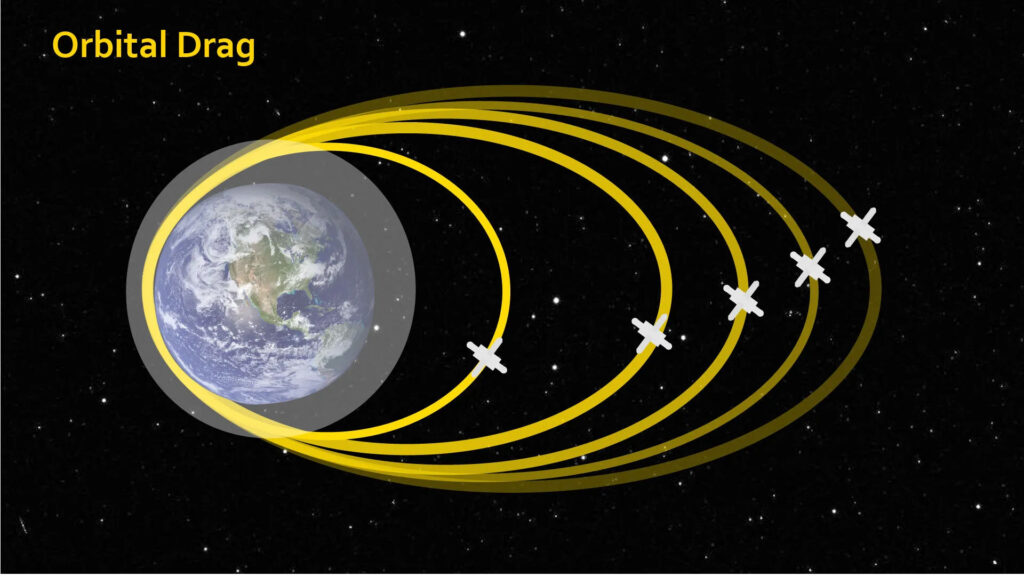
Accelerated Re-entry: The Solar Drag Effect
Originally deactivated in October 2019 after exhausting its fuel, Van Allen Probe A was initially projected to remain in orbit until at least 2034. However, its descent was dramatically accelerated by a factor of nearly eight years due to intensified solar activity.
During the peak of Solar Cycle 25, frequent solar flares and coronal mass ejections (CMEs) deposited massive amounts of energy into Earth’s upper atmosphere. This energy caused the atmosphere to heat and expand outward, increasing the density of the air at altitudes where satellites orbit. For a spacecraft like Probe A, which traveled in a highly elliptical orbit (ranging from roughly 384 miles to over 18,000 miles), the increased friction or “atmospheric drag” encountered at its lowest point (perigee) acted as a brake, steadily lowering its highest point (apogee) and pulling it toward a fiery demise.
Connection to Trend 8: Orbital Carrying Capacity and Mitigation
The premature re-entry of Probe A is a real-world validation of the concerns highlighted in Trend 8, which addresses the management of orbital carrying capacity. As Low Earth Orbit (LEO) becomes increasingly crowded with commercial constellations, the unpredictability of solar cycles presents a major challenge for debris mitigation:
- Atmospheric Expansion as a “Janitor”: Intensified solar activity acts as a natural cleaner by dragging defunct satellites and small debris back into the atmosphere. This helps preserve orbital capacity by removing “zombie” satellites that no longer have the fuel to de-orbit themselves.
- Collision Risk and Unpredictability: Conversely, the same expansion that helps debris re-enter also makes it harder for operators to predict satellite trajectories. When the atmosphere swells unexpectedly, active satellites may lose altitude faster than planned, increasing the risk of collisions in densely populated shells.
- Responsible Disposal: The Van Allen Probes mission was one of the first to proactively plan for re-entry years in advance. By performing “perigee-lowering” maneuvers in early 2019 while fuel was still available, NASA ensured the probes would re-enter in a reasonable timeframe rather than remaining as hazardous “ghost ships” for decades.
Re-entry Statistics and Legacy
Van Allen Probe A—a 1,323-pound (600 kg) satellite—is expected to largely disintegrate upon re-entry. NASA and the U.S. Space Force estimate a 1 in 4,200 risk of debris hitting anyone on the ground, as roughly 70% of the Earth’s surface is water and much of the rest is uninhabited.
While Probe A meets its end today, its twin, Van Allen Probe B, is currently projected to remain in orbit until roughly 2030. Together, these probes revolutionized our understanding of “killer electrons” and the radiation belts that protect our planet, providing the very data scientists now use to protect the next generation of satellites from the solar activity that ultimately claimed Probe A.
