

On May 14, 2026, SpaceX provided a final technical briefing on Starship Version 3 (V3) ahead of its planned debut launch on May 19, 2026. Designated as Flight 12, this mission marks the first orbital test of the redesigned vehicle architecture, which has undergone a complete design overhaul to move Starship from a testbed toward an operational, rapidly reusable heavy-lift system.
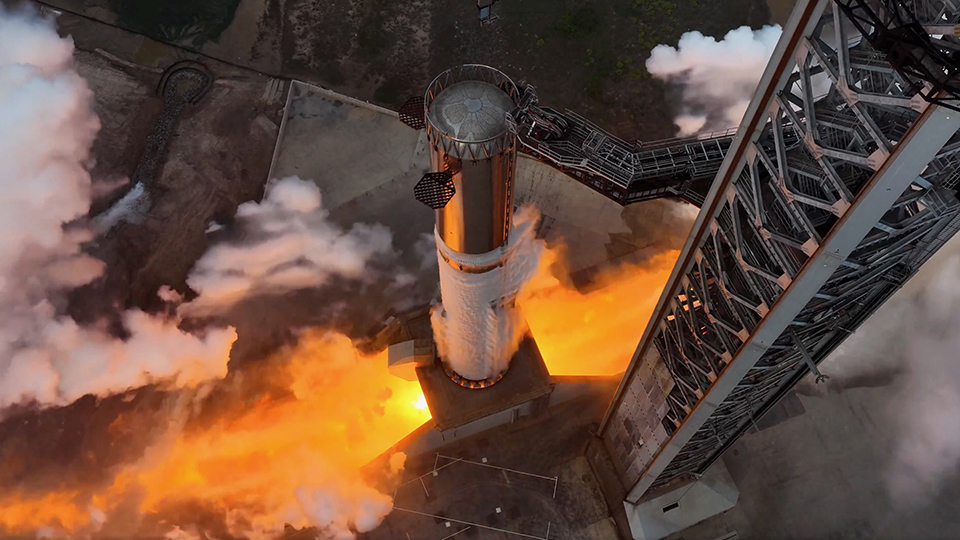
Launching from the newly commissioned Pad 2 at Starbase, Texas, V3 represents a critical step in NASA’s Artemis program, which relies on Starship’s upcoming propellant transfer and lunar landing capabilities.
Technical Evolution: Super Heavy V3 and Ship V3
The V3 architecture features extensive structural and propulsion redesigns aimed at reducing dry mass and increasing orbital payload capacity.
- Vehicle Dimensions: The full stack stands approximately 1.5 meters (5 feet) taller than Version 2, reaching a total height of approximately 124 meters.
- Booster Refinements: The Super Heavy V3 booster has reduced its grid fin count from four to three. Each fin is 50 percent larger and significantly stronger to better support “catch” operations at the launch tower.
- Propulsion Integration: Both stages now utilize the Raptor 3 engine. The “clean-sheet” redesign of the aft-end fluid and electrical systems has eliminated the need for individual engine shrouds and the large aft close-out volume, reducing overall vehicle mass by approximately one ton per engine.
- Hot-Staging Overhaul: V3 utilizes an integrated hot-stage design where the forward dome of the booster fuel tank is directly exposed to the upper stage’s engine ignition. This area is shielded by a non-structural steel layer and internal tank pressure, replacing the heavier, single-use protective interstages of previous versions.
Raptor 3 Engine Performance Specifications
The Raptor 3 engine is the core driver of V3’s increased performance. By internalizing secondary flow paths and utilizing advanced additive manufacturing, SpaceX has simplified the engine’s exterior while simultaneously boosting thrust.
| Engine Variant | Raptor 2 Thrust | Raptor 3 Thrust | Improvement |
| Sea-Level | 230 tf (507k lbf) | 250 tf (551k lbf) | +8.7% |
| Vacuum (RVac) | 258 tf (568k lbf) | 275 tf (606k lbf) | +6.6% |
The engine’s mass has been reduced to 1,525 kg (from 1,630 kg), achieving a thrust-to-weight ratio that exceeds 180. These gains enable Starship V3 to target a fully reusable payload capacity of over 100 tons to Low Earth Orbit (LEO), with the potential to reach 200 tons in future expendable configurations.
Infrastructure and Mission Readiness
Flight 12 will also be the operational debut of Starbase’s Launch Pad 2, which features an upgraded propellant farm with increased storage and faster pumping speeds. The launch tower’s “chopstick” catch arms have been shortened for faster tracking and transitioned from hydraulic to electromechanical actuators to improve reliability.
For real-time telemetry, V3 is equipped with an upgraded camera suite providing over 50 views, supported by 480Mbps of redundant Starlink connectivity. Following a successful static fire of all 33 engines on May 7, the vehicle completed a full-duration launch rehearsal on May 11, loading more than 5,000 metric tons of liquid methane and oxygen.
Rationale: Bridging the Heavy-Lift Gap
The development of V3 addresses the “Heavy-Lift Launch Gap” by providing a reliable, high-cadence alternative to heritage expendable rockets. For commercial satellite operators and civil space agencies, the vehicle’s massive payload bay and orbital refueling capability are essential for the next phase of space industrialization, including the deployment of large-scale lunar infrastructure and next-generation communication constellations.
