

By Nick David, Editorial Lead, SatNews
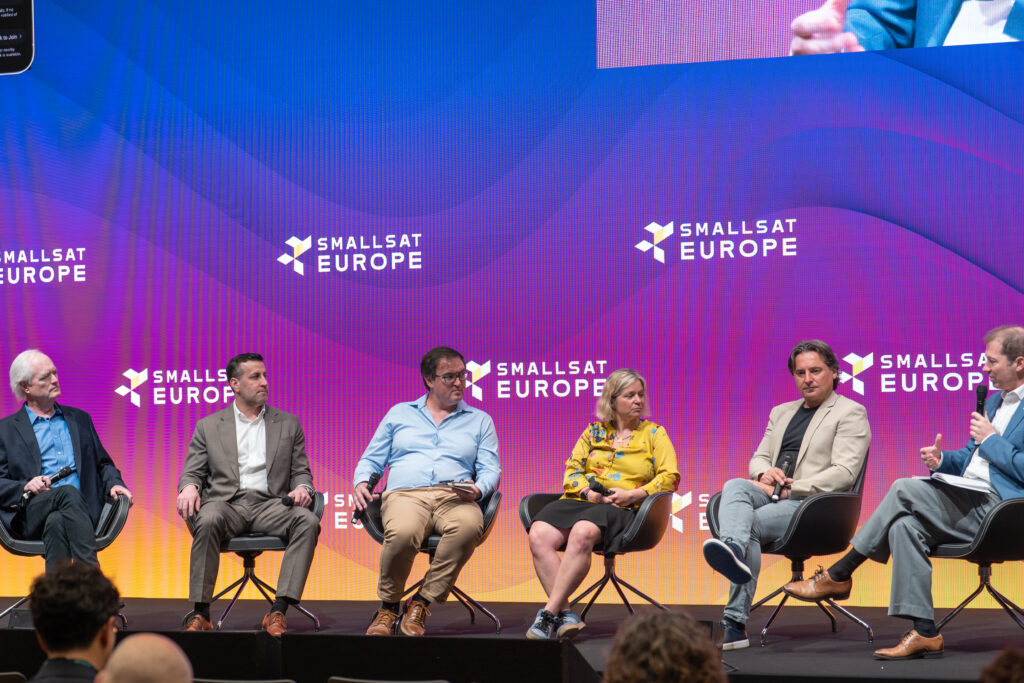
For the last eighteen months, the orbital data centre conversation has been carried more by IPO filings and forward-looking decks than by physics. Day 2 of SmallSat Europe 2026 was the meeting where that stopped. The Business Stage spent the better part of a day pulling the thesis apart on cost, thermal, and capital-allocation grounds. The most important conversation of the morning was a tech brief delivered by a former AMD Corporate Vice President in front of a room of European investors and operators.
Struhsaker’s conclusion was not that orbital data centres are impossible. “Is it possible? Is it within what we can do? Absolutely,” he told the room. “But smart design’s going to be required.” The megawatt-class orbital data centre being financed at scale in 2026, on his read, has three engineering preconditions that have to land before the public-market thesis closes, custom silicon, modular plug-in architecture so a 5-year compute card can swap under a 20-25-year platform, and launch costs below $300 per kilogram. The version of in-orbit computing that does close commercially in the near term is a smaller, sharper, edge-compute play with a defined ROI window.
The thermal arithmetic
The brief came from Dr. Paul Struhsaker, CEO of Arrasar Partners. Struhsaker opened with his own background, which was the credential.
“In a former life I was the corporate vice president for commercial systems at AMD and one of our biggest customers was Cray Computer. The AI chip sets you see today are the product of that card-level architecture of GPUs and CPUs that came about about 12 or 13 years ago. So we’re going to talk about data centres and I’ve been in the process of building a few, so I can kind of relate the difference between all the hype and the reality.” Dr. Paul Struhsaker, CEO, Arrasar Partners
The structural argument followed from there. The case for putting compute in orbit, Struhsaker said, rests on the claim that unlimited space and unlimited solar energy will outweigh the launch cost of getting hardware to orbit. The case has a hidden assumption. Today’s GPU and accelerator silicon is designed for terrestrial data centres. It is power hungry by architecture. There are no power limitations or any power savings features whatsoever built in.
Each generation of accelerator chip has roughly doubled in power draw, Struhsaker said, walking the room through the watts-per-card numbers his slides were built around.
Struhsaker’s GPU Thermal Math · Watts Per Card
1.2 kW
Blackwell generation
2.3 kW
Vera Rubin (current)
3.0 kW
Vera Rubin (next)
6-7 m²
solar per single card
The thermal arithmetic alone makes the megawatt orbital data centre a structural-and-radiative design problem on a scale the satellite industry has never built before. Terrestrial GPU thermal envelopes hit the wall on air cooling roughly four years ago and have been moving to liquid cooling since. The orbital equivalent has to dissipate kilowatt-class waste heat across tens of thousands of accelerators by radiation alone. The next speaker on the same stage would put a sharper number against that order of structure.
The capital allocation question
The Market Brief on Orbital Data Centers Economics, delivered an hour later on the same Business Stage by Dr. Oguz Karasu, Postdoctoral Research Fellow at the University of Oxford, made the explicit capital-allocation case. Karasu opened by reframing the problem statement.
“When we delve into the concept of the data centres, actually we see more at digital infrastructure rather than a normal data centre on Earth,” Karasu said. The current terrestrial data centre build-out has, on his read, completed only thirty to thirty-five per cent of its planned infrastructure. Karasu argued the orbital equivalent should be assumed to take longer still.
The physics constraints, Karasu argued, are not optional. “What’s happening in orbit, the heat only released via radiation. So to be able to keep the infrastructure cooled down all the time, for example, for 50 megawatts, big data centre, you need to have an ISS-large infrastructure. So it is technically, like physically, it’s not feasible for now. To be able to do that, you need to send a big launcher. You need to wait for Starship first. So without Starship, even the concept is not feasible for now.”
The capital-allocation case is Karasu’s second-order argument, and it carries into the rest of the day. The structural argument: multi-billion-euro investment in an orbital data centre thesis not yet physics-checked at the megawatt scale displaces investment in the gaps the rest of Day 2 spent unpacking on the same stage. Component supply-chain resilience. Serial production at the smallsat tier. Defence replenishment economics. EO fusion. Optical mesh networks. Each carries a clear customer, a defined product, and a published procurement instrument.
Two theses, same stage
Same Conference, Two Different Businesses
MEGAWATT ORBITAL DC: PUBLIC-MARKET THESIS
Replace terrestrial hyperscaler. Tens of thousands of GPU cards. Station-class spacecraft. Multi-decade asset against non-stationary debris risk. Thermal envelope is the structural bottleneck. Financed at scale. Not yet physics-checked at megawatt scale.
EDGE AI ACCELERATOR: EUROPEAN COMMERCIAL CASE
Extract intelligence, delete data. Single onboard inference unit per smallsat. Mission-sized compute envelope. D-Orbit, Ubotica, Innoflight, SITAEL already shipping. Closes inside one budget cycle.
Where in-orbit compute does close
The Latency Arbitrage panel, moderated by Dr. Eric Anderson, President of And One Technologies, did the most useful framing of the day on where in-orbit compute does close commercially. The panel was Johan Åman, CEO of Unibap Space Solutions; Vincenzo Stanzione, CTO of SITAEL; Ryan Conroy, VP of Business Development at Elve; Vincent Gagnon, Chief Revenue Officer at Innoflight; and Viney Dhiri, who runs D-Orbit UK’s space cloud business.
Dhiri, whose company has compute on multiple operational spacecraft, gave the cleanest version of the edge case.
“It’s heresy in EO circles, but take the data, extract the intelligence, delete it, get rid of it. Never want to see it again. Somebody else can store it.” Viney Dhiri, Head of Space Cloud Business Unit, D-Orbit UK
Stanzione made the technical case for federation between satellites rather than monolithic orbital data centres. SITAEL’s edge-compute model, he said, is to keep the inference workload close to the sensor and to share intelligence across satellites in a constellation. “I see as possible scenario for a large orbital data centre only something like Starlink, so managed by the usual guys we know very well. Orbital data centre service, I see it a bit far in terms of technical feasibility, opportunity and security.”
Gagnon made the engineering case for the edge thesis from the Innoflight side. Innoflight’s integrated avionics suite covers processing, networking, encryption, and radio in one architecture designed to minimise latency at the satellite level.
The verdict from Day 2
Day 2 did not end the orbital data centre conversation. It moved the conversation onto more honest ground. The megawatt vision is still on the table, but the table is now in front of a thermal engineer with a calculator and a market analyst with an opportunity-cost spreadsheet. The edge-compute version is in production planning at multiple European companies and was front of mind for several investor and operator conversations on the conference floor.
Key Takeaway
The megawatt orbital data centre thesis just became an economics question. The thermal physics requires station-class infrastructure that depends on Starship. The capital-allocation case competes with multiple better-defined European space-industry investments. The edge-compute version of in-orbit computing is shipping now and closes inside one budget cycle.
About the Author
A storyteller at heart, Nick David covers space policy, satellite markets, defense, and the technologies reshaping how humanity operates beyond Earth. With a background in creative direction, brand strategy, and editorial storytelling, he brings a modern lens to complex subjects and a relentless curiosity about what comes next.
