

On August 11, 2026, internal European space sector reports confirmed that Arianespace and the European Space Agency (ESA) have paused development of the ICARUS carbon-composite upper stage project.
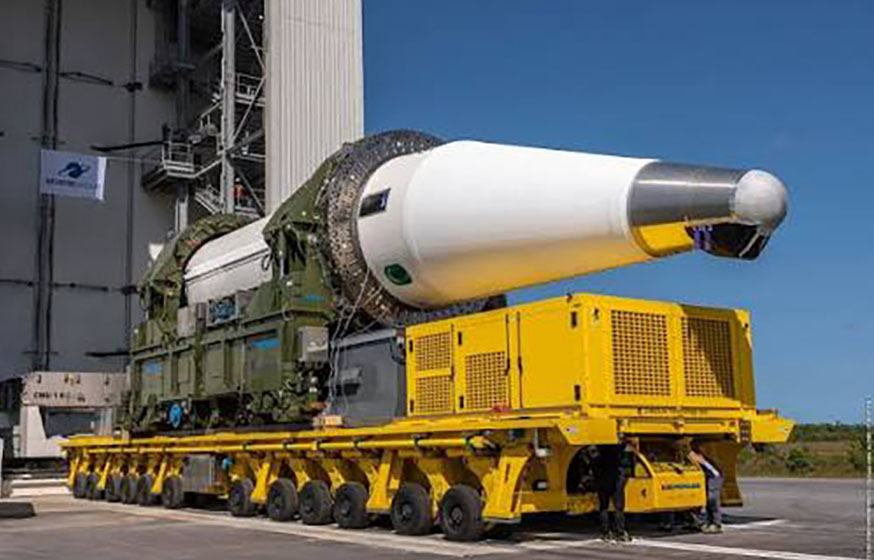
The decision, following directives established during the 2025 ESA Ministerial Council (CM25), shifts capital expenditure away from the long-term Ariane 6 Block 3 (Ariane 6 Evo) architecture to focus near-term resources on scaling launch rates, reducing unit manufacturing costs, and meeting immediate commercial satellite manifest obligations under the active Block 2 configuration.
The strategic pivot reflects an operational priority to maximize current Ariane 6 flight output rather than pursuing major structural redesigns while global launch availability remains tightly constrained.
Ministerial Directives and Upper Stage R&D Reallocation
The ICARUS (Innovative Carbon ARiane Upper Stage) initiative was originally designed to replace the metal structures and propellant tanks of the Ariane 6 upper stage with lightweight carbon-fiber composite materials. The weight reduction was projected to add several metric tons of net payload capacity to Low Earth Orbit (LEO), geostationary transfer orbit (GTO), and lunar trajectories, serving as the core upgrade for a future Block 3 variant.
However, European space ministers allocated over €4.4 billion to space transportation activities during CM25 with an explicit focus on operational exploitation, launcher competitiveness, and industrial throughput. While the underlying carbon-composite manufacturing technologies developed under ESA’s Phoebus program remain under technical study, funding for full-scale ICARUS flight development has been placed in abeyance to ensure prime contractor ArianeGroup concentrates on factory throughput at facilities in mainland Europe and assembly lines at the Guiana Space Centre.
The shift builds upon earlier operational updates detailing ESA’s baseline launch infrastructure for the Ariane 6 launcher, reinforcing that near-term investments must prioritize vehicle delivery over future hardware iterations.
Block 2 Specifications and Solid Booster Capabilities
With the ICARUS program paused, the Ariane 6 Block 2 configuration establishes the baseline heavy-lift architecture for Arianespace through the late 2020s. The Block 2 upgrade centers on the deployment of upgraded P160C solid rocket boosters, which replace the earlier P120C variants used on initial flights. Key technical parameters of the current operational fleet include:
- P160C Solid Boosters: Each P160C booster carries 156 metric tons of solid propellant—representing a 10 percent fuel capacity increase over the P120C—delivering higher liftoff thrust during initial ascent.
- Ariane 64 Payload Capacity: Operating in the four-booster configuration (Ariane 64), the launcher delivers approximately 22 metric tons of payload to Low Earth Orbit and up to 11.5 metric tons to Geostationary Transfer Orbit.
- Re-ignitable Vinci Upper Stage: Powered by the liquid oxygen and liquid hydrogen Vinci engine, the upper stage features multiple restart capabilities and an automated end-of-life de-orbit burn to prevent orbital debris accumulation.
As detailed in recent analysis regarding Arianespace’s commercial flight manifest, the integration of four P160C boosters enabled the rocket to expand its single-flight capacity to 36 satellites for Amazon’s Kuiper LEO constellation.
Commercial Backlog and Heavy-Lift Market Strategy
Pausing the Block 3 composite stage allows Arianespace to protect its commercial commitments without introducing technical risk or assembly delays into active production lines. Arianespace maintains a significant launch backlog dominated by commercial constellation deployments—including 15 remaining heavy-lift launches for Amazon’s Leo network—alongside flagship European institutional missions such as Galileo navigation satellites, MetOp-SG weather spacecraft, and Sentinel Earth observation platforms.
By prioritizing factory throughput and launcher reliability over structural overhauls, Arianespace aims to stabilize its annual launch cadence, meet contractual milestones for major satellite operators, and maintain European sovereign access to orbit amidst intense commercial competition.
