

On Tuesday, July 28, 2026, space operations service provider Telespazio—a Leonardo company—announced the completed installation of a new proprietary S/X-band satellite tracking antenna on the island of Santa Maria in the Azores archipelago.
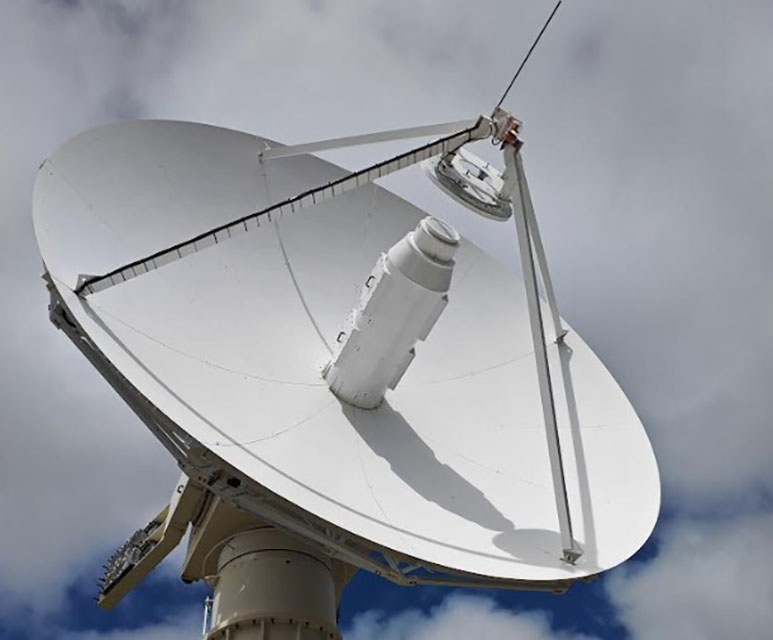
Located strategically in the mid-Atlantic Ocean, the new ground node strengthens Telespazio’s global ground segment footprint, expanding data downlinking and command-and-control capabilities for low-Earth orbit (LEO) and multi-orbit space missions.
The Azores installation operates within Telespazio’s Polar Station Facility (PSF) initiative, a corporate infrastructure effort designed to deliver scalable Ground Station as a Service (GSaaS) capabilities to commercial and institutional satellite operators.
Operational Architecture and Ground Segment Parameters
The new S/X-band antenna links into Telespazio’s centralized ground system management architecture, connecting remote reception nodes with centralized satellite operations centers. The integrated platform enables end-to-end mission phase execution from a unified management interface:
- Dual-Band Capabilities: Operates across S-band frequencies for telemetry, tracking, and command (TT&C) operations and X-band frequencies for high-throughput payload data downlinking.
- Latency Reduction: Supports real-time and near-real-time data distribution for Earth observation (EO) imagery and payload telecommunication pipelines.
- Network Integration: Pairs with Telespazio’s existing ground assets, including two polar tracking antennas in Sodankylä, Finland, and the BTS-2 antenna array situated at the Fucino Space Centre in Abruzzo, Italy.
The distributed mid-Atlantic location provides extended pass durations for polar-orbiting and medium-inclination satellites, closing tracking coverage gaps between continental European stations and American ground infrastructure.
Program Integration and Strategic Context
The infrastructure investment supports several flagship European space initiatives. The Santa Maria node will begin initial operations supporting the Flight Operations Segment (FOS) for Italy’s national Earth observation constellation under the IRIDE programme. Owned by the Italian Space Agency (ASI) and managed in partnership with the European Space Agency (ESA), the IRIDE system will rely on the Azores site to ingest payload telemetry from incoming NIMBUS and PLATiNO satellite missions.
The Azores deployment complements broader ground network modernizations across Telespazio’s facilities, including recent deep-space tracking enhancements executed under the RESPONSE program at Fucino.
Operational Roadmap and Defense Applications
Following its operational commissioning for the IRIDE-FOS framework, Telespazio plans to integrate the Santa Maria terminal into the support pipeline for the dual-use COSMO-SkyMed Second Generation (CSG) radar constellation, which is funded by ASI and the Italian Ministry of Defence. The facility will provide redundant high-speed X-band downlinking for synthetic aperture radar (SAR) imagery, supporting civil protection and defense monitoring operations across Europe and maritime Atlantic domains.
