

Italian private space company SITAEL has announced an ambitious growth plan aimed at reaching €200 million in annual revenues by 2031.

Industrializing Europe’s New Space Cycle
Unveiled at the SmallSat Europe conference in Amsterdam, the strategy leverages a decade of proactive investments in satellite platforms, electric propulsion systems, and advanced production infrastructure.
Currently generating approximately €60 million in revenue, the company plans to systematically increase its profit margins over the next five years. This financial trajectory is backed by a robust order backlog exceeding €150 million and a manifest of nine planned launches between 2026 and 2030, including the PLATINO and IRIDE satellite programs.
To support this rapid expansion, SITAEL operates two major industrial hubs in Italy:
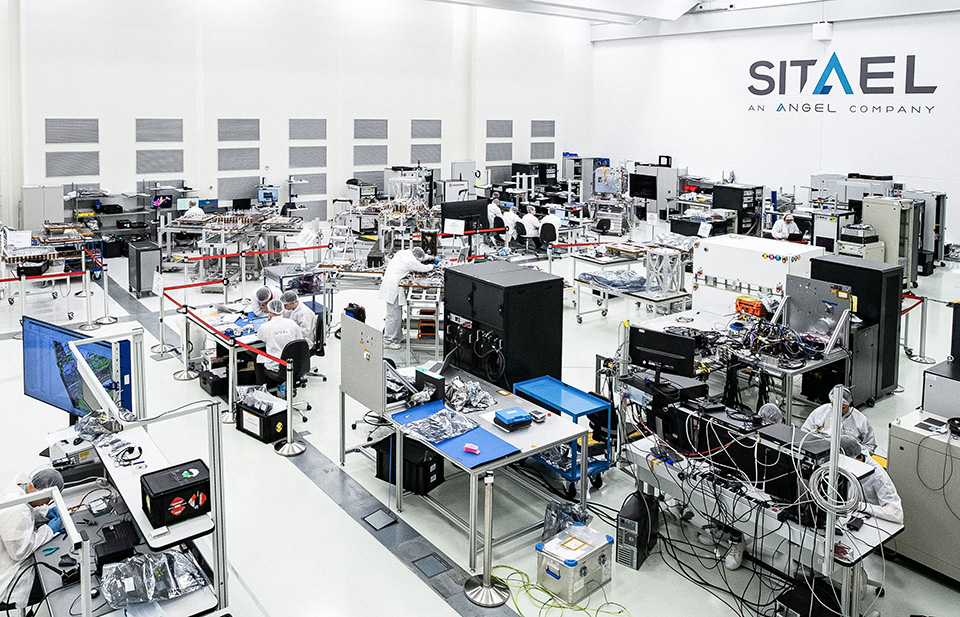
- Mola di Bari: Features a state-of-the-art cleanroom where five satellites are currently under simultaneous construction.
- Pisa: Houses a newly inaugurated, dedicated production line for Hall-effect electric propulsion systems.
Prime Contractor for ESA’s HiBiDiS Mission
A cornerstone of SITAEL’s upcoming launch manifest is its selection as the prime contractor for the European Space Agency’s Scout HiBiDiS mission. Scheduled to launch in 2030, this selection represents a significant operational milestone, confirming the company’s evolution from a hardware supplier into a prime contractor capable of managing complete European space missions.
HiBiDiS (Hyperspectral Biodiversity Scout Mission) will utilize SITAEL’s proprietary EMPYREUM medium-class satellite platform. The scientific objective is to study terrestrial biodiversity by using advanced multi-angular hyperspectral observations to monitor complex forest ecosystems, specifically focusing on the hard-to-see understory layers hidden beneath forest canopies. SITAEL will lead a consortium of premier European partners for the mission, including:
- AMOS: Providing the core hyperspectral imaging instrument.
- VITO: Managing the processing of the remote sensing data.
- University of Zurich: Leading the scientific use case and ecosystem modeling.
Expanding Global Footprint and Partnerships
In parallel with its European institutional milestones, SITAEL is actively strengthening its commercial internationalization strategy. The company has signed a strategic Memorandum of Understanding with Eycore, a Polish service provider that recently launched its first synthetic aperture radar (SAR) satellites.
This agreement aims to explore new collaborations in high-potential commercial markets, initially focusing on Earth observation applications, advanced synthetic aperture radar services, and multi-source satellite data integration. According to SITAEL CEO Chiara Pertosa, these recent milestones prove that the broader space market is now directly aligning with the sovereign industrial capabilities the company has spent years building.
