

By Nick David, Editorial Lead, SatNews
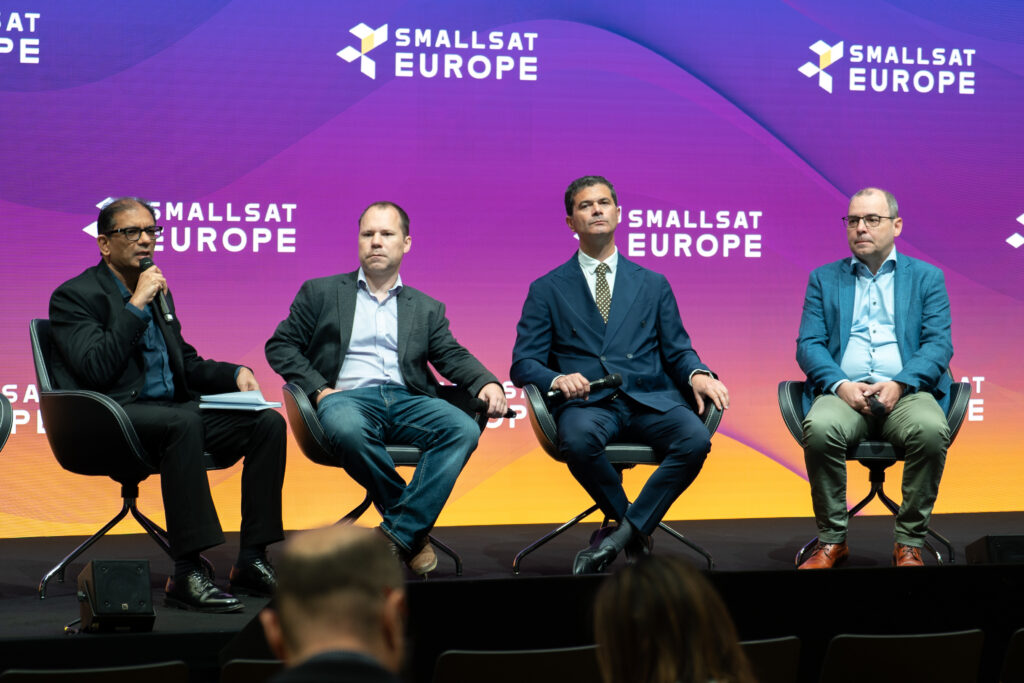
The label the European Commission and EUSPA have spent two budget cycles building procurement policy around got taken apart on Day 3 of SmallSat Europe 2026 by the people it is supposed to help. The dismantling came from the operators themselves. The resilience panel on the Defense Stage, moderated by Hogan Lovells partner Peter Watts, turned what was billed as a doctrine conversation into the most candid public takedown of the “dual-use” frame this funding cycle has produced. The through-line is that dual-use was supposed to unlock procurement and is now creating friction at both ends of the contract.
“Industry is now being caught up in this concept of dual use. So now every space company is now apparently defense. Everyone’s saying you’re dual use.” Sabrina Alam, Space Lead, SnT Technology Transfer Office, University of Luxembourg
That is a more pointed argument than anyone on the European institutional side has been willing to make at this conference, and it is the argument the funding side has not yet engaged.
What “dual-use” actually means in EU procurement language now
Dual-use started as a regulatory term for technologies with both civil and military application. Inside the EU’s current funding logic it has become the deciding category for who gets paid. Alam laid out the mechanic in two sentences. The European institutions, she said, “are really focused on this concept of dual use, meaning that we don’t want anything as pure war, but if you can prove a commercial value to it as well, then we’ll fund you.”
That is the funding word doing its work. Pure-defence applications are politically harder to justify under EU treaty constraints, and pure-civil applications do not access the post-Niinistö-era defence envelope. Dual-use threads the gap. The Commission and EUSPA route capital to companies that can plausibly claim both, so every European space company that wants the money has learned to claim both.
Public institutions become “the funders and the customers” at the same time, Alam said. The label meant to broaden the supplier base ends up narrowing what suppliers will publicly say their products do.
The targeting argument the agencies have not engaged
Dr. Michael “Mick” Gleason, Senior Policy Analyst at the Center for Space Policy and Strategy at The Aerospace Corporation, gave the panel its hardest single moment. The audience asked the panel directly whether dual-use assets become legitimate military targets, given that most insurance policies disclaim war risk. Gleason did not soften the answer.
“If you’re part of a military kill chain — that means you’re part of the chain of command or the chain of activities that gets a bomb on target and could kill somebody — well, you are then a legitimate military target for the entity that’s trying to defend itself. And so that’s based on international law… there’s no sanctuary in that regard.” Dr. Michael “Mick” Gleason, Senior Policy Analyst, Center for Space Policy and Strategy, The Aerospace Corporation
That is the targeting word arriving where the funding word started. The EC tells a commercial operator that what gets it paid is the defence-relevant utility of its product, and international law tells the same operator that the defence-relevant utility is precisely what makes its satellite, its ground station, and the personnel inside a legitimate object of attack. The label that opens the budget line is the label that complicates the sanctuary.
Gert Villemos, CISO and CTO of Leanspace, sharpened the point. Twenty-five years building ground segment systems, and he said what most ground-segment operators in the room already knew and had not said publicly.
“I would be prepared, we are being targeted not only [as] dual-use but even civil use. So regardless of whether it’s military, dual or civil, you are being targeted already today.” Gert Villemos, CISO & CTO, Leanspace
The dual-use debate is downstream of the actual operating condition. The civil-only sanctuary the European industry has been assuming is narrower than it used to be, and the legal regime that should follow from the targeting reality has not been written.
One Label, Two Regimes
HOW THE LABEL WORKS IN THE EC FUNDING LOGIC
- Pure-defence applications fail EU treaty constraints.
- Pure-civil applications miss the defence envelope.
- “Dual-use” threads both. Money flows to companies that claim both.
- Every commercial player learns to self-label as dual-use.
- Public institutions become funder and customer simultaneously.
HOW THE LABEL WORKS UNDER INTERNATIONAL LAW
- Participation in a military kill chain is the test.
- Once an asset feeds the kill chain, the asset is targetable.
- The civil-asset sanctuary the industry assumed narrows.
- Personnel and ground segments lose insurance and indemnity cover.
- No wartime legal regime exists in most European states to operate inside.
Two separate regimes are using the same word to mean opposite things. The procurement officer hears “commercial-grade product with a defence application,” while the international lawyer hears “civilian object that has lost protected status.” Both are correct about the word, and neither is talking to the other.
The missing legal regime
James Black, Deputy Director of Defence and Security and European Lead for Space at RAND Europe, supplied the structural piece. Of the diagnoses on the panel, Black’s is the one that should register with the Commission most.
“Lots of countries in Europe do not have the emergency legal powers in place for wartime to deal with the space of their fighting force, or to deal with space industry,” Black said. “The reality is in the military, you have this conceptual unlimited liability. You can be sent into danger because that is a national requirement. There is no such thing in the industry.”
That asymmetry is the architecture problem. The defence customer has bought a capability the supplier cannot legally operate. Health and safety law, employment law, insurance contracts: none of it lets the commercial operator keep its people in a building that is a known target. The military has unlimited liability built in, and industry has the opposite.
Ground stations, Villemos said, “are going to be taken out in day one of a major war.” Operations centre first, backup second, and Europe has built no wartime legal framework that lets industry function during that interval. Several countries have no emergency powers at all. Others have powers written in the 1940s and 1950s “when nobody had really heard of satellites.”
The Missing Legal Regime
- Asymmetric liability: the military operates under conceptual unlimited liability; commercial space operators do not, and cannot be ordered into a known target.
- Health and safety law: tells the ground-segment engineer to leave the facility when it becomes unsafe, directly contradicting wartime mobilisation.
- Insurance and indemnity: most war-risk policies disclaim state-actor attacks on known industrial sites; the dual-use label narrows civilian-asset protections that underwrote the cover.
- Emergency powers: several European countries have none at all; others rely on statutes written in the 1940s and 1950s, before satellites existed in policy.
- Day-one targeting reality: per Villemos, ground stations are taken out on day one, backup on day two, and Europe has no legal framework that lets industry function in the interval.
- Funding–law gap: the EC has built the funding label without the matching wartime legal regime that would let the companies it funds operate legally under attack.
The counter-frame from the agency tier
One floor up, the same word is doing very different work. Juan Carlos Cortés Pulido, Director of the Spanish Space Agency, used his closing keynote to make the institutional case for the exact label the resilience panel was examining. The Spanish Space Agency reports to both the Ministry of Science, Innovation and Universities and the Ministry of Defence, and that dual reporting line, Cortés Pulido said, “is a key element in the sense that space is by definition a dual activity.”
For a civil-tier agency head, that line reads as a feature. It lets one institution coordinate procurement across two ministries with separate budgets. Col. Marcin Mazur, Vice President of the Polish Space Agency, framed the same logic from Warsaw. Asked about Poland’s sovereign capability, Mazur defined it as “the diversity of resources.” National plus “bilateral, federated or commercial sources, which supplement the information for our needs.”
Mazur and Cortés Pulido are reading the frame from where it works for them. It works at the institutional layer, where the procurement gets routed and the public-versus-defence split is the legal-political problem they are paid to solve. The disconnect is that the same word is the operating problem at the company layer, where the kill-chain question lives.
A third constituency adds a fourth reading. Sabrina Andiappane, Luxembourg Managing Director of ClearSpace, was asked on the on-orbit servicing panel whether her servicer was dual-use. Her answer was the cleanest version of the commercial side’s instinct.
“Everything we do in space is in any case dual-use. I think there’s no problem.” Sabrina Andiappane, Luxembourg Managing Director, ClearSpace
Andiappane’s frame, that dual-use is the operating baseline in space, full stop, collapses the question entirely. Every rendezvous capability is targeting capability. Every robotic arm is a grappler. Where the Spanish-Polish frame celebrates dual-use as a procurement bridge, the Aerospace-Corp frame describes it as a kill-chain trap, and the ClearSpace frame treats it as a category that has stopped doing useful work. Three constituencies, three operating definitions, one EUSPA funding stream.
The verdict
The label is doing too much work. The convergence of commercial and military capability in space is accelerating and the label points to something real, yet it is straining under three incompatible jobs at once. It routes EC funding. It narrows commercial legal sanctuary. It gets celebrated by civil agencies as a coordination bridge.
The work for the next eighteen months is the work the resilience panel was sketching. Separate what the label funds from what the label describes. Write the wartime legal regime for the companies the funding has now drawn into the kill chain. Stop asking commercial operators to self-label into a status that narrows their insurance, indemnities, and personnel protections without giving them the legal scaffolding the military operators next to them have by default.
Alam’s closing diagnosis was the one to register. Europe is “seeing a lot of fragmentation today because we’re seeing a lot of lack of understanding of this concept.” The concept gets cleaned up next, or the procurement question gets harder, the legal exposure gets greater, and the industry gets less candid about what its products do.
What the panel surfaced is that operators are asking what the label still describes. The next phase of European institutional work, including the Commission’s consultations on the EU Space Act, the post-Niinistö readiness file, and the secure-waveform programme already underway across twenty-two companies and twelve member states, is where the label gets reconciled with the law it operates under.
Key Takeaway
“Dual-use” is the deciding category for European defence-space funding and it is doing three incompatible jobs at once. The Commission routes capital through it. International law uses it to narrow civilian-asset protections. Civil agencies celebrate it as a coordination bridge. The resilience panel at SSE26, with Gleason on legitimate targets, Villemos on civil-use targeting, Black on the missing wartime legal regime, and Alam on the funding loop, argued the word has stopped describing anything stable. Separate what the label funds from what the label exposes, and write the wartime legal scaffolding the commercial layer is operating without.
About the Author
A storyteller at heart, Nick David covers space policy, satellite markets, defense, and the technologies reshaping how humanity operates beyond Earth. With a background in creative direction, brand strategy, and editorial storytelling, he brings a modern lens to complex subjects and a relentless curiosity about what comes next.
