

By Nick David, Editorial Lead, SatNews
The AI conversation at European space conferences has been the same conversation for three cycles. A vendor describes an onboard processing demo. An institutional speaker gestures at regulatory complexity. A defence analyst invokes the U.S. primes. The panel ends with a polite consensus that the technology is promising and the policy frame is unresolved. Day 2 of SmallSat Europe 2026 was the meeting where that conversation finally moved.
It moved because the vendors came with deployed product instead of demos, and the institutional speakers came with operational use cases instead of regulatory hand-waving. The result was a more pointed question, and one European defence procurement will now have to answer publicly. Where does the human stop being in the loop, and how do you trust the machine on the right side of that line.
From demo to deployed product
The framing started on the Defense Stage tech brief from Dr. Aubrey Dunne, Chief Technology Officer of Ubotica Technologies. Ubotica is the Dublin-based AI-on-orbit company whose accelerator boards are flying on multiple European Earth observation constellations. Dunne’s brief was unusually narrow for a conference slot. Fifteen minutes on three operational use cases. Onboard processing of data captured in space. AI-managed orchestration of constellation assets. And what Dunne called “space computing and data centers in space,” reserved for later in the discussion.
The proof point was a hyperspectral maritime case the team ran in the last twelve months. A two-gigabyte raw image. Onboard segmentation of vessels using AI tiling. Extraction down to a couple of hundred bytes of structured intelligence, vessel position, orientation, beam, size. The extracted information sent down over an intersatellite link in about ninety seconds. End-to-end chain through ground in about ten minutes. The point Dunne was making was not the resolution or the model. The point was that the architecture moves a defence-relevant decision from a multi-hour ground-pass workflow to a ten-minute decision-cycle workflow.
Where the human stops being in the loop
The Defense Stage panel that followed took the same operational frame into harder territory. SpaceNews correspondent Debra Werner moderated The Role of AI in Space Defense with Guy de Carufel, CEO of Cognitive Space; Stewart Hall, Sales Director for Satellite Operations and Systems at Telespazio; Eng. Frank M. Salzgeber, Partner at Nadir Space Venture and former Vice Governor for the Space sector at Saudi Arabia’s Communications, Space and Technology Commission (CST); and Dr. Marco Rocchetto, CEO of Spaceflux.
“If you have a volley of missiles coming, you don’t have time to have a human in the loop and call a meeting. So consensus, right? Europe is very good for that. But you will need to move towards automation. But there is a risk there. There’s a huge risk.” Guy de Carufel, CEO, Cognitive Space
Read across what de Carufel, Hall, Rocchetto, and Salzgeber said in turn, a temporal boundary takes shape. For battle management and intercept, where the decision window is sub-second, automation is the operating model the panelists assumed. For humanitarian-impact decisions, where the consequence of an error is irreversible and the decision window is measurable in minutes or hours, the human stays in the loop. The contested middle is the minutes-to-hours range, where no panelist claimed the answer is settled.
The Automation Boundary
- Sub-second: Missile intercept, battle management. Automation mandatory.
- Minutes-to-hours: ISR tasking, prioritisation. The contested middle.
- Humanitarian: Collateral assessment, strike authorisation. Human in the loop preserved.
The trust problem is the procurement problem
“These LLMs, you can’t trust them 100%. You have to put guardrails in place. You need to verify. You need to make sure it’s coming from a verifiable source that’s been tested, that you can understand and repeat, that it’s not going to hallucinate.” Guy de Carufel, CEO, Cognitive Space
That is the actual blocker on the European defence procurement side. The question is not whether the model is good enough. The question is whether the model is auditable enough that a procurement officer can sign for it. Whether the inference is reproducible enough that an incident review can be conducted six months after the fact. Auditability is the missing layer around the model, not in the model.
Stewart Hall of Telespazio put the institutional case in a single line. European militaries are not going to allow decisions made by opaque code. The legal requirement, Hall said, is a chain of attribution that lets an after-action review trace any decision back to a human accountable for it. That requirement is independent of how good the model is. It is a doctrine constraint, and it is the procurement gate.
Dr. Marco Rocchetto, CEO of Spaceflux and the UK government’s preferred SDA provider since 2023, walked the room through how the layered trust problem looks in production. Pattern detection in noisy sensor data using astronomy-derived ML techniques. Predictive behavioural modelling that fingerprints individual satellites and flags anomalies in real time. And the third layer, the agentic decision tree, which Rocchetto said requires a change of doctrine before it can ship to a defence customer. The architecture is ready. The procurement framework is not.
Edge compute closes the commercial case
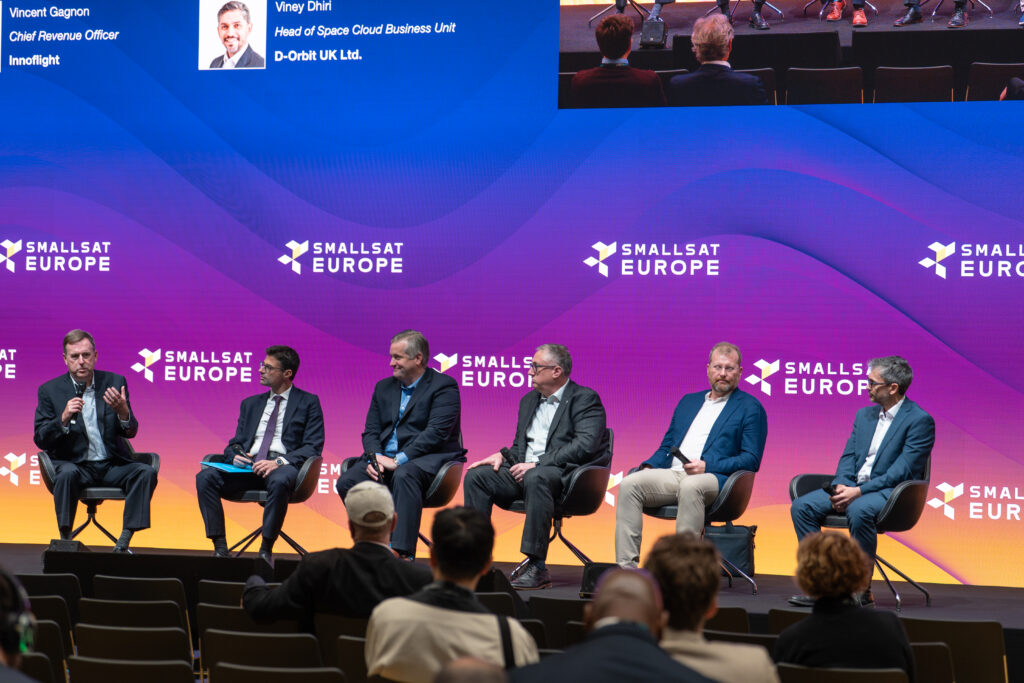
The Latency Arbitrage panel on the Business Stage, moderated by Dr. Eric Anderson, President of And One Technologies, worked through where the in-orbit-compute ROI actually closes. The panel was Johan Åman of Unibap Space Solutions, Vincenzo Stanzione, CTO of SITAEL, Ryan Conroy of Elve, Vincent Gagnon of Innoflight, and Viney Dhiri of D-Orbit UK.
Dhiri’s small heresy is the commercial near-term case for in-orbit compute, and it is a far smaller and sharper case than the orbital data centre vision.
“It’s heresy in EO circles, but take the data, extract the intelligence, delete it, get rid of it. Never want to see it again. Somebody else can store it.” Viney Dhiri, Head of Space Cloud Business Unit, D-Orbit UK
The decision-quality model sits next to the sensor. The raw data gets deleted. The downlink bandwidth is saved. The storage cost is avoided. The time-to-decision compresses from minutes to seconds. That is the version of in-orbit compute that closes inside one constellation budget cycle and is in the production plan at multiple European companies right now.
The verdict from Day 2
U.S. defence AI vendors are racing to capability and scale, and have been quieter on the auditability and provenance side because U.S. procurement tolerates more opacity. European procurement does not. Member-state defence ministries, the European Commission, and the EU Space Act framework all push in the direction of explainability, lock-down, and audit.
The European AI-on-orbit company that closes the auditability gap is procurable in Europe ahead of larger U.S. competitors with more capability and fewer compliance answers. The audit layer is the moat.
Key Takeaway
AI shipped to production in European space on Day 2. The next procurement question is auditability, not capability. The European vendor that builds the audit layer around the model gets the defence contract.
About the Author
A storyteller at heart, Nick David covers space policy, satellite markets, defense, and the technologies reshaping how humanity operates beyond Earth. With a background in creative direction, brand strategy, and editorial storytelling, he brings a modern lens to complex subjects and a relentless curiosity about what comes next.
