

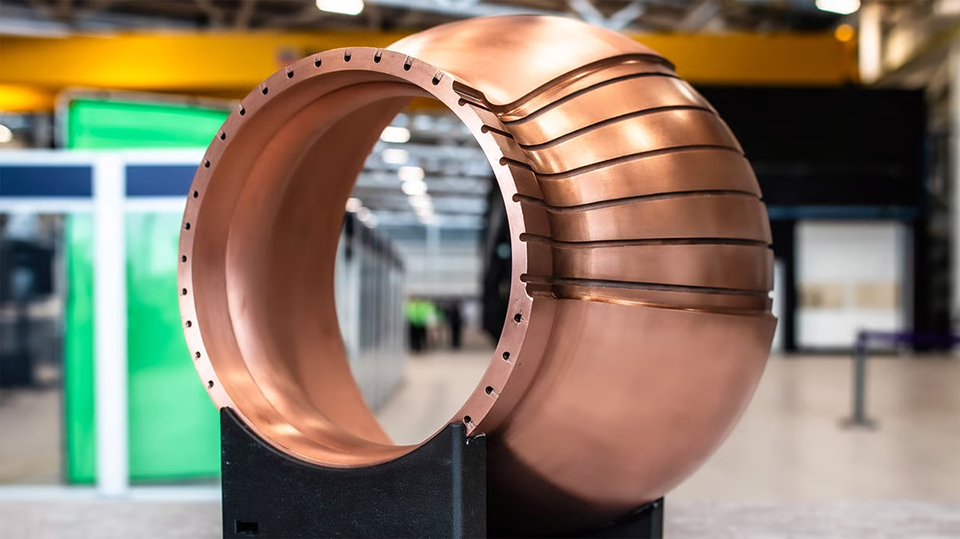
Engineers at the National Manufacturing Institute Scotland have developed a new manufacturing route for copper rocket nozzles utilizing high-pressure cold spray technology.
Overcoming Traditional Manufacturing Hurdles
This advancement addresses one of the most persistent challenges in rocket engine production, which is the creation of large copper structures that feature intricate cooling channels. Rocket combustion chambers and nozzles must withstand extreme environments where temperatures routinely exceed the melting point of the structural materials.
Historically, producing these geometries while maintaining material performance and cost efficiency has been incredibly difficult. Traditional production routes are notoriously slow and labor-intensive, demanding multiple fabrication stages and extensive machining. Additive manufacturing approaches like powder bed fusion provide design freedom but are limited by their build size, making them unsuitable for larger components. Electroplating, another common method, suffers from prolonged production lead times that can span several months, driving up costs and severely limiting design flexibility.
Furthermore, copper itself presents unique processing challenges. Its specific thermal and mechanical properties, alongside its highly reflective nature, make it exceptionally difficult to process using conventional additive manufacturing techniques. This has continuously restricted the production of advanced geometries, especially the vital internal cooling features required for optimal rocket nozzle performance.
The Cold Spray Solution
To bypass these limitations, the engineering team developed a hybrid manufacturing approach centered entirely on high-pressure cold spray technology. This high-rate additive process deposits copper in a solid state rather than melting it.
By avoiding the melting phase, the process significantly reduces the risks of thermal distortion and material degradation that are frequently associated with traditional welding and manufacturing methods.
Using this solid-state approach, the main structure of the nozzle was constructed layer by layer through rapid material deposition. The technique easily supports large-scale production without sacrificing fine geometric details, allowing highly complex internal features to be efficiently integrated directly into the structure.
Transforming Production Timelines
The resulting copper rocket nozzle demonstrates the immense potential of high-pressure cold spray to completely change how large metallic parts are produced. The process is capable of achieving deposition rates of up to ten kilograms per hour. This remarkable speed has the potential to slash production lead times from several months down to just a few days, all while drastically reducing material waste when compared to conventional machining methods.
Although the newly developed method still requires validation through comprehensive full-scale rocket engine testing, the prototype nozzle offers clear evidence that large, high-performance copper components can be successfully and rapidly produced using this technology.
Expanding Beyond the Space Sector
While this specific application was developed for the space industry, the implications of the technology extend well beyond orbital ambitions. The cold spray approach offers a highly scalable manufacturing route for various high-value sectors, including aerospace, energy, and shipbuilding, where relying on robust and corrosion-resistant materials is critical. Additionally, the technology shows promise for repairing and remanufacturing existing components, which could extend asset lifespans and support much more sustainable manufacturing practices across the board.
Calum Hicks, senior technologist at the Digital Factory, NMIS, said: “This project marks an important milestone in demonstrating how advanced manufacturing can be applied to complex rocket engine components. Developing the copper rock nozzle allowed us to explore new approaches to producing high‑performing thermal management structures, reducing development times and improving production efficiency. This work strengthens the UK’s capabilities in the space sector and beyond.”
Ryan Devine, senior research and development engineer at NMIS, added: “The real value of this work is in showing how advanced manufacturing can move beyond experimentation into practical application. By combining engineering expertise with innovative processes such as high-pressure cold spray, we’re enabling manufacturers to rethink how complex components are designed, produced and maintained. Taking these steps allows us to support faster development cycles and more resilient manufacturing systems.”
