

Chris Forrester — It might be some time yet for the dust to settle and would-be buyers to emerge over Europe’s plans to sell off some key satellite frequencies over Europe, within the 2GHz band. These frequencies sit in the valuable MSS bands (Mobile Satellite Services) and currently held by Viasat/Inmarsat and EchoStar and become available for re-licensing in May 2027.
The decision, published on May 27 (as “Proposal for the EU-level authorisation of systems providing mobile satellite services, MSS)” and as part of Europe’s Digital Networks Act.
The decision is not yet ‘law’ but that move is only a matter of time. The recommendation needs approval from both the European Parliament and Council. There will inevitably be some heavyweight lobbying from interested parties.
The EU’s statement outlines the decision’s objectives: “Since 2008, there has been a number of technological and geopolitical developments which have profoundly affected the importance of this band. Large constellations of Low Earth Orbit (LEO)2 satellites, also as part of multi-orbit constellations, are emerging: their function in the space can be compared to the one of terrestrial mobile communication towers, as they enable hybrid terrestrial-satellite systems and future converged 6G mobile networks. They offer notably satellite Direct-to-Device (D2D) connectivity, i.e. connectivity to unmodified mobile phones, tablets and other end-user devices. This infrastructure is vital for ensuring access to high-speed internet for all, particularly in underserved and remote regions.”
The EU’s “compelling” plan – in essence – is to split the overall capacity into three equal ‘thirds’. It means that non-European satellite operators such as Starlink and Amazon can bid for mobile satellite spectrum, the European Commission has stated. Two thirds of the available spectrum will be divided equally between EU and non-EU operators for commercial use.
In Summary:
- Two thirds to be divided 50/50 between EU and US operators
- (this means one-third is potentially available for non-EU players)
- One third held for the upcoming IRIS2 European mega-constellation of satellites
The EU move to permit US activity is seen as a pragmatic compromise after at least one EU commissioner wanted to exclude US operators.
The opening for US players is also a reflection on FCC Commissioner Brendan Carr and his warning comment that the US would mirror the EU’s approach if US operators were closed out. “For decades, reciprocity and non-discrimination have been at the heart of the FCC’s approach to the many European satellite operators that do business in America. Reciprocity will continue to be the touchstone. And the FCC has a proceeding open aimed at ensuring fair treatment for American businesses,” stated Carr.
Commissioner Carr has some powerful ammunition should it be needed, not least reducing the benefit to SES of the proposed Upper C-band auction which is of considerable interest to SES/Intelsat.
The EU executive said its decision aims to allow new operators into the market although under a transitional period, licences currently held by US companies Viasat/Inmarsat and EchoStar will be extended for two more years from their current planned expiry in May 2027.
The frequencies include the airwaves that let satellites talk directly to ordinary smartphones (D2C) and aircraft cabin equipment without specialized hardware. Viasat, for example, uses the band for its hybrid satellite-cellular European Aviation Network (EAN), which provides in-flight broadband across the continent.
One existing segment covers the exact S-band that AST SpaceMobile has been pursuing through its European joint-venture with Vodafone (Satellite Connect Europe). This j-v is headquartered in Luxembourg with operations in Germany, although it is yet to be seen whether the EU considers this to be sufficiently European.
The remaining third will be reserved for EU state use such as security and military, which will be provided by an EU operator that will integrate the capability with the EU’s IRIS2 multi-orbit array of 290 satellites, the Commission said. IRIS2 is Europe’s response to Starlink.
However, there are caveats. For example, EchoStar cannot sell its EU 2 GHz MSS license to SpaceX. SpaceX will have to compete like everyone else on the open commercial block to recover 2 GHz spectrum in Europe.
EchoStar acquired the European 2 GHz (S-band) mobile satellite spectrum in January 2014 by purchasing 100% of Solaris Mobile Ltd.—a joint venture previously owned by Eutelsat and SES. The spectrum encompasses a 30 MHz pair within the 2 GHz band (1980–2010 MHz and 2170–2200 MHz).
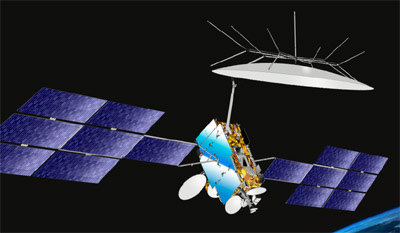
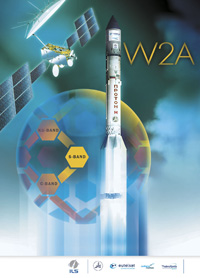
Solaris Mobile, originally a joint venture between Eutelsat and SES Astra, was set up in 2008 to develop next generation mobile communication services. In May 2009, the European Commission awarded Solaris Mobile the right to operate satellite & terrestrial services in S-Band in all EU member states. But its satellite, Eutelsat W2A suffered a partial failure of its massive S-band antenna following launch in April 2009. A full insurance claim was made, and paid.
The satellite’s S-band payload, despite its defect, was bought by EchoStar. Solaris Mobile, later renamed EchoStar Mobile, was based in Dublin. EchoStar agreed to sell its portfolio of US-issued 2 GHz (AWS-4 and H-block) licenses to SpaceX to power the Starlink Direct-to-Cellular network. The FCC approved the transfer, and EchoStar completed a significant portion of this spectrum transfer to a business trust associated with SpaceX.
