

The professional display industry is shifting its focus beyond high-brightness LCD and LED technologies toward sustainable alternatives.
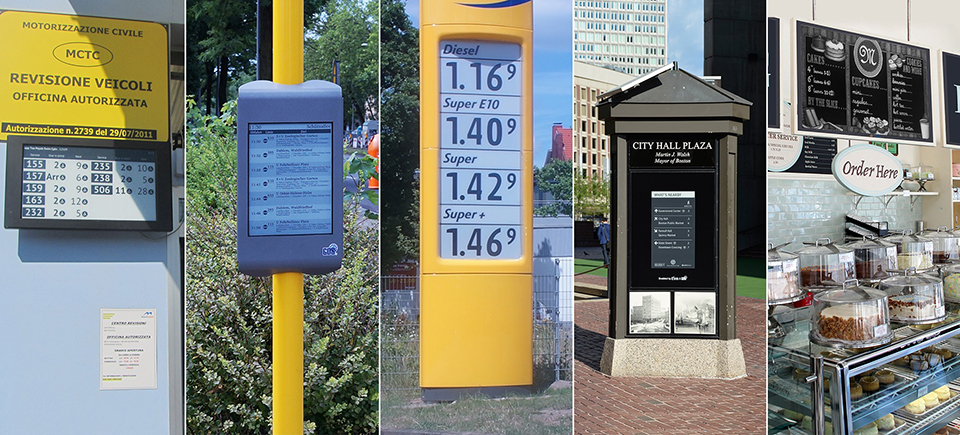
New research from Futuresource Consulting highlights the expanding role of e-paper signage (EPD) as a vital, low-power component within the digital signage ecosystem. While still in its early stages, this technology is carving out a specific market by replacing traditional analogue print with connected digital infrastructure that consumes minimal energy.
Market Momentum and Scaling Deployments
The global e-paper display market is projected to reach 7.56 billion dollars in 2026, representing a compound annual growth rate of 32.1 percent. Although the installed base for large-format signage is currently smaller than traditional display categories, shipments reached 16.4K units in 2025. This growth is driven by a move away from project-led pilot programs toward broader commercial rollouts in retail and corporate environments.
Strategic Position as a Bridge Between Print and Digital
E-paper acts as a bridge between traditional print workflows and digital connectivity rather than a direct competitor to high-refresh video walls. Its primary value lies in static and semi-dynamic use cases where persistence is more important than motion. Because e-paper is bistable, it requires power only when content changes, allowing it to maintain an image indefinitely with zero energy draw. This functional difference allows it to unlock new applications in locations where running electrical cabling is cost-prohibitive.
Sustainability and the Drive for Operational Efficiency
Environmental, Social, and Governance (ESG) mandates are becoming primary drivers for e-paper adoption. Large-scale deployments can reduce annual energy consumption by approximately 90 percent compared to equivalent LCD systems.
For example, an e-paper screen that updates once per day eliminates the continuous power draw and infrastructure complexity of an LED setup, allowing organizations to hit aggressive carbon reduction targets while maintaining a connected presence.
Vertical Adoption Led by Retail and Public Infrastructure
Retail remains the dominant sector for e-paper technology, accounting for nearly 45 percent of the total market share. This is primarily driven by the massive deployment of electronic shelf labels (ESLs) for real-time pricing and inventory management.
Beyond retail, the technology is gaining traction in transportation and smart city infrastructure. Solar-powered bus stop schedules and wayfinding maps are increasingly common in urban centers, providing high visibility in direct sunlight without requiring a connection to the electrical grid.
Technical Evolution Toward Color and Scalability
The maturation of the e-paper ecosystem depends on ongoing innovations in color fidelity and software integration. New platforms like the Spectra 6-enabled displays are providing richer color palettes that allow brands to maintain visual identity while benefiting from low-power operation. Success for manufacturers now depends on aligning this hardware innovation with robust content management systems that allow for seamless integration into existing digital signage networks.
