

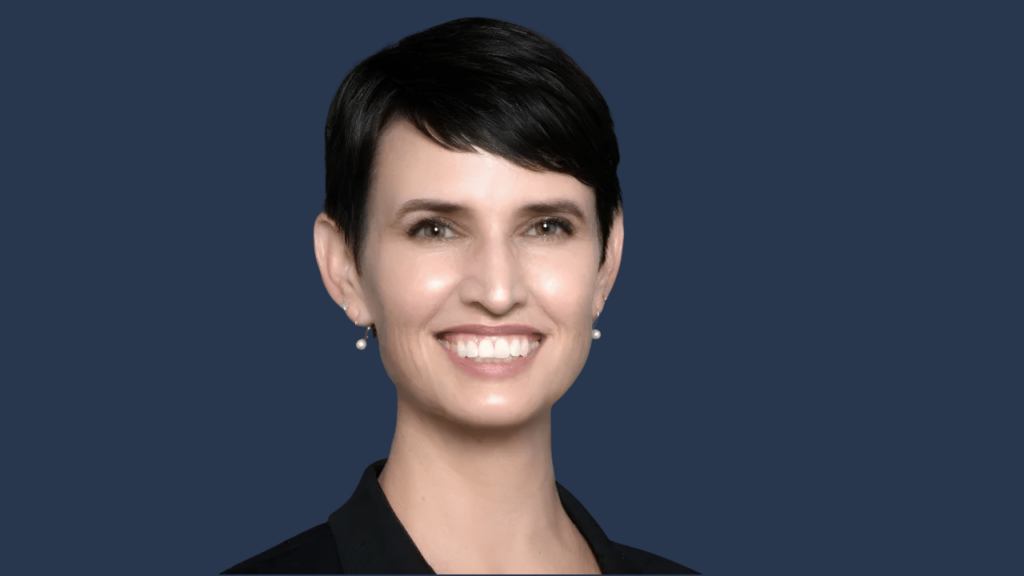
Updated September 23, 2026: Lewis has since become General Counsel at Rocketdyne. She was Senior Vice President of Policy and General Counsel at Astroscale U.S. when this article was published, and the conference program now lists her with Rocketdyne. Her current role has been added and the references to her Astroscale work put in the past tense. The account of Astroscale’s on-orbit servicing programs is unchanged.
Updated September 7, 2026: The session Lewis moderates has moved from 3:15 p.m. to 3:30 p.m. on the conference agenda, and one of the two market briefs that followed it has been removed. The article has been updated, and a sponsorship disclosure has been added.
Astroscale U.S. has a $25.5 million spacecraft finished and waiting on a ride. Provisioner, contracted to perform the first refueling of a United States Space Force asset above geostationary orbit, would be ready to launch by the end of summer 2026, the Space Force’s servicing, mobility and logistics program office said in May 2026, but the demonstration has since moved to an early 2027 window. The lawyer who carried the policy case for that mission takes both Silicon Valley Space Week stages, as a Satellite Innovation panelist and a MilSat Symposium moderator.
Janna Lewis is General Counsel at Rocketdyne. She was Senior VP of Policy and General Counsel at Astroscale U.S. Inc., the Denver-headquartered American arm of Tokyo-listed Astroscale Holdings, and served as Secretary on the U.S. company’s board of directors. The company builds on-orbit servicing spacecraft for inspection, maneuvering and endurance, and removal and deorbit: Provisioner is the refueler, LEXI-P the life-extension servicer for geostationary satellites. Lewis joined Astroscale in May 2024 from BAE Systems, Inc., where she was Senior Corporate Counsel on legal and policy matters spanning satellite integration and launch, on-orbit communications and sensing, space and missile defense, microelectronics and cybersecurity. Before BAE she was Corporate Counsel in Northrop Grumman’s Mission Systems sector as a senior intellectual property lawyer and innovation strategist, and before that she sourced partnerships at Facebook for space-based and high-altitude global connectivity programs. She began in private practice as counsel to aerospace, defense and telecommunications clients. She is a registered patent attorney, a member of the International Institute of Space Lawyers, and serves on the AIA Space Council. She holds a Juris Doctor from the University of Utah and a Bachelor of Science in criminal justice from Southern Utah University, with certificates from the University of Cambridge and Stanford University.
Both sessions turn on the same unsettled question: whether the government buys a capability as a service or builds it in house. On-orbit servicing has contracts and hardware but no flight record with a defense customer. Astroscale U.S. completed a four-week rendezvous and proximity operations test campaign at NASA’s Goddard Space Flight Center in 2025, and Space Systems Command awarded the $25.5 million Provisioner contract in September 2023, so the move to early 2027 reads as a manifest problem to advocates and a readiness problem to skeptics. Government demand has grown louder meanwhile: Space Systems Command and SpaceWERX opened a challenge for multi-orbit orbital warehouses and fuel depots in June 2026, and Astroscale Holdings entered a capital and business alliance with SKY Perfect JSAT in May 2026. Whether the Pentagon underwrites a commercial logistics layer at scale or treats servicing as a specialty buy is the open item.
On Tuesday, October 27, Lewis joins “Orbital Data Centers: Investable Infrastructure or Thermodynamic Bet?” from 12:15 p.m. to 1:00 p.m. in Hahn Auditorium. The program calls it the largest capital and engineering story of 2026 and asks whether AI data centers can be built in space, setting believers against skeptics on both the engineering and the economics. Her co-panelists are Jason Aspiotis, CEO and Co-Founder of OwlO Cloud, a company the program lists as in stealth, and previously Global Director of In-Space Data and Security at Axiom Space; Rob DeMillo, CEO and Cofounder of Sophia Space; Filip Rezabek, Co-founder and CTO of SpaceComputer; Dr. Slava Turyshev, Senior Research Scientist at NASA’s Jet Propulsion Laboratory; and Joseph Yaffe, Chief Operating Officer and Chief Legal Officer of Cowboy Space Corporation. The program lists no moderator for the 45-minute session. On Thursday, October 29, Lewis moderates “How Commercial Space Companies Can Support Future Defense Space Architectures with Speed, Flexibility, and Affordability” from 3:30 p.m. to 4:15 p.m., also in Hahn Auditorium. Her panelists are Allyson Jenkins, Vice President, Public Sector at Pixxel; Sho Nakanose, Founder and CEO of GITAI USA Inc.; Dr. Robbie Robertson, CEO and Co-founder of Sedaro; Karl Stedman, CEO of Pulse Space; and Brian Rishikof, Co-Founder and CEO of Odyssey Space Research, L.L.C. The program frames it around a future architecture that is heavily proliferated, relying on hundreds or thousands of smaller, cheaper, networked satellites in low Earth orbit.
Silicon Valley Space Week runs Tuesday, October 27 through Thursday, October 29 at the Computer History Museum in Mountain View, California. Lewis’s moderated panel is the final full session of the MilSat Symposium, followed by a single market brief before the program closes at 4:30 p.m. Provisioner is scheduled to launch in early 2027 and to perform two refueling operations on a single Department of Defense satellite above geostationary orbit, topping off its own tank at a prepositioned depot in between.
Sedaro, whose chief executive is on the panel Lewis moderates, is a sponsor of Silicon Valley Space Week, which SatNews produces.
