

LOS ANGELES, CA — In a major doctrinal shift aimed at countering aggressive adversarial maneuvering, Space Systems Command (SSC), in partnership with the U.S. Space Force’s innovation arm, SpaceWERX, has officially launched the In-Domain Orbital Logistics Challenge.
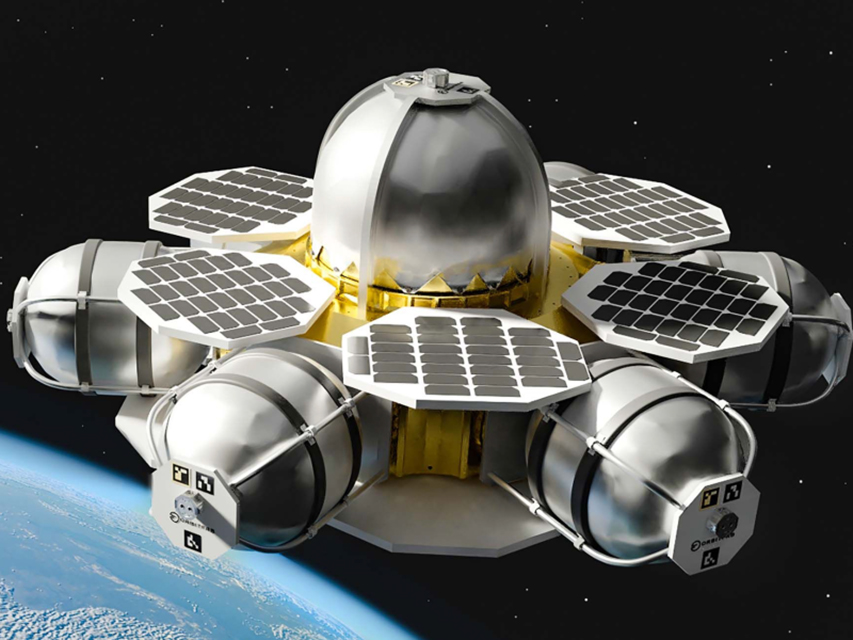
The $20 million program seeks to transition the military’s terrestrial supply chain framework directly into orbit, formalizing the concept of space-based “warehouses” and “delivery trucks” to enable continuous, high-energy tactical operations.
The initiative marks a calculated push by the Department of the Air Force to operationalize In-Space Servicing, Mobility, and Logistics (SML), aligning with the military’s recently published Objective Force 2040 enterprise blueprint.
Dismantling the “Sitting Duck” Vulnerability
Historically, national security satellites operating in Low-Earth Orbit (LEO) and Geosynchronous Earth Orbit (GEO) have been plagued by a fundamental constraint: a finite, non-replenishable supply of fuel. To conserve their lifetimes, operators drastically limit satellite movements.
However, defense planners warn that this predictability has turned multi-billion-dollar sovereign hardware into vulnerable, static targets. In recent years, both China and Russia have routinely deployed highly maneuverable “inspector” satellites designed to shadow, inspect, and potentially disable U.S. hardware. Concurrently, Beijing is aggressively scaling up its own state-directed mega-constellations, such as the 14,000-satellite Qianfan (“Thousand Sails”) network.
By researching and establishing orbital warehouses, the Space Force intends to decouple a satellite’s operational lifespan from its initial launch fuel volume. This allows commanders to engage in high-energy “Space Maneuver Warfare”—repositioning, dodging, or pursuing orbital targets without the fear of running their tanks dry.
“The evolving strategic environment in space is driving the need for an in-domain logistics capability that delivers bulk and retail propellant, spares, inspection, and repair at forward orbital nodes,” said Col. Scott Carstetter, director of SML within Space Systems Command. “The future development and implementation of depots, transfer vehicles, and validated fuel handling standards will enable responsiveness and decrease predictability and risk.”
Anatomy of an Orbital Depot
According to parameters outlined by SSC, an orbital warehouse will mirror its terrestrial counterpart: acting as an environmentally shielded, automated transit hub that handles the reception, staging, storage, inspection, and cross-loading of critical payloads.
The architecture relies on a “hub-and-spoke” logistics pattern consisting of three core technological layers:
- The Warehouse (Depot): A hardened structural node that acts as bulk containment for propellant (such as hydrazine or xenon) and modular spare parts, shielded against extreme solar radiation and micrometeoroid impacts.
- Orbital Transfer Vehicles (OTVs): Reusable, highly agile autonomous “space tugs” or “delivery trucks” that dock with the warehouse, extract retail portions of fuel or components, transport them to a distressed satellite, execute the servicing, and return to the depot.
- Distribution Network Mechanics: Proprietary orbital modeling designed to compute optimal shuttle routes that are easily accessible to friendly servicing vehicles, yet computationally difficult for adversaries to intercept.
The 2027 Pathfinder Manifest
To gather the empirical data necessary to draft formal requirements for these upcoming warehouses, the Space Force has confirmed two fully funded on-orbit pathfinder demonstrations scheduled to fly in early 2027 aboard a United Launch Alliance (ULA) Vulcan Centaur rocket (USSF-23).
- The Refueling Demo (Astroscale U.S. & Orbit Fab): Under a $25.5 million contract, Astroscale U.S. will deploy its Provisioner (APS-R) servicing vehicle. The craft will dock with a commercial fuel depot provided by the Defense Innovation Unit (DIU) and Orbit Fab, transfer propellant into its own tanks, and then navigate to refuel government satellites—including the Air Force Research Laboratory’s (AFRL) Tetra-5.
- The Augmented Maneuver Demo (Starfish Space): Backed by a $37.5 million contract, Starfish Space will launch its US-Otter 1 space tug to demonstrate autonomous rendezvous, proximity operations, and docking (RPOD) with a non-operational client vehicle in near-geosynchronous orbit, physically moving the space debris to a disposal trajectory before attempting a follow-on operational life-extension mission.
By pairing these 2027 flight demonstrations with the newly launched SpaceWERX challenge, the Pentagon aims to open an aggressive, multi-phase acquisition pipeline this summer. Target participants include commercial startups, aerospace primes, and cryogenic research labs capable of delivering mass-producible, scalable ground-to-space logistics infrastructure.
