

Targeting the vendor lock-in and closed ecosystem limitations of proprietary mega-constellations like SpaceX’s Starlink, Lithuanian optical communications developer Astrolight is scaling an open-standard, interoperable laser communication architecture across space, ground, and maritime domains.
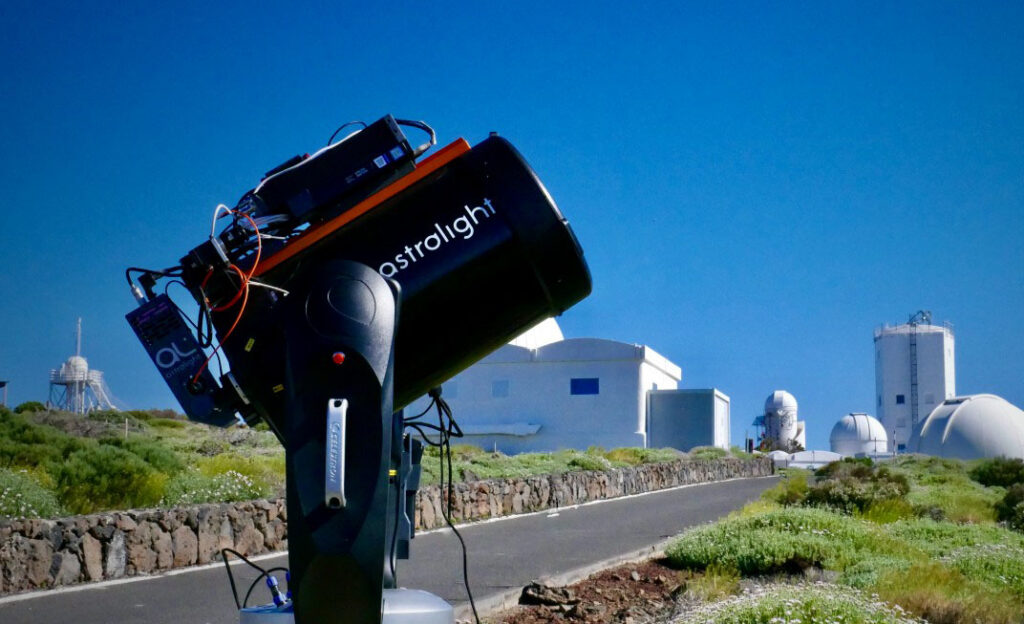
The strategy enables commercial satellite operators, defense agencies, and research institutions to construct independent, sovereign optical transport networks rather than relying on single-provider infrastructure.
Terminal Hardware Specifications and Interoperability Metrics
Astrolight’s core hardware portfolio centers on its low Size, Weight, and Power (low-SWaP) ATLAS series of spaceborne laser terminals. Operating in the 1550-nanometer optical wavelength band, the terminals deliver point-to-point data throughput rates ranging from 2.5 Gbps up to multi-gigabit capacities, bypassing the spectrum allocation delays and electronic warfare vulnerability inherent to traditional radio-frequency (RF) links.
To ensure multi-vendor interoperability, the system features:
- Standard Compatibility: Full hardware alignment with both the U.S. Space Development Agency (SDA) Optical Communications Terminal (OCT) standard and the European Space Agency (ESA) Specification for Terabit/sec Optical Links (ESTOL).
- Pointing Autonomy: An integrated Coarse Pointing Assembly (CPA) that allows terminal operation on compact commercial small-satellite buses without requiring high-cost, ultra-precise attitude control systems.
- Ground Segment Integration: Interoperability with automated Optical Ground Stations (OGSs), including operational nodes in Greece delivering 2.5 Gbps downlink speeds and a polar ground station under development in Greenland.
Institutional Integration and Re-Entry Flight Demonstrations
Astrolight’s open-standard architecture has been integrated into flagship European space programs and commercial flight manifests. Under an €18.6 million ESA ARTES ScyLight contract, the company partnered with Kepler Communications to supply the ATLAS-X laser terminal for the ESA HydRON Element 3 mission, establishing multi-orbit optical data routing across low Earth orbit constellations.
Additionally, on August 10, 2026, Astrolight signed an agreement with ATMOS Space Cargo to conduct a 2027 flight test demonstrating a real-time, 2.5 Gbps optical communications link between the PHOENIX 2 re-entry capsule and an orbiting LEO partner satellite.
“Our goal is to help re-entry vehicles and satellite operators connect directly with multi-vendor networks, ensuring operators can access critical data in real time using standardized, secure hardware,” stated Laurynas Mačiulis, CEO of Astrolight.
Operational Deployment
Astrolight is expanding hardware qualification for its ATLAS-X terminal ahead of scheduled orbital flight demonstrations under the ESA HydRON framework and the ATMOS PHOENIX 2 mission. The company continues deploying additional ground nodes across Europe to build out an open, end-to-end optical transport network for commercial and defense satellite fleets.
