

Viasat, Inc. confirmed on Wednesday, July 22, 2026, the successful mechanical deployment of the main boom and ultra-large reflector on its ViaSat-3 Flight 3 (VS-3 F3) broadband satellite.
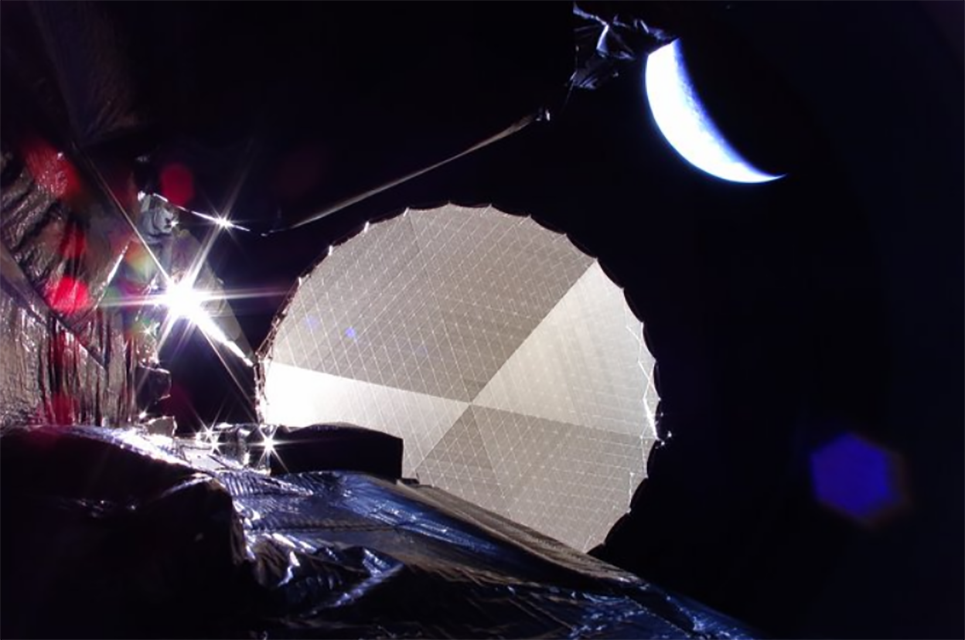
Visual verification beamed from onboard cameras confirmed that the high-capacity spacecraft completed the unfurling sequence, clearing a critical engineering milestone prior to full-system commissioning.
Constellation Architecture and Deployment History
The deployment completes the structural assembly sequence for the third and final high-capacity geostationary satellite in Viasat’s next-generation global fleet. The spacecraft launched aboard a SpaceX Falcon Heavy rocket from Kennedy Space Center on April 29, 2026, joining ViaSat-3 Flight 1 covering North America and ViaSat-3 Flight 2 covering the EMEA region.
Reflector Payload Specifications and On-Orbit Verification
The unfurling of the giant deployable antenna reflector represents one of the most mechanically complex orbital maneuvers for the 1-Terabit-per-second (1 Tbps) class satellite:
- Payload Coverage: Tailored to focus dynamic Ka-band spot beams across high-density maritime, commercial aviation, and fixed-broadband corridors.
- Deployment Telemetry: Confirmed via real-time onboard optical sensors and telemetry, ensuring structural alignment of the flexible mesh reflector antenna and boom assembly.
- Operational Configuration: Enables precision beam-forming routines to allocate network capacity dynamically across key coverage zones.
In-Orbit Testing and APAC Service Timeline
With structural deployment complete, Viasat engineering teams have initiated formal in-orbit payload and bus performance checks. The satellite will complete diagnostic testing and orbit-raising operations over the coming months before commencing commercial service across the Asia-Pacific (APAC) region later this year.
